
'It is important India to stay focussed on its primary national objectives: Combating terrorism; not losing sight of other security and strategic concerns (on the Sino-Indian front for instance); ensuring a strong economy and registering growth which includes improving the lot of common people; and finally making certain that the social fabric remains intact and harmony among people is not jeopardised, at least any further,' asserts Nilanjan Mukhopadhyay.
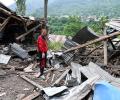
Drones were sighted and explosions were heard in Jammu and Kashmir on Friday, a day after India thwarted attempts by the Pakistan military to attack Indian military installations using drones and missiles. The drones were also engaged in Udhampur and Nagrota of Jammu and Punjab. Heavy cross-border shelling started along the International Border in Suchetgarh and Ramgarh sectors of Jammu and Samba districts. Chief Minister Omar Abdullah appealed to residents to stay indoors and ignore rumors.

Operation Sindoor is not just a name but India's latest policy against terror as it has set a new standard, a 'new normal' in counter-terrorism measures, Prime Minister Minister Narendra Modi asserted on Monday.
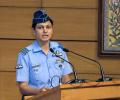
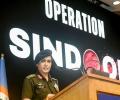
Wing Commander Vyomika Singh, an accomplished helicopter pilot in the Indian Air Force, was chosen to brief the nation about India's 'Operation Sindoor' strikes on Pakistan. She has flown a variety of aircraft and taken part in rescue operations in extreme conditions. Vyomika, who has logged over 2,500 flying hours, has operated helicopters across challenging terrains, from the high-altitude sectors in Jammu and Kashmir to the remote areas in the Northeast. She led a rescue operation in Arunachal Pradesh in 2020, flying in extreme conditions to evacuate civilians.
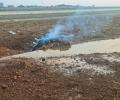
Dar's statement, echoed by another federal minister, came as the Indian and Pakistani militaries targeted each other's installations using missiles in the last more than 12 hours, further escalating the already tense conflict situation.

Arathy, daughter of N Ramachandran who was killed in a terror attack in Kashmir's Pahalgam, welcomed the Indian Army's "Operation Sindoor" and said it was a reply from the women of India. She said the loss cannot be compensated, but the operation is a kind of relief from the government and the army. Arathy's father was killed by terrorists in front of her while holidaying in Kashmir's Pahalgam on April 22.

Amid concerns of espionage, the Rajasthan administration has intensified security measures along the India-Pakistan border, with authorities in Jaisalmer and Sri Ganganagar banning the use of Pakistani SIM cards.

The Supreme Court of India has extended the interim bail of Ashoka University professor Ali Khan Mahmudabad, who was arrested for contentious social media posts on Operation Sindoor. The court, however, restrained him from posting anything online with respect to the cases against him, stating that there was no impediment on his right to speech and expression. The court directed the Special Investigation Team (SIT) to furnish the investigation report on the next date of hearing.

The Pakistan Army continued shelling along the Line of Control (LoC) in four sectors of Jammu and Kashmir, prompting a befitting response by the Indian Army, officials said on Thursday. The intensity of cross-border firing was less than Wednesday, when Pakistan Army carried out one of the most intense artillery and mortar shelling in years targeting the forward villages in J-K following missile strikes by India as part of 'Operation Sindoor'.

John Spencer, the chair of Urban Warfare Studies at US-based think-tank Modern War Institute, said India showcased its ability to strike any target in Pakistan "at will" and drew and enforced a "new red line" for cross-border terrorism under the operation that was launched early on May 7.

From the 30-share Sensex firms, Tata Motors, Bajaj Finance, Eternal, Adani Ports, Tata Steel, Titan, Mahindra & Mahindra and Power Grid were among the gainers. Asian Paints, Sun Pharma, ITC, Nestle, Reliance Industries and HCL Tech were among the laggards.
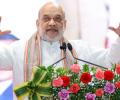
Union Home Minister Amit Shah said on Sunday that indigenously developed BrahMos missiles destroyed Pakistani air bases while its air defence system, borrowed from China, remained unused, during Operation Sindoor, which exposed its lies on terrorism to the world.

Of these only 150 attacks were successful, officials said on Monday.

Even Prime Minister Narendra Modi told US Vice President JD Vance on May 9 that Indian response will be "more forceful, stronger, devastating" in response to Pakistani actions, the sources said.
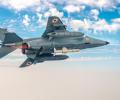
India's precision strikes using an array of weapon systems and missiles on eight key installations ranging from air defence systems to radar sites and command centres of the Pakistani military forced Islamabad to urge New Delhi to end the hostilities, the sources said.
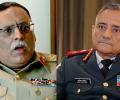
In the wake of the recent hostilities, both sides have moved from weapons to words, with India dispatching several delegations to visit more than 30 capitals across the world. A similar effort by Pakistan is set to start on Jun 2.

India on Sunday said it inflicted tremendous losses to the Pakistan military, including downing its fighter jets featuring latest technologies and damaging key military installations close to even capital Islamabad, during the three-day confrontation between the two sides.

Top military officials from India and Pakistan highlighted their views at the Shangri-La Dialogue in Singapore, billed as Asia's premier defence forum, amid heightened tensions between the two sides following last month's military confrontation.
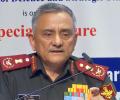
Pakistan's decision to talk to India on May 10 stemmed from realisation that it will suffer more if its operation continues, Gen Chauhan said.
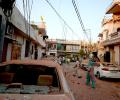
Pakistan's drone strikes and mortar shelling targeted six locations in Jammu, including the densely populated Rehari Colony, leaving one person injured and causing widespread damage. Residents described scenes of devastation and expressed fear, while others voiced defiance and called for action against Pakistan. The attacks, which occurred early Saturday, have been condemned by Jammu and Kashmir's Chief Minister Omar Abdullah as the "worst targeting of civilians in Jammu city since 1971."
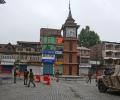
Raj Kumar Thapa, additional district development commissioner, Rajouri, and his two staff members were seriously injured when an artillery shell hit his official residence in Rajouri town, the officials said.
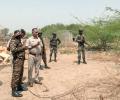
The western Rajasthan experienced a complete blackout and sirens were sounded multiple times, particularly in Barmer, to alert residents.
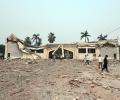
A former Pentagon official, Michael Rubin has said that India targeted terror infrastructure with precision, and it was able to blunt Pakistan's response following the recent strikes.

A villager was killed and three others were injured in shelling by Pakistan in forward areas of Jammu and Kashmir's Poonch and Rajouri districts early Friday morning, prompting Army troops to retaliate. The shelling also caused significant damage to property, with many houses and hundreds of vehicles affected. The firing and shelling were directed at areas in Rajouri, Poonch, and Jammu districts, apart from Kashmir's Kupwara and Baramulla districts, overnight.

Meanwhile, a precautionary blackout has been enforfced in the multiple areas amid the esclating tensions between India and Pakistan.
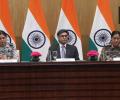
Colonel Sofiya Qureshi revealed that 300 to 400 drones were deployed across 36 locations, with several being shot down by Indian forces using both kinetic and non-kinetic methods.

Madhya Pradesh Minister and Bharatiya Janata Party leader Vijay Shah has sparked a major controversy with objectionable comments that appeared to be directed at Colonel Sofia Qureshi, whom he tried to project as a 'sister of terrorists'.
The top court also referred to the distinctions achieved by women officers, and put out an example of Col Qureshi's achievements.

India's recent missile strikes on nine terrorist locations in Pakistan and Pakistan-occupied Kashmir (PoK), including Bahawalpur, mark a significant escalation in the long-standing military tensions between the two nations. This article provides a historical overview of the Indo-Pak military confrontations, tracing their roots back to the 1947 war following India's independence and the partition of the sub-continent, and highlighting key conflicts such as the 1965 war, the 1971 Bangladesh Liberation War, the 1999 Kargil War, the 2016 Uri attack, and the 2019 Pulwama attack.

Congress leader Uttam Kumar Reddy said the country wanted to know whether any aircraft were downed during the conflict, especially in the wake of the CDS' "admission".

The next Census' findings will help identify the extent of India's ageing population and vulnerability levels.

The tragedy struck the family on May 7 when they found themselves in the middle of intense Pakistani shelling at their rented accommodation in Poonch which was badly hit by the cross-border shelling.

Prime Minister Narendra Modi on Friday said the world has seen the power of India's indigenous weapons during Operation Sindoor, which is 'not over yet'.

Field Marshal Sam Manekshaw Field Marshal K M Cariappa Marshal of the Indian Air Force Arjan Singh The three highest-ranking military heroes of the Indian Armed Forces. They were the rarest of the rare. The bravest of the brave.
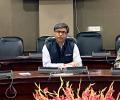
The sources said Misri reiterated the government's stand that the decision to stop military actions was taken at a bilateral level, as some opposition members questioned US President Donald Trump's repeated assertions about his administration's role in stopping the conflict.
He went on to say that even though this has not been discussed, he is going to 'increase trade substantially with both of these great Nations.'
'We believe that in the new world order FTAs or bilateral trade agreements (BTAs) are the way forward.' 'They are enablers for our participation in global value chains. Today, around 70 per cent of global trade is tied to these chains.'

The ministry of external affairs also seemed to reject Trump's forceful comments that Washington brokered the understanding between India and Pakistan on ending their four-day military conflict.
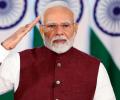
Operation Sindoor has carved out a new benchmark in our fight against terrorism, and has set up a new parameter and new normal. Operation Sindoor is not just a name but a reflection of the emotions of millions of Indians. Operation Sindoor is an unwavering pledge for justice. Terrorists dared to wipe 'sindoor' from the foreheads of our sisters; that is why India destroyed the very headquarters of terror.

'Still, people are asking why we have not gone for a full-out war. As a military man, if ordered, I will go to war, but that will not be my first choice'
 © 2026 Rediff.com - Investor Information - Advertise with us - Disclaimer - Privacy Policy - Sitemap - Feedback - About us - Terms of use - Grievances