
Bangladesh's High Court has granted bail to Hindu rights leader Chinmoy Krishna Das in two cases, though he remains in prison due to four other pending charges, including murder and treason. His arrest in November 2024 on sedition charges had sparked protests and communal tensions, drawing concern from India and occurring amidst strained India-Bangladesh relations following the ouster of Prime Minister Sheikh Hasina.

Bangladesh police on Monday arrested Das, the leader of the Hindu group, Sammilita Sanatani Jote, from the Hazrat Shahjalal International Airport area in Dhaka.

This comes amid the row over the arrest of former priest of ISKCON Bangladesh, Chinmoy Krishna Das Brahmachari, over sedition charges, which led to protests and unrest in Bangladesh.
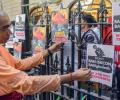
'It is unjust for the Bangladesh government to send ISKCON monk Chinmoy Krishna Das, who is leading the Hindus in such peaceful demonstrations, to jail'
Bangladesh Bank's Financial Intelligence Unit (BFIU) sent these directives to different banks and financial institutions on Thursday, suspending all types of transactions in these accounts for a month, the Prothom Alo newspaper reported.

Protests continue in Kolkata against attacks on minority Hindus in Bangladesh. BJP leader Suvendu Adhikari threatens a large-scale protest if the attacks are not stopped.

The Bangladesh Assistant High Commission in Tripura's capital Agartala on Tuesday announced the suspension of all visa and consular services with immediate effect until further notice because of 'security reasons', a day after the mission's premises was breached by a group of people protesting against the arrest of Hindu monk Chinmoy Krishna Das in Dhaka.
A bench of the Bangladesh High Court ordered the release on bail of Hindu leader Chinmoy Krishna Das, who was arrested in November on charges of defaming the country's national flag. The two-judge bench granted the bail after a final hearing on their previous rule asking authorities why he should not be granted bail. Das, a former ISKCON leader, was arrested at Dhaka's Hazrat Shahjalal International Airport on November 25.
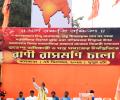
Rabindra Ghosh, a prominent Bangladeshi lawyer, has received death threats since he decided to represent jailed Hindu monk Chinmoy Krishna Das. Ghosh claims the interim government in Bangladesh is targeting Das for his vocal criticism of atrocities against Hindus and his efforts to unite the persecuted community. Despite the threats, Ghosh vows to continue fighting for justice and minority rights. He believes Das has been framed on false charges for his efforts to unite the Hindu community.

Bangladesh has summoned its Acting Deputy High Commissioner in Kolkata for urgent consultations following protests over attacks on Hindu minorities. The mission in Kolkata has witnessed multiple protests over the past week by political parties and religious groups condemning the reported atrocities against Hindus in Bangladesh. In a related development, the Bangladesh Assistant High Commission in Agartala, Tripura, suspended all visa and consular services on Tuesday, citing security reasons. The decision followed an incident where protesters breached the mission's premises on Monday to protest the arrest of Hindu spiritual leader Chinmoy Krishna Das in Dhaka.

A Hindu leader in Bangladesh, Chinmoy Krishna Das, had his bail hearing in a sedition case postponed for a month due to the absence of a lawyer to represent him. The hearing was scheduled for December 3rd, but was adjourned to January 2nd, 2024. Das was arrested on November 25th for alleged sedition and has been denied bail since. The incident has sparked protests from his supporters and has highlighted concerns about the safety of minorities in Bangladesh. The postponement of the bail hearing further delays a decision on his release.

India has expressed serious concern over the increasing incidents of violence and extremist rhetoric against minorities in Bangladesh, urging the interim government to fulfill its responsibility of protecting all minorities. The Ministry of External Affairs (MEA) spokesperson, Randhir Jaiswal, stated that India has consistently raised the issue of threats and targeted attacks on Hindus and other minorities with the Bangladeshi government. Jaiswal emphasized that these developments cannot be dismissed as mere media exaggeration and called upon Bangladesh to take immediate steps to ensure the safety and security of minorities.

At least 30 suspects have been detained in Bangladesh's Chattogram city for their alleged involvement in the killing of a lawyer and attacking security personnel following the arrest of a prominent Hindu community leader. The violence erupted after Chinmoy Krishna Das Brahmachari, spokesperson for Bangladesh Sammilita Sanatani Jagran Jote, was denied bail and sent to jail in a sedition case. The lawyer, Assistant public prosecutor Saiful Islam, was killed during clashes between security personnel and Das' followers. The interim government has condemned the violence, urging people to remain calm and has ordered an investigation into the killing and appropriate legal measures.

A group of people set fire to an ISKCON temple in Dhaka district in Bangladesh in the early hours of Saturday.

The lawyer had sought a ban from the high court on the International Society for Krishna Consciousness (ISKCON) after placing some newspaper reports related to the organisation on Wednesday.
A Bangladeshi court on Tuesday denied bail to prominent Hindu leader Chinmoy Krishna Das Brahmachari, arrested on alleged 'sedition' charges, and sent him to prison, amid protests by community members in the capital Dhaka and the port city of Chattogram.

The incident happened on Monday as activists of the Hindu Sangharsh Samity were protesting the arrest of Hindu leader Chinmoy Krishna Das and atrocities on minorities in Bangladesh.
A court in Bangladesh on Thursday denied bail to a Hindu priest and a former International Society for Krishna Consciousness (ISKCON) leader in a sedition case.

Protests erupted in various parts of West Bengal on Sunday over alleged atrocities against Hindu minorities in Bangladesh. Demonstrations were held in Kolkata, Kanthi, Kakdwip, Sandeshkhali and Purulia, with protesters calling for the release of Hindu leader Chinmoy Krishna Das and boycotting Bangladeshi goods. They condemned the alleged targeting of Hindus in Bangladesh and the hate-driven narratives against India. The protests also saw the burning of Dhakai Jamdani sarees from Bangladesh.

Indian Foreign Secretary Vikram Misri is scheduled to visit Bangladesh next week for a foreign secretary-level meeting, amidst ongoing tensions between the two countries. The visit comes after the interim government led by Muhammad Yunus took power in Bangladesh, following the ouster of Sheikh Hasina as prime minister. The meeting will focus on a range of bilateral issues, including the potential extradition of Hasina and visa-related matters. Tensions between the two nations escalated further with the arrest of Hindu monk Chinmoy Krishna Das in Bangladesh, leading to concerns from India regarding attacks on minorities in the country.
A lawyer was killed on Tuesday during clashes between the security personnel and followers of a Hindu community leader, who was denied bail and sent to jail by a court in the port city of Chattogram in Bangladesh, police said.

Recent attacks on Hindus in Bangladesh have ignited political debate in West Bengal, with the ruling TMC and opposition BJP utilizing the issue to advance their respective agendas. While the TMC emphasizes communal harmony and calls for international intervention, the BJP criticizes the TMC's inaction and links the situation to its push for the Citizenship Amendment Act. The issue has also brought other opposition parties into the fray, with all sides highlighting the interconnectedness of the region's socio-political fabric.

Bangladesh's ousted Prime Minister Sheikh Hasina has launched a scathing attack on the interim administration, accusing Chief Adviser Muhammad Yunus of running a "fascist regime" that persecutes minorities and allows terrorists to operate freely. Hasina, who is currently in India, made the remarks in a virtual address to overseas Awami League supporters, vowing to bring Yunus and his allies to justice for alleged atrocities. Her comments come ahead of a visit by India's Foreign Secretary to Dhaka, where he is expected to raise concerns about the safety of minorities in Bangladesh.
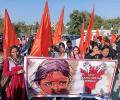
A 17-year-old girl from Bangladesh was arrested by West Bengal Police after the Border Security Force (BSF) apprehended her for illegally crossing the border into India. The girl, who is a resident of Panchagarh district in Bangladesh, claimed that she fled after her family members were threatened by fundamentalists in Bangladesh for being ISKCON devotees. The girl's relatives confirmed that they had received threats and were planning to send her to India to protect her from harm.
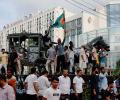
A key aide to Bangladesh's interim government has urged India to unequivocally recognize the July-August uprising that toppled Prime Minister Sheikh Hasina's regime, arguing that this is crucial for rebuilding bilateral ties. Mahfuj Alam, considered a de facto minister in the interim government, criticized India's portrayal of the uprising as militant, anti-Hindu, and an Islamist takeover, and called for a change in approach to understand the "new Bangladesh realities." He stated that bypassing the uprising would be detrimental to relations between the two countries. Alam, whose organization spearheaded the protests against Hasina's government, emphasized the democratic nature of the struggle, which he said was about a "generational and responsible struggle." His statement comes amid strained relations between Dhaka and Delhi, with India expressing concerns over the safety of Bangladesh's Hindu community.

Three Hindu temples were vandalized by a mob in Bangladesh's Chattogram on Friday, following protests and violence sparked by the arrest of a former ISKCON member on sedition charges. The attack occurred in the port city's Harish Chandra Munsef Lane, where the Shantaneshwari Matri Temple, the nearby Shoni Temple, and the Shantaneshwari Kalibari Temple were targeted. Temple authorities reported that a group of hundreds threw brickbats at the temples, causing damage to the Shoni Temple and the gates of the other two. The incident has triggered diplomatic tensions between India and Bangladesh, with both countries expressing concerns over the safety of their respective minorities.
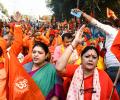
India has expressed concerns over a rise in violence against Hindus and other minorities in Bangladesh and Pakistan, reporting 2,200 cases in Bangladesh and 112 in Pakistan this year. The Indian government has urged both countries to take measures to ensure the safety of minorities and has highlighted the issue at international forums. The government has also stated that it is monitoring the situation closely and has shared its concerns with the respective governments.

India needs to address Bangladesh's longstanding concerns to improve bilateral ties between Dhaka and New Delhi, Hossain said adding: Bangladesh's previous (ousted) government addressed the concerns of India, but India did not address Bangladesh's concerns.

Hasina said she left Bangladesh in August with an aim to stop the violence. However, the situation has deteriorated further, she said.
India on Monday described as 'deeply regrettable' an incident of breach of the premises of Bangladesh Assistant High Commission in Agartala by a group of people protesting against the arrest of Hindu monk Chinmoy Krishna Das in the neighbouring country.
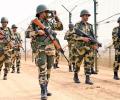
Amateur Ham Radio operators have picked up suspicious late-night radio signals in coded Bengali, Urdu and Arabic along the Indo-Bangladesh border in South Bengal over the last two months, raising concerns about possible extremist activities. The signals, which have been detected between 1 AM and 3 AM, are unusual in their pattern and language usage, according to Ham radio operators, who have reported the matter to authorities. The development comes amidst ongoing unrest in Bangladesh and growing anti-India rhetoric in the neighbouring country. Security agencies are investigating the matter, and the Border Security Force (BSF) has acknowledged the seriousness of the situation.

Foreign Secretary Vikram Misri arrived in Dhaka on Monday on a day-long visit to hold talks with his Bangladeshi counterpart, amid strained bilateral ties since August following the ouster of prime minister Sheikh Hasina.

'The government is saying 88 Hindus have been killed, but it could be much more.' 'Their properties are being looted, their businesses have been ransacked. I am getting distress calls from there.' 'Muslims who believe in the philosophy of Sheikh Mujibur Rahman are also under attack. Most of those who have fled Bangladesh after Sheikh Hasina's fall are Muslims.'

Even a whiff of an incident like the violent 1989 shirt-ripping attack on Krishnamachari Srikkanth by a Karachi spectator would be ruinous. It would set back the ties further, derail an ongoing tournament, and harden Indian attitudes on playing Pakistan anywhere at all, asserts Shekhar Gupta.
