
The latest development comes as diplomatic efforts between Washington and Tehran continue despite renewed hostilities. CNN reported that US and Iranian officials are still working towards a nuclear agreement by mid-August, even as preparations for possible military action have continued in parallel.

As Qatari negotiators travel to Iran in an effort to ease tensions and create conditions for the resumption of US-Iran talks following the recent military escalation between them, US President Donald Trump on Friday said that Washington has agreed to continue talks with the Islamic Republic following Tehran's request but reiterated that the US still considers the ceasefire between the two sides to be "over".

The United States conducted retaliatory strikes against Iran, targeting over 80 sites, after accusing Tehran of attacking commercial vessels in the Strait of Hormuz, while Iran condemned the US decision to revoke a temporary suspension of sanctions on Iranian oil sales.

US President Donald Trump has declared the ceasefire agreement with Iran effectively concluded, stating he no longer wishes to engage in diplomatic dealings with Tehran and labelling Iranians as 'liars, cheats and sick people' following recent military actions.

US President Donald Trump has claimed that Iran has accepted "just about everything" the United States has demanded in ongoing indirect nuclear negotiations, particularly regarding denuclearisation. He also asserted that American forces repeatedly carried out military strikes that crippled Tehran's military infrastructure, including radar installations, and escorted commercial oil tankers through the Strait of Hormuz. Trump dismissed reports of Iran's strength, stating its military and economy were severely weakened.

US President Donald Trump has abruptly withdrawn from a peace deal with Iran, citing fresh intelligence of Iranian assaults on commercial vessels in the Strait of Hormuz. The decision, made just a fortnight after celebrating the deal, has led to a significant military escalation in the region, with the US launching extensive counter-operations against Iranian military infrastructure.

It is an unusual choice to depute a retired general for the funeral of a revered religious figure but a thoughtful one in an attempt to inject verve into the bilateral relationship and restore the equilibrium in India's West Asian policies, notes Ambassador M K Bhadrakumar.

Iran has extended an invitation to Congress president Mallikarjun Kharge and other party leaders, including Salman Khurshid and Pawan Khera, to attend the burial ceremonies of its late supreme leader Ayatollah Ali Khamenei. The ceremonies are scheduled from July 5 to 9 across various Iranian cities. India will also be represented by Minister of State for External Affairs Pabitra Margherita and Bihar Governor Ata Hasnain.

Iranian Foreign Minister Seyed Abbas Araghchi mocked US President Donald Trump's claim of the US being the 'guardian' of the Strait of Hormuz, asserting that Iran has always been and will remain the sole guardian, while also suggesting that any entity providing security should be compensated, though Trump's proposed '20 per cent' levy is 'too much'.

'Actual implementation of the 14-point agreement is proving hard to achieve let alone striking and sustaining a long-term treaty or deal.'

Iran's Persian Gulf Strait Authority (PGSA) has declared the Strait of Hormuz closed due to 'recent illegal movements' by the US military, demanding transit permits, while the US Central Command (CENTCOM) insists the strait is 'open to all vessels' and vows to ensure 'freedom of navigation'.

Iranian Parliament Speaker Mohammad Bagher Ghalibaf stressed on Friday (local time) that Tehran remains prepared for "full-scale defence" should the US betray the Memorandum of Understanding signed by the two countries last month.
US President Donald Trump on Friday (local time) said that he has "left instructions" to launch a massive military action against Iran, if Tehran succeeds in the plan of assassinating him, while stressing that the country would be bombed "at levels they have never seen before", New York Post reported.

The US Central Command (CENTCOM) has launched extensive precision strikes across multiple Iranian military installations, deploying both one-way attack aerial and sea drones for the first time, to degrade Tehran's ability to disrupt international maritime trade in the Strait of Hormuz.

The United States on Saturday (local time) launched a third round of strikes against Iran after alleging that Iran's Islamic Revolutionary Guard Corps (IRGC) attacked the Cyprus-flagged container vessel M/V GFS Galaxy in the Strait of Hormuz.

Belgium, who missed a slew of scoring chances against Iran on Sunday, have taken only two points from their opening two matches despite entering the tournament as favourites to progress from the group.

PDP president Mehbooba Mufti has received an official invitation to attend the state funeral of Iran's slain supreme leader Ayatollah Ali Khamenei in Tehran. She will travel to Iran as a distinguished guest of India to pay her final respects, highlighting the historical and strategic ties between the two nations.

The United States has launched a fresh wave of precision strikes, hitting approximately 90 Iranian military targets deep inside Iran, further intensifying a rapidly expanding regional conflict, with Tehran warning of severe retaliation.

Formerly Iran's second-largest oil customer, Indian financial institutions were forced to withhold crude oil payments following the 2018 US sanctions.

Former Spain defender Joan Capdevila has appealed to President Donald Trump for help after being denied permission to enter the United States for Sunday's World Cup final between Spain and defending champions Argentina.

Indian benchmark indices Sensex and Nifty experienced a downturn in early trade, primarily influenced by a dip in HDFC Bank shares, persistent outflows from foreign funds, and escalating geopolitical tensions between the US and Iran. Track Sensex, Nifty performance.

Following the death of Ayatollah Ali Khamenei, his son and successor, Mojtaba Khamenei, issued a "revenge list" featuring 13 world leaders, including Donald Trump and Benjamin Netanyahu, with a graphic depicting them as targets, amidst escalating regional hostilities and US reports of an Iranian assassination plot against Trump.

Indian benchmark indices, Sensex and Nifty, closed lower due to significant selling in HDFC Bank and Axis Bank shares, driven by margin-related concerns and escalating US-Iran tensions, which also pushed crude oil prices higher.

Hours after US President Donald Trump on Wednesday said that the ceasefire deal with Iran was "over", the US President indicated that Washington could launch another round of strikes against the Islamic Republic, following strikes on Tuesday, saying it had already hit Tehran "very hard" and warning of further attacks.

'Thank you Los Angeles for your hospitality'

Thousands of mourners and international delegates gathered as Iran paid its final respects to its late supreme leader Ayatollah Ali Khamenei, who was killed in an Israeli strike on February 28, in Tehran.

India has condemned the attack on the Cyprus-flagged container ship M/V GFS Galaxy in the Strait of Hormuz, which resulted in one Indian crew member going missing. The United States responded with a third round of retaliatory strikes against Iranian targets, further escalating tensions in the Gulf.

Indian benchmark indices, Sensex and Nifty, closed higher, primarily driven by bank stocks and encouraging US inflation data, which fuelled expectations of a less aggressive Federal Reserve monetary policy. However, escalating US-Iran hostilities tempered investor sentiment, leading to some profit-taking.

The US forces conducted strikes against Iran, on Friday, as a powerful response to Thursday's attack on a commercial ship that was transiting the Strait of Hormuz, said Central Command (CENTCOM) in a statement.

Indian equity benchmark indices Sensex and Nifty plummeted over 2 per cent following US President Donald Trump's declaration that the interim agreement with Iran is 'over', which led to a sharp rally in crude oil prices and heightened geopolitical tensions.

Iran's football coach, Amir Ghalenoei, has strongly criticised the United States for imposing travel restrictions on his team during the World Cup, claiming it unfairly hampered their preparation and performance.

Iran's bid for a first World Cup knockout stage appearance ended dramatically after Austria's late equaliser against Algeria denied them a spot. Despite remaining unbeaten, the team faced significant logistical challenges and travel restrictions due to their conflict with the U.S., which captain Mehdi Taremi described as a "disaster."

'In the current environment, India is effectively paying a premium for supply security and diversification.'
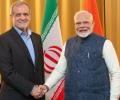
Prime Minister Narendra Modi held a telephonic conversation with Iranian President Masoud Pezeshkian, discussing recent developments in West Asia and reiterating India's emphasis on the importance of freedom of navigation in the Strait of Hormuz. Modi welcomed the recent peace understanding between the US and Iran, stressing dialogue and diplomacy for regional stability. India will also send representatives to the burial ceremonies of Iran's late Supreme Leader.
Indian benchmark indices Sensex and Nifty experienced a significant decline in early trade, driven by renewed tensions between the US and Iran and a subsequent spike in global crude oil prices, creating uncertainty in the market. Track Sensex, Nifty on July 8.

On June 21, the United States and Iran started high-level talks at the Burgenstock luxury hotel in Switzerland, with mediation by Qatar and Pakistan, in an effort to build on a fragile ceasefire and launch a 60-day roadmap toward a broader agreement.

Iran's Football Federation will lodge an official protest with FIFA after the United States reportedly denied the national team's request to travel to Los Angeles two days before their FIFA World Cup 2026 Group G match against Belgium, citing geopolitical tensions and previous visa issues.

Lieutenant General Apti Alaudinov, deputy chief of the Russian Armed Forces' Main Military-Political Department, has warned that the escalating conflict in West Asia could lead to Israel ceasing to exist as a state, accusing Israel of seeking to widen the confrontation to involve the US and NATO.

US and Iran officials have reportedly agreed to de-escalate tensions and ensure free passage through the Strait of Hormuz, with technical talks scheduled to continue. This development follows months of conflict, rising gas prices, and strained diplomatic relations, marked by recent retaliatory strikes and threats from both sides. Further discussions on Iran's nuclear program are set to take place in Qatar, highlighting ongoing diplomatic efforts despite recent volatility.

US President Donald Trump on Monday claimed that Iran had requested a meeting with the US after the recent military escalation between the two sides over the Strait of Hormuz and announced that talks with Tehran would take place in Doha, Qatar, on Tuesday, despite Iranian officials stating that no technical meetings have been scheduled this week.
