
The highlight of the successful BRICS Summit was its ability to deliver a joint statement that all members, including Iran and the United Arab Emirates, embroiled in the war in West Asia, signed.

New Delhi was told it had given something up; in reality it had stopped talking about it, notes Dr Abhishek Puri.

The 18th BRICS Summit got underway in New Delhi with leaders of partner countries gathering in the capital to discuss the changing global economic and geopolitical landscape.

A Kishore Kumar song, a birthday cake, a prince's break from protocol to thank his driver, a Persian painting on the ceiling of the presidential residence -- the BRICS Summit had many memorable moments.

Xi brought in asymmetrical power play by stating that India should have 'strategic cognition' and 'strategic judgement made on the basis of the stage of development the two countries are at'. This is a very nuanced way of asserting China's coercive diplomatic posture and reflects Beijing's penchant to unleash border instability at will, restrict rare earth metal exports, exert pressure on India at global and regional orders, asserts China expert Srikanth Kondapalli.

Uttar Pradesh Governor Anandiben Patel addressed AI Manthan 2.0, advocating for the comprehensive integration of Artificial Intelligence across all university subjects rather than as a standalone course. She urged universities to develop clear, time-bound AI roadmaps covering education, research, healthcare, and agriculture, emphasising indigenous AI development, employment creation, and the importance of "Safe and Trusted AI." The event also saw the formation of an AI Policy Advisory Group and an AI Implementation Group to drive these initiatives.

'Uranium supply is going to come under increasing pressure.'

'The Chinese military cannot advance much in Ladakh, even if they want to.' 'Similarly, in Arunachal Pradesh, they can rename a village or two, intrude here or there, but cannot do much more realistically.'

Pakistan's army chief held a series of engagements with Iranian leaders in Tehran as regional diplomacy remained in focus.

Russia remains India's biggest fertiliser supplier, with imports rising nearly 40 per cent in 2025.

Notwithstanding the economic complementarities and the host of agreements for deepening economic relation on a host of areas, both sides share common viewpoints on the foreign policy domain and seek common grounds to serve as a counterweight to China, notes Dr Rajaram Panda.

Russia on Monday assured India of uninterrupted supply of energy and fertilisers amid disruption caused by the West Asia crisis, as External Affairs Minister S Jaishankar met President Vladimir Putin in Moscow and held talks with his key interlocutors.

External Affairs Minister S Jaishankar visited Kyiv, reiterating India's readiness to assist in ending the Ukraine-Russia war. He emphasised that solutions would not emerge from the battlefield and highlighted Prime Minister Modi's call for an end to the conflict. Discussions also covered humanitarian aid, the impact on commercial shipping, and bilateral trade, with Jaishankar inviting his Ukrainian counterpart to India for further talks.

'ISRO will not manufacture any launch vehicles. That will all be done by the private sector or public sector undertakings.'

Who is running the show in Dhaka? This kind of flip-flop, culminating in a last-minute decision to skip a maiden visit, can happen only when the remote is in the hands of one of the competing lobbies within the BNP -- one that appears determined to play a game of chess with India.

Bangladesh-China and Bangladesh-US relations have evolved from reluctant engagement to increasingly consequential strategic partnerships.

Japan is deepening its defence relationship with India while simultaneously expanding its economic, infrastructure and security engagement with countries around India -- particularly Bangladesh. The result is an emerging Japanese conception of South Asia in which India remains the strategic anchor, but the geography surrounding India is becoming increasingly important, points out Varun Arya.

'It is not because of the war in West Asia, which began on February 28.' 'Petroleum product prices are already going through the roof. They are bound to have a serious inflationary impact.' 'A country's leadership is tested in trying times. It is here that the current leadership is failing.'

External Affairs Minister S Jaishankar met his Chinese counterpart Wang Yi in Manila, reiterating that peace and tranquillity in border areas are prerequisites for normal India-China relations. He stressed the importance of mutual respect, interest, and sensitivity, while also raising concerns about market access, trade imbalance, and supply chain uncertainties.

India is navigating a complex diplomatic landscape, attempting to balance its 'forever honeymoon' with the Israel-UAE-Bahrain axis against its historical ties with Iran, as evidenced by recent high-level visits and evolving geopolitical realignments in the Middle East, observes Ambassador M K Bhadrakumar.

The harsh truth is that the US is no longer a reliable partner, cautions Ramesh Menon.

'Actual implementation of the 14-point agreement is proving hard to achieve let alone striking and sustaining a long-term treaty or deal.'

'The flip side of this is that he won't hesitate to call out India if he thinks its policies are hurting US economic interests or border US foreign policy goals.'

Nagabandham promises a fantasy treasure hunt adventure but ultimately devolves into a senselessly violent and shallow revenge saga.

The proposed facility seeks to simplify and speed up PF withdrawals by allowing Employees' Provident Fund Organisation (EPFO) subscribers to access up to 75 per cent of their balance through ATMs and UPI-based systems, while retaining at least 25 per cent in their accounts.
The National Medical Commission is emphasising the importance of preparing doctors and healthcare systems for the responsible and effective use of artificial intelligence, highlighting the need for ethical and equitable AI adoption in healthcare.
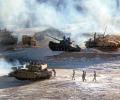
While tensions have eased at several friction points and mechanisms for managing the boundary have been reactivated, underlying differences persist. Disputes over naming practices in Arunachal Pradesh, continued infrastructure development on both sides, and unresolved questions regarding patrolling rights indicate that the structural gap remains, notes Dr Kumar.

The Quad grouping has expanded cooperation in critical minerals and energy, while unveiling new measures to boost maritime surveillance and port infrastructure across the Indo-Pacific. This move comes against the backdrop of China's growing military posturing in the region, with ministers reiterating strong opposition to destabilising actions and expressing serious concerns over militarisation of disputed features.

The BRICS foreign ministers' meeting in New Delhi concluded without a joint statement due to disagreements over the West Asia conflict, with Iran blaming the UAE for the lack of consensus. India, as the host, issued a chair's statement highlighting the differing views.

Vietnam is an emerging regional power and a closer relationship with Hanoi is closely aligned with Prime Minister Narendra Modi's Act East Policy, points out Dr Rajaram Panda.

Wen has postponed an official visit to the Philippines, which was originally scheduled for December 13-14, Foreign Ministry spokesman Qin Gang announced in Beijing on Sunday.

Vice President C P Radhakrishnan has championed the use of artificial intelligence for good governance, highlighting its potential to improve government services and build an inclusive and efficient India.
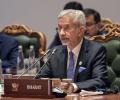
India has expressed serious concerns about the West Asia crisis and its potential impact on energy supplies and maritime stability, urging BRICS nations to find practical solutions to geopolitical challenges and unilateral sanctions.

Prime Minister Narendra Modi spoke with Iranian President Masoud Pezeshkian to discuss the escalating tensions in West Asia, emphasising the safety of Indian nationals and the need for regional stability through dialogue and diplomacy.

Prime Minister Narendra Modi spoke with Iranian President Masoud Pezeshkian, condemning attacks on critical infrastructure in West Asia and emphasising the importance of safeguarding freedom of navigation and ensuring secure shipping lanes.

60 years ago, on January 24, 1966, Dr Homi J Bhabha, the father of India's nuclear programme, died in an air crash on Mont Blanc. The official inquiry said the plane went off course in bad weather, but coincidences, missing evidence, and later unproven claims have kept conspiracy theories alive. A fascinating excerpt from Bakhtiar Dadabhoy's book, Homi J Bhabha: A Life.

Karnataka Chief Minister announces a ban on social media for children under 16 and increased measures to prevent drug abuse in schools, colleges, and universities, alongside investments in education infrastructure and mental health support.

Karnataka and Andhra Pradesh announce ban social media for teens, sparking debate about its effectiveness, impact on education, and implications for advertisers targeting young audiences.

'To suddenly give the impression of taking a position that is hostile to Iran, or, at least, not friendly to Iran, is not a good thing.'
We know in our heart that speaking the truth on this stupid Iran war will anger Trump and so we look the other way because if we look him in the eye the bully will straighten us out, asserts Aakar Patel.
