
'Dating someone during divorce proceedings is legally permissible as long as it does not involve provable physical intimacy,' says lawyer Navaneet Kumar.

The Supreme Court on Monday expressed its displeasure at the Delhi High Court Bar Association for questioning the representation of women judges in the top court while arguing for reservation for women lawyers in the high court bar. The court refused to hear further arguments from the bar body and set November 29 for final arguments on the issue of reservation. The court had previously directed the DHCBA to reserve the post of treasurer for a woman and consider reserving one more post for a woman in the five-member office-bearer body. It had also directed that at least three out of the 10 executive members be women, with at least one being a senior designated advocate.

Chief Justice of India Justice B R Gavai on Friday praised Justice Bela M Trivedi for her career trajectory from the subordinate judiciary all the way up to the Supreme Court, where she became the eleventh woman judge to be appointed in its history.
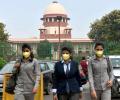
Justice Indira Banerjee, who was the eighth woman judge in the Supreme Court, on Friday demitted office with Chief Justice of India UU Lalit, terming her as a "jewel" of the legal fraternity.

Appointed as the first female head of the state judiciary on August 3, 2018, she retired on December 8, 2020.
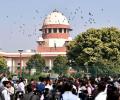
Chief Justice of India D Y Chandrachud has constituted an all-woman bench comprising Justices Hima Kohli and Bela M Trivedi to hear transfer petitions involving matrimonial disputes and bail matters on Thursday.

The Supreme Court-appointed Justice Gita Mittal committee, set up to oversee relief and rehabilitation of the victims of ethnic violence in Manipur, on Monday submitted three reports highlighting the need for reconstruction of identity documents, upgradation of compensation and appointment of domain experts to facilitate its functioning.
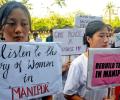
The Supreme Court on Friday said the trial in the Manipur violence cases being probed by the Central Bureau of Investigation (CBI) will take place in neighbouring Assam and asked the Chief Justice of the Gauhati high court to nominate one or more judicial officers to deal with the matters.

As many as 430 high court judges out of a total of 554 appointed since 2018 belong to the general category, Law Minister Kiren Rijiju told the Rajya Sabha on Thursday, noting that 58 were from the Other Backward Classes and 19 from the Scheduled Castes.

As Manipur sank deeper into ethnic violence, the Supreme Court on Monday ordered the setting up of a committee of three former women high court judges to oversee relief and rehabilitation of victims and compensation to them, besides asking former Maharashtra police chief Dattatray Padsalgikar to monitor the probe in criminal cases.

Chief Justice of India D Y Chandrachud on Friday said truth has become a "victim" in the age of false news and with the spread of social media, something which is said as a seed germinates into virtually a whole theory that can never be tested on the anvil of rational science.

In the high courts, only 13.2 per cent women occupied the position of judge.

Prior to the swearing-in of Justices Hima Kohli, Nagarathna and Bela M Trivedi, only eight women judges, including sitting judge Justice Indira Banerjee, were appointed as apex court judges.
In a first, the Supreme Court Collegium had last week recommended for appointment to the apex court three women judges, including Justice B V Nagarathna who will be in line to be the first woman Chief Justice of India (CJI) in September 2027 if she gets the final nod.
The new judges of the top court include Justice B V Nagarathna, who will be in line to be the first woman Chief Justice of India (CJI) in September 2027, Justice Bela M Trivedi, Justice Hima Kohli, Justice C T Ravikumar, Justice M M Sundresh, and senior advocate and former Additional Solicitor General P S Narasimha.

Chief Justice of India (CJI) D Y Chandrachud's first 100 days in office saw the Supreme Court take a giant leap towards reforms, especially making courts more technology-friendly, and ensuring relatively fast judicial appointments including those of eight judges to the apex court.

In another first, the venue of the ceremony was shifted to the newly-built auditorium instead of the CJI's courtroom, the traditional place for such a ceremony.
In an unprecedented development, the Supreme Court Collegium has made public the names of the two judges on the panel who objected to the method of 'circulation' adopted for eliciting the views of its members on the appointment of judges to the apex court.

"I don't want you to cry but with anger, you have to shout and demand that we need 50 per cent reservation," the CJI said.

In an unprecedented decision, the Supreme Court Collegium has recommended the names of three women judges for appointment in the apex court which, if cleared, would give the country its first woman Chief Justice of India (CJI) in the form of Justice B V Nagarathna on February 10, 2027.
The year 2022 is going to be the second year since the inception of the top court in 1950 which will see three different CJIs in as many months.

Outgoing Chief Justice of India (CJI) N V Ramana on Friday said the appointment of 11 Supreme Court and 224 high court judges, besides recommending the names of more women for judgeship during his tenure as the head of the judiciary, was a reflection of "the coherence and determination" of judges to strengthen the judiciary to further the goal of justice.

The Supreme Court on Monday regained its full strength of 34 judges as chief justice of Gauhati high court Justice Sudhanshu Dhulia and Gujarat high court judge Justice Jamshed B Pardiwala took oath as apex court judges.
The Supreme Court is all set to regain its full strength of 34 judges with the apex court collegium headed by CJI N V Ramana recommending names of the Chief Justice of Gauhati high court Justice Sudhanshu Dhulia and Gujarat high court judge Justice Jamshed B Pardiwala for elevation to the apex court, sources said.

Our Rediff labs team analysed 2014 data from the Ministry of Statistics and Programme Implementation on the participation of women in decision making at administrative levels in India in three different sectors.

It is for the first time in the history of the apex court that nine judges took oath of office at one go.

The former CJI was criticised for being part of a special bench set up to hear a suo motu case titled 'In Re: Matter of Great Public Importance Touching upon the Independence of the Judiciary' on a Saturday on April 20, 2019.

'Coupled with e-filing procedures it would really enhance the ability of the judiciary to provide speedier justice.'

Observing that Laxman rekha of separation of power is 'sacrosanct,' Chief Justice of India N V Ramana Friday said at times courts are compelled to intervene in the interest of justice and the intention is to nudge the executive, and not to usurp its role and they should not be projected as judiciary targeting another institution.
"Day in day out there exists a misconception in the minds of people that judges stay in big bungalows, work only 10 AM to 4 PM and enjoy their holidays. Such a narrative is untrue," Chief Justice N V Ramana said on Thursday while paying glowing tributes to Justice Rohinton Fali Nariman on his superannuation after over seven years at the Supreme Court bench.

She is the first woman lawyer to enter the top judiciary directly.

There is no woman judge among the five new judges appointed in the Supreme Court who were sworn-in on Friday.
Malhotra was administered the oath of office and secrecy in a ceremony held at court number 1 in the apex court.
Along with her, Uttarakhand high court Chief Justice K M Joseph has also been cleared for elevation to the apex court.

The former woman employee of the apex court, who has levelled the sexual harassment allegations, has opted herself out from participating in the enquiry.

While Justice Gyan Sudha Misra, a sitting Supreme Court judge, suggested amendments to the Evidence Act to avoid recording of evidence at multiple stages to "cut-short" the whole process of trial, former Delhi high court judge, Justice Usha Mehra opined that the trial judge should ensure service of lawyers to accused from the very outset of the trial.
During the hearing, only the woman was present and the secretary general was not privy to the proceedings.

The former Supreme Court employee dubbed on Tuesday as "very frightening" the atmosphere of the in-house inquiry committee and "walked out" raising various objections including denial of her lawyer's presence.

Apart from Joseph, Justices Indira Banerjee, Vineet Saran sworn in as judges of the Supreme Court in the order of seniority notified by the Centre.
The five-member Collegium, headed by Chief Justice of India Dipak Misra, said that there was 'nothing adverse' regarding suitability of Justice Joseph.
 © 2026 Rediff.com - Advertise with us - Disclaimer - Privacy Policy - Sitemap - Feedback - About us - Terms of use - Grievances