
Foreign Secretary Vikram Misri held extensive discussions with China's Vice Foreign Minister Hua Chunying and other senior officials in Beijing, reviewing bilateral relations, trade, cultural exchanges, and emphasising peace and tranquillity in border areas. His visit aims to advance the vision of both nations as development partners.

US President Donald Trump concluded his Beijing summit with Chinese President Xi Jinping, describing it as 'incredible' and highlighting 'fantastic trade deals' and a 'very strong' relationship between the two leaders.

External Affairs Minister S Jaishankar stated that the stability of the Line of Actual Control (LAC) is essential for normalising India-China relations, asserting that border disturbances will have consequences. He connected trade and investment growth to border peace and highlighted significant economic issues, including a severe trade imbalance and lack of market access for India in China. Jaishankar also referenced the 2020 Galwan clashes as a critical turning point, underscoring the profound impact of border tranquillity on the overall bilateral relationship.

India has reiterated that any code of conduct for the South China Sea must align with international maritime law, particularly the UN Convention on the Law of the Sea (UNCLOS). This statement comes as China and ASEAN continue negotiations on a pact for the contested region, where concerns over China's expansive claims and military activities persist.

External Affairs Minister S Jaishankar stated that India's border with China has become "more alive," necessitating a greater and sustained commitment of Indian troops. He highlighted India's enhanced military capabilities along the LAC since the 2020 Galwan Valley clashes and the significant infrastructure development in border areas over the last decade. Jaishankar also discussed the economic asymmetry between India and China, attributing it to India missing industrialisation opportunities in the 1980s and outlining India's current strategy to address this imbalance.

Beijing has strongly criticised new US export controls on advanced semiconductor chips to five countries, viewing them as an attempt to prevent diversion to China. This condemnation comes just before US President Donald Trump's visit to Shenzhen for the APEC summit, where geopolitical tensions, including China's opposition to the Quad, are also in focus.

'Therefore, Beijing comes to wrong conclusions.'

US President Donald Trump, Chinese President Xi Jinping, and Russian President Vladimir Putin adopted a joint 'Declaration towards Peace' following their trilateral summit in Shenzhen, committing to dialogue on reducing nuclear risks, ensuring stable energy flows, and preventing the abuse of jurisdiction by the International Criminal Court.

Prime Minister Narendra Modi, in bilateral talks with Chinese President Xi Jinping, emphasized that both nations must show sensitivity to each other's core issues and be guided by mutual respect, sensitivity, and interest. Modi highlighted the critical importance of peace and tranquillity along the Line of Actual Control for the development of India-China relations, while also addressing concerns regarding Taiwan and Tibet.

Chinese President Xi Jinping is in New Delhi for the 18th BRICS Summit, where he is scheduled to hold bilateral talks with Prime Minister Narendra Modi. This visit, his first to India in nearly seven years, comes amidst efforts to normalise India-China relations following the 2020 Eastern Ladakh standoff and is expected to have significant implications for bilateral ties and BRICS cooperation.

US Treasury Secretary Scott Bessent on Friday faulted the Commerce Secretary Howard Lutnick for stalling the designation of Nvidia client Megaspeed as a potential national security risk, bringing internal Trump administration friction into the open in the wake of Nvidia CEO Jensen Huang's departure.

An Army officer's wife has been booked in Jammu for alleged espionage, accused of using AI tools like ChatGPT and Claude to write analytical papers on sensitive national security issues for Chinese intelligence operatives. The well-qualified freelance researcher, who had an IT internship with the UN, is cooperating with investigators after being intercepted at Jammu Tawi railway station. The probe focuses on her alleged contacts with foreign nationals and the nature of the sensitive documents found on her mobile phone.

During the 18th BRICS Summit in New Delhi, Chinese President Xi Jinping and Prime Minister Narendra Modi held a bilateral meeting, outlining a four-point approach for the steady and long-term development of China-India relations. The leaders stressed strategic understanding, win-win cooperation, mutual respect, and inclusive multilateral engagement, reaffirming their commitment to resolving the boundary question and addressing economic concerns. They also discussed global challenges and strengthening people-to-people ties.

US intelligence agencies have reportedly concluded that Alice Huang, a Chinese businesswoman with close ties to Nvidia CEO Jensen Huang, was a Chinese intelligence asset. She is accused of funnelling information to Beijing and helping China circumvent US AI chip restrictions. China has dismissed these allegations as a "smear". The findings raise concerns about potential access to sensitive information regarding US-China relations and Nvidia's technology.

'We are open to all countries around the world as long as we get a fair deal, as long as we are ensured continuity in the engagement.'
'The close collaboration between Pakistan and China, and the assistance Pakistan receives, is a factor in our planning, and the IAF is building its capacity to counter precisely such collusive threats.'
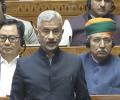
Jaishankar said India-China ties have been abnormal since 2020 when peace and tranquillity in border areas were disturbed due to Chinese actions.

France football captain Kylian Mbappe has issued an apology after Chinese brands severed ties with him over a comment referring to late Chinese leader Mao Zedong, highlighting the swift repercussions international celebrities face in the crucial Chinese market.
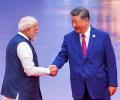
A senior Chinese Communist Party official stated that the meeting between Prime Minister Narendra Modi and President Xi Jinping was fruitful, leading to a new consensus on developing bilateral relations. Both countries aim to enhance cooperation and manage differences.

US President Donald Trump received a grand welcome from Chinese President Xi Jinping in Shenzhen for the APEC Economic Leaders' Meeting, culminating in an unprecedented trilateral meeting with Russian President Vladimir Putin. The leaders discussed critical global issues including the Ukraine conflict, Iran, artificial intelligence, and nuclear arms reduction, marking significant political gains for each leader on the international stage.

The subtext here is that nobody else really matters to America today; only China, because nobody else can truly hurt them, points out Mihir S Sharma.

Chinese President Xi Jinping's arrival in Washington marks a pivotal moment for global diplomacy, as he advocates for a "partners, not rivals" approach to US-China relations amidst high-stakes discussions on trade, technology, and international stability.
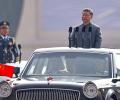
Chinese President Xi Jinping has declared the "complete reunification" of Taiwan with the mainland an "unwavering historical mission" for the Communist Party of China. Speaking at an event commemorating Sun Yat-sen, Xi emphasised that while China is willing to engage in dialogue and consider Taiwan's realities, it will not tolerate any form of "Taiwan independence" separatist activities. He reiterated commitment to the "one country, two systems" policy and the 1992 Consensus.

China announced a "ground-breaking" trilateral meeting between the presidents of China, the US, and Russia, scheduled for November 19 in Shenzhen during the APEC summit. This first-ever face-to-face meeting aims to discuss safeguarding world peace, strategic stability, and global challenges like nuclear arms reduction and artificial intelligence. Beijing has shown reluctance on trilateral nuclear arms control due to its smaller arsenal, while the war in Ukraine will not be a discussion point. The APEC summit will also see Japanese Prime Minister Sanae Takaichi's participation, drawing attention due to recent Sino-Japanese tensions over Taiwan.
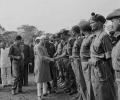
The conversations on July 22 and 23, 1962, meetings in Geneva between V K Krishna Menon, India's defence minister at the time, and Chinese vice premier Chen Yi are important because, had they been followed up, the subsequent border war may perhaps have been avoided, notes former foreign secretary Shyam Saran.

Chinese Foreign Minister Wang Yi stated that President Xi Jinping and Prime Minister Narendra Modi reached a crucial consensus during the BRICS summit, agreeing that China and India should be partners, not rivals. The leaders pledged to maintain peace and tranquility in border areas, deepen cooperation, and support each other in multilateral forums, aiming to strengthen the Global South and promote a multipolar world order.

France captain Kylian Mbappe had put a difficult period behind him and is focused on helping his team ahead of Nations League fixtures against Italy and Turkey, defender Ibrahima Konate said.

US President Donald Trump, Chinese President Xi Jinping, and Russian President Vladimir Putin held an unprecedented trilateral meeting at the APEC Economic Leaders' Meeting in Shenzhen, discussing global conflicts, nuclear arms reduction, and artificial intelligence.

China Southern Airlines is set to resume its Guangzhou-New Delhi passenger service from September 21, ending a six-year suspension. This move is part of a broader normalisation of India-China relations, following recent high-level diplomatic meetings and previous flight resumptions by other carriers.

Xi's bilateral meeting with Modi was substantial and readouts from both sides gave indications of rapprochement, if not a reset of bilateral relations between India and China, notes Ambassador T P Sreenivasan.
'Eastern Ladakh set the relationship back by about 10 steps. So far, especially since Galwan, we may have taken just 4 steps forward.'

Chinese President Xi Jinping began his second state visit to the US, meeting President Donald Trump at the White House. Both leaders expressed a desire for a better future for their nations, with Xi emphasising cooperation over confrontation and the avoidance of the "Thucydides Trap." Discussions also touched upon artificial intelligence governance and the extension of a trade truce. The visit was notably marked by a media boycott of White House coverage due to a dispute over press access.

China emphasises proper handling of differences and a long-term perspective for bilateral ties ahead of President Xi Jinping's visit to India for the BRICS summit and talks with Prime Minister Narendra Modi. The visit aims to stabilise relations following the 2020 Ladakh standoff and strengthen BRICS cooperation.

India is set to host the SCO Civilisational Dialogue Forum in New Delhi from November 20-22, with 15 countries, including China, Kazakhstan, and Iran, confirming participation. Union Culture Minister Gajendra Singh Shekhawat expressed hope for Pakistan's attendance, emphasizing the cultural commonalities despite geopolitical differences. The forum aims to reinforce cultural relations and showcase India's rich civilisational history.

India and China are in what experts call 'a cooperation-versus-competition situation'.

'Xi is conveying that China is a pre-eminent power, and India should modulate its actions or approaches accordingly.'
Prime Minister Narendra Modi conveyed to Chinese President Xi Jinping that peace and tranquillity along the frontier remains an "essential" basis for the development of India-China relations, even as the two leaders welcomed "steady progress" in bilateral ties during their talks on the sidelines of the BRICS summit.

Goldman Sachs has upgraded India to 'overweight' with a Nifty target of 28,500 by 2027-end, driven by an anticipated 15 per cent earnings growth, strong domestic demand, robust earnings, and historically low foreign positioning.

An Indonesian woman was arrested at the Sonauli check-post in Maharajganj for allegedly concealing her nationality and obtaining Indian identity documents under a fake name. She was living as 'Lee Kim Lian' with fraudulent voter ID, Aadhaar, and PAN cards, and was detained while attempting to cross into Nepal.

Prime Minister Narendra Modi addressed the ASEAN-India summit, advocating for a free, inclusive, and rules-based Indo-Pacific based on cooperation. He proposed nine initiatives, including a long-term maritime plan, free e-visas, and cooperation in civil nuclear energy, emphasizing India's commitment to ASEAN's unity and centrality amidst global uncertainties.
