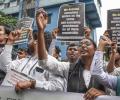
The prime accused in the Kolkata law college gang rape case, Monojit Mishra, is a history-sheeter having a slew of pending cases of sexual harassment and violent crimes registered against him, police said on Monday.

The victim, in her written complaint to the police, alleged that the security guard did not help her.

Around 400 people of Lapangap and other villages, backed by members of several social organisations of Meghalaya, went to the plantation area, uprooted the saplings and burnt the wooden structure around 11 am, claiming that Assam was trying to encroach into their state by carrying out the plantation.
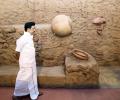
'There is no doubt about the antiquity of Tamil Nadu.'
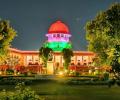
Article 363 bars the interference of courts in any disputes which may arise from certain treaties, agreements, covenants, sanad, engagements, etc., executed between a princely state and the government of India.

Astronaut Shubhanshu Shukla, aboard the International Space Station, interacted with students in Lucknow, answering questions about life in space, the challenges of readjusting to Earth, and the benefits of space exploration.
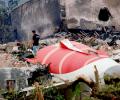
Both the CVRs and FDRs were recovered within a week after the accident. One was retrieved from a rooftop of the building at the crash site on June 13, and the other from the debris on June 16.

The meeting will focus on the current internal security scenario in the state, with a special emphasis on anti-Maoist operations, the release added.
If the threat from the 'Maovadis' (Maoists) is fading, the danger now lies with the 'MoUvadis' -- those who might exploit the resource-rich Abujhmad region through corporate or State-backed projects.

Due to the rising COVID cases, the Centre is conducting mock drills to check facility-level preparedness and has instructed all states to ensure availability of oxygen, isolation beds, ventilators, and essential medicines, official sources had said.
Census exercise with caste enumeration will be carried out with the reference date of October 1, 2026, in snow-bound areas like Ladakh and of March 1, 2027, in the rest of the country, the Home Ministry announced on Wednesday.
'Once bitten, twice shy, I didn't take up the challenge this time...' 'I realised I had failed to follow my karma because I feared failure.'
Only in the event of the RSS managing to force Modi into accepting a consensual candidate, will the party not continue to 'being' the 'next Congress', observes Nilanjan Mukhopadhyay.

India's active Covid case tally crossed the 5,000 mark with Kerala remaining the most affected state followed by Gujarat, West Bengal and Delhi, according to the Union health ministry data released on Friday.
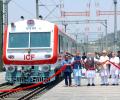
Sinha said the inauguration of the Kashmir rail service has connected the hearts of the people of Jammu and Kashmir with the rest of the country and will pave the way for the economic prosperity of the region.
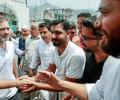
On Saturday, May 24, 2025 Rahul Gandhi -- leader of the Opposition in the Lok Sabha -- arrived in Jammu and Kashmir's Poonch district to meet the victims of Pakistan's relentless shelling last fortnight.

The process of identification of victims by matching the DNA samples is currently underway, and the bodies will be handed over to their relatives once the process is complete.

More than 118 Pakistani forward posts and their surveillance system were completely destroyed by the BSF during Operation Sindoor, dealing a major blow to the neighbouring country, Union Home Minister Amit Shah said on Friday.

There are 4,026 active cases in India and five fresh deaths have been reported in the last 24 hours.
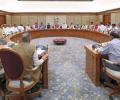
The meeting under the chairmanship of Prime Minister Narendra Modi has been convened at 11 am on Wednesday.
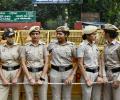
The agency seized documents like answer sheets, OMR codes, hand-written notes related to IDs and names of candidates apart from their education certificates, the sources said.

The 21-month-long Emergency also saw the government amend the Constitution several times, including to keep the elections to the offices of President, Vice President, Prime Minister and Speaker beyond the scrutiny of courts and insert the words 'socialist', 'secular' and 'integrity' in the Preamble.
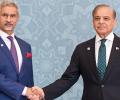
Shehbaz made the comments during a visit to the Kamra air base in the country's Punjab province where he interacted with officers and soldiers involved in the recent military confrontation with India.

The Lucknow-born Shukla, former NASA astronaut Mission Commander Peggy Whitson, Slawosz Uznanski-Wisniewski of Poland, and Tibor Kapu of Hungary are part of the Axiom-4 mission that marks the return to space for the three nations.
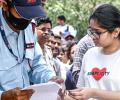
In its notice dated June 2, NBEMS said the exam, conducted for admission to MS, MD and PG diploma courses, has been postponed to arrange for additional test centres and infrastructure.
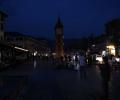
Mock drills were conducted on Saturday in states and Union territories adjoining the western border -- from Jammu and Kashmir to Gujarat -- to enhance wartime emergency preparedness and response capabilities, officials said.
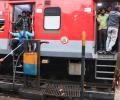
A controversy erupted after a train with dilapidated and dirty coaches was provided to ferry Border Security Force (BSF) personnel from Tripura for deployment during the Amarnath Yatra in Kashmir, with Railway Minister Ashwini Vaishnaw suspending four officials and ordering an inquiry.

According to Misri's statement, Modi said he could not accept the invitation due to a pre-existing schedule, and invited Trump to visit India for the Quad Summit, likely later this year.
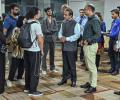
"We saw missiles in the sky and heard bombs in our neighbourhood... We were petrified," said MBBS student Mir Khalif, his voice still trembling with fear, as he stepped out of the Delhi airport after being evacuated from war-hit Iran under Operation Sindhu.
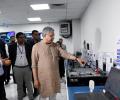
'I think that kind of change is coming. We should stay prepared for that change, whichever industry or sector we are in, we must be prepared.'
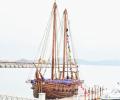
The Indian Navy has inducted a traditionally-built stitched ship, named INSV Kaundinya, at the Karwar naval base in Karnataka. The ship is a recreation of a fifth-century vessel and is named after Kaundinya, a legendary Indian mariner who sailed across the Indian Ocean to Southeast Asia. The ship is a tangible symbol of India's long-standing maritime traditions and its induction marks a culmination of a project celebrating India's rich shipbuilding heritage. The INSV Kaundinya will embark on a trans-oceanic voyage along the ancient trade route from Gujarat to Oman later this year.

Chhonzin Angmo became the first visually-impaired woman from India to plant the Tricolour on Earth's highest mountain.
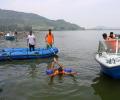
Following a directive from the Union ministry of home affairs, personnel from the Jammu and Kashmir State Disaster Response Force conducted a mock drill at the Dal Lake in Srinagar on Tuesday, May 6, 2025.
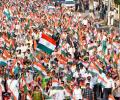
The next Census' findings will help identify the extent of India's ageing population and vulnerability levels.
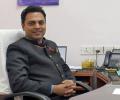
The Congress party in India has accused the government of "impropriety" in the sudden termination of KV Subramanian's position as India's executive director at the IMF, alleging it was linked to the Union Bank of India's purchase of two lakh copies of his book. The party also questioned the government's stance on Pakistan's request for a loan from the IMF.

The Supreme Court of India dismissed a plea seeking the inclusion of Vinayak Damodar Savarkar's name in the Emblems and Names (Prevention of Improper Use) Act, 1950. The petitioner, appearing in person, argued for the inclusion based on his 30 years of research and claimed a need to establish facts about Savarkar in a legally verifiable manner. However, the court found no violation of fundamental rights and suggested the petitioner make a representation to the Union of India for curriculum inclusion. This dismissal follows the court's earlier reprimand of Congress leader Rahul Gandhi for his remarks on Savarkar at a rally in Maharashtra, although criminal proceedings against Gandhi were stayed.
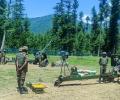
India fully utilised its military modernisation budget in 2024-2025 -- the first time in five years -- and signed a record Rs 2 trillion defence contracts.
Kerala leads with 1,147 active cases, and reconciliation of mortality figures is ongoing. Bihar is awaiting daily Covid-19 updates.
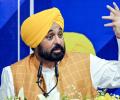
Punjab Chief Minister Bhagwant Mann took a jibe at the Bharatiya Janata Party over Operation Sindoor on Wednesday, saying this is the first time that Indian representatives have been sent abroad to convey about the country's victory in an armed conflict.
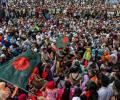
A fresh political row has erupted in West Bengal after a person allegedly involved in Bangladesh's August 2024 student protests was found listed as a voter in Kakdwip, triggering sharp Bharatiya Janata Party-Trinamool Congress exchanges over alleged illegal infiltration and manipulation of the voter list in the state.
 © 2026 Rediff.com - Investor Information - Advertise with us - Disclaimer - Privacy Policy - Sitemap - Feedback - About us - Terms of use - Grievances