
Kanwal Rekhi is a peaceful techie who ardently believes in competitive market economics and democracy, despite the trauma his family suffered during Partition and his narrow escape from violent mobs in 1984.

'We were in a heavily nuclearised environment. China had tested for Pakistan in the 1980s and helped their missile programme stay just one step behind us.'

'We kept importing educational models from outside that had no connection to our cultural and intellectual strengths.'

'Pakistan's is the only military-controlled nuclear weapons programme in the world.' 'As people get radicalised, the risk of a brigadier or pilot taking matters into their own hands is a real concern.'

Shivanand Kanavi remembers his father, the eminent Kannada poet Nadoja Chennaveera Kanavi.

'Our problem is not a budget deficit but a trust deficit. We need to trust our institutions and industries to innovate and lead. That is the way forward for India.'

'The heat shield technology for re-entry vehicles was first mastered in DRDO for the Agni missile.' 'This is why the Americans were so opposed to Agni in the 1980s, unlike other missiles -- it was a re-entry vehicle.'
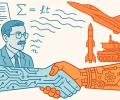
'Government officials use Gmail and ordinary phones without basic security consciousness.' 'Interoperability, especially in joint exercises with countries like the US, worries me.' 'It often means we open our systems to them, but they don't reciprocate.' 'They could have kill switches in their systems and might even be able to affect ours.'

'The Bhashini Mission has delivered a working technology at large scale, which is as good as or better than the one with MNC tech giants.'

'He asserted in his usual jovial style that he was not an MBA like his audience at IIM-Ahmedabad but perhaps had an even better business degree: MBB'. 'He went on to explain to his perplexed, blue chip B-School audience that MBB stood for "Marwadi by birth"!' Shivanand Kanavi salutes Shashi Ruia, co-founder of the Essar group who passed into the ages on November 25, 2024 in Mumbai.
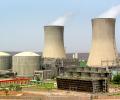
'Chinese are going bang, bang, bang building 30-35 reactors.' 'We should announce a programme of 50 new reactors and show that we mean business on the ground and not just announcements.'
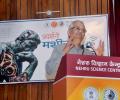
'Why should we disclose classified information to satisfy those who doubt our Hydrogen Bomb capability?'

Faqir Chand Kohli, Padma Bhushan, will be 90 on March 19, 2014. It is a day to celebrate for many Indians whose life he has touched directly or indirectly, says Shivanand Kanavi, the well-known technology journalist who as vice-president, TCS, has known Mr Kohli for two decades.
Amar Bose never grew old. He simply oozed positive energy. He visibly cringed if anybody called him an icon but used to jump up to the blackboard with a chalk and wave his hand all over if you discussed physics, recalls Shivanand Kanavi
Today we are importing over 80 per cent of our oil needs which gets refined into kerosene, LPG, petrol, diesel, fuel oil, naphtha etc hence not only all our energy needs but also fertilisers and plastics needs are susceptible to international crude prices.
After three decades of hard work, and despite the devastating tsunami of 2004, the 500 megawatt Fast Breeder Reactor at Kalpakkam is coming up at a furious pace, says Shivanand Kanavi who visited the project site recently. It also happens to be the first tsunami-ready reactor in India.
In July 2008, Shivanand Kanavi had a long conversation with strategic guru K Subrahmanyam on a variety of strategic and geo-political issues -- India's nuclear weapon programme, the India-US nuclear deal, Af-Pak, India's global ambitions...
Strategic guru K Subrahmanyam, who passed into the ages recently, discusses the history of India's nuclear weapon programme in a fascinating interview.

'In today's India very few would, of course, stand Basavanna's test. This led Professor Kalburgi to not only take on casteist and conservative forces in general, but also some powerful conservatives among Lingayats.' 'Conservatives found him polarising and some researchers disagreed with his speculations while admiring his scholarship, but he posited that culture studies and historians have to perforce join the dots, speculate, interpret, interpolate, extrapolate and take leaps to make progress even if some of them later turn out to be wrong.' Shivanand Kanavi salutes Professor M M Kalburgi, the scholar who was assassinated in Dharwad on Sunday, August 30.

'When resources are few; when frugality demands repairing a broken thing rather than replacing it with a brand new and expensive option, enterprising commoners in rural and urban India improvise on a daily basis and solve their problems with whatever they have,' observes Shivanand Kanavi.

How Narinder Kapany, the Father of Fibre Optics, joins a very long list of Indians who, though richly deserving of the Nobel Prize, have been mysteriously passed over by the Royal Swedish Academy of Sciences.

'James Crabtree ignores the emergence of a nexus between business and politics going back to the 1920s and talks of it as a new child of 21st century India,' says Shivanand Kanavi.
Dr Kakodkar's strategic stubbornness ultimately got India what it wanted though the negotiations with the US went to the wire, notes Shivanand Kanavi.

She was a Hollywood star, much sought after. She also helped invented technology which changed the world.

Combining affordable IT with native Indian ingenuity and entrepreneurship F C Kohli believed would enable Indian small businesses match anyone and thrive.
'The goal seems to be that we do not invest further in our system to make our system more accurate and more reliable or more global in reach,' an ISRO source tells Shivanand Kanavi.

One should appreciate the sagacity and audacity of JRD and Nani Palkhivala in founding TCS on April 1, 1968. At that time there was no Microsoft or Intel, SAP or Accenture, much less Google.
They needed a person who could build and execute their vision: A frontiersman; a problem solver and an institution builder. It was their and India's good fortune that Faqir Chand Kohli more than measured up to their requirements and indeed laid the foundation to take TCS to unimaginable heights and to the giant success that it is today. Shivanand Kanavi salutes the incomparable F C Kohli, who passed into the ages last week.

'It looked as if India had been a major player in science at that time, raising the question when and why things changed,' says distinguished aerospace scientist Professor Roddam Narasimha.

'Some Indians take the extreme view that everything was known to our ancients, but others go to the opposite extreme and consider everything Indian was superstition and rubbish.' 'Indian science was perhaps more rational than the European science of the time.'

'Temperature and wind can be predicted more easily than rainfall.' 'Rainfall, as common experience suggests, is very spotty.' 'The last bit of physics required that tells us whether it is going to rain or not is very hard.' Professor Roddam Narasimha, the eminent scientist, explains the monsoon, climate change and global warming, in a fascinating conversation with Shivanand Kanavi.

50 years ago, on April 1, 1968, Tata Consultancy Services -- now India's leading IT company -- was born. The foundation for TCS was laid by Faqir Chand Kohli whose life touched directly or indirectly many, many, Indians, says Shivanand Kanavi.

'Any new technology, either before or soon after its release, will face severe criticism by one or the other segment of society. It is only after seeing the benefits of new technology for themselves that our farmers accept it.' 'The arable land in India is not increasing and currently hovers at around 140, 145 million hectares.' 'Today, Indian agriculture has to work towards achieving nutritional security.'

'If not, we can become frighteningly chaotic, more chaotic than what we are today.' 'In today's environment in the country, we still have a window of opportunity.'

Blue light-emitting diodes help create the glowing screens of mobile phones, computers and TVs and promises to revolutionise the way the world lights its homes and offices.

'We are looking at a joint venture between ISRO and a few companies to assemble the PSLV and launch it from Sriharikota.' 'In a month or two, the vehicle assembly building will be ready.' 'After that, we could see 13, 14 launches a year.'

'No PM has said no to anything we have proposed. I am not a politician and I cannot give speeches about things, but a lot of good things have been done in science by previous governments.' 'Under Dr Manmohan Singh, we could do a few important things. I used to meet him once in 6, 8 weeks. He often said, 'Professor Rao, you assume that you have my approval and carry on.' He was shy and decent. He is a real gentleman.' 'Science keeps me going at 80. I feel young.' Professor C N R Rao, the eminent scientist who was honoured with the Bharat Ratna, on the state of science in India.

U R Ananthamurthy was one among the most creative triumvirate of Modernist Kannada literature of the late sixties and seventies (the other two being the late P Lankesh and K Poornachandra Tejaswi). He will be missed by all who care to step out and fight for justice and human rights of ordinary people in India despite being surrounded by the consumerist fog, says Shivanand Kanavi.
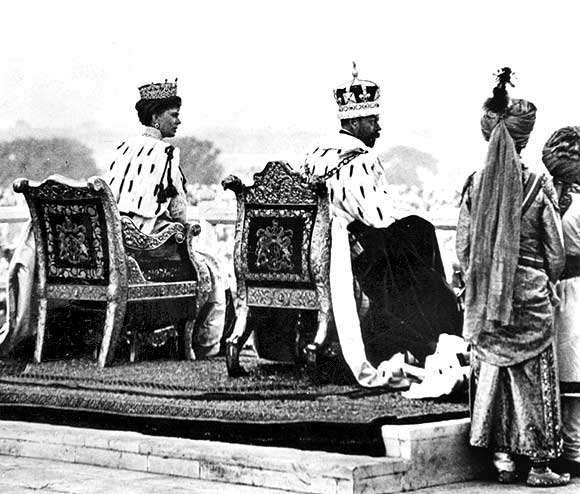
'I would recommend every young Indian reads Shashi Tharoor's book to get a perspective of our colonial past in the present day mesmerising euphoria of the global village in spite of Donald Trump, says Shivanand Kanavi.

While chips have become ubiquitous, Moore's Law has remained a self-fulfilling prophecy even half a century later. Not bad for an industry where the time scale is not measured in decades and centuries, but in annual quarters, says Shivanand Kanavi.

20 years ago this day, May 11, 1998, India conducted its second nuclear test at Pokharan in Rajasthan. In a fascinating interview on Rediff.com, K Subrahmanyam revealed how Indian PMs reacted to nuclear ambitions.
