A street vendor in Bihar's Nawada district died after a group of youth tortured him for hours because he was Muslim.

In the recent Bangladesh elections, four minority candidates, including two Hindus, secured parliamentary seats, highlighting the evolving political landscape and representation of minority communities within the BNP's victory.

'Kashmir needs to be divided and we need the land of Panun Kashmir in Kashmir.'

Kis Kisko Pyaar Karoon 2 may be a comedy filled with chaos, but in its indirect way, it speaks about a time when the Constitution mattered more than one's religion and when the idea of India was larger than personal hate, observes Syed Firdaus Ashraf.

After taking a dig at former India skipper Rohit Sharma on his fitness, Congress leader Shama Mohamed, on Wednesday, again sparked controversy, drawing a religious angle to cricketer Sarfaraz Khan's omission from the India and India A squads announced recently by the Board of Control for Cricket in India (BCCI).
'Rather than deploying Pakistani nationals or using identifiable cross-border materials, the ISI sought to radicalise and recruit local Indian youth, including well-educated professionals such as doctors.'

The Supreme Court delivered a split verdict on a plea by the Maharashtra government seeking a review of the court's earlier direction to form a special investigation team (SIT) with Hindu and Muslim officers to investigate the 2023 Akola communal riots. Justice Sanjay Kumar refused to review the direction, while Justice Satish Chandra Sharma agreed to hear the review plea in open court.

'His campaign reached into every community, every constituency, with a unifying platform of affordability.' 'Zohran began by listening to Trump supporters and brought many of them to his side because they too care about affordability.' 'Care for the poor is a tenet of every faith; this is the best platform to unite us.'
'Sometimes it might look wrong in the fans' eyes, but please don't twist things or create narratives that aren't even close to the truth.'
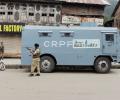
In a major breakthrough, the National Investigation Agency (NIA) has arrested two men for harbouring the terrorists who had carried out the Pahalgam terror attack that left 26 people dead, the agency said on Sunday.
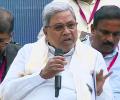
Karnataka Chief Minister Siddaramaiah condemned the alleged poisoning of drinking water at a government school in Belagavi district, reportedly to force the transfer of a Muslim headmaster. He termed it a 'heinous act' driven by religious hatred and fundamentalism.
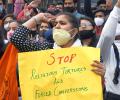
The Supreme Court has sought the Uttar Pradesh government's response on a plea challenging certain provisions of the 2024 amended UP law on unlawful religious conversion, citing concerns about free speech and religious propagation.

The National Investigation Agency (NIA) on Monday said that it has gathered a substantial body of evidence regarding identities of the terrorists involved in Pahalgam terror attack.
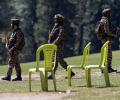
The officials said that intelligence agencies had been alerted about the possibility of a terror attack, but the inputs were utilised at another place, some 90 kilometres away from the site where the attack took place, resulting in a key security lapse.

Quraishi asserted that India has, is and will always stand up and fight for its constitutional institutions and principles.

The incident has brought back into focus the controversy that erupted last year when BJP-led governments in Uttar Pradesh and Uttarakhand directed food outlets along the Kanwar route to display the names of their owners and staff.

The highlight of Tuesday's debate on Operation Sindoor was the speech by Prime Minister Narendra Modi, with the rebuttal by Congress's Wayanad MP Priyanka Gandhi coming a close second.
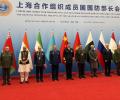
In his address, Singh said there should be "no double standards" in combating terrorism and urged the SCO member nations to condemn the menace with unity.
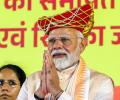
"In Pahalgam, terrorists not only shed the blood of Indians, but also attacked our culture. They tried to divide our society and the biggest thing is that the terrorists have challenged the women power of India," Modi said.
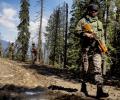
'The terrorists included underage boys around 15 years old. There were at least four of them. They were taking selfies during the attack and had cameras mounted on their heads'
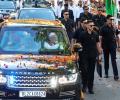
'It is important India to stay focussed on its primary national objectives: Combating terrorism; not losing sight of other security and strategic concerns (on the Sino-Indian front for instance); ensuring a strong economy and registering growth which includes improving the lot of common people; and finally making certain that the social fabric remains intact and harmony among people is not jeopardised, at least any further,' asserts Nilanjan Mukhopadhyay.
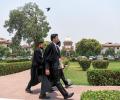
The Supreme Court of India has reserved its interim orders on three key issues related to the Waqf (Amendment) Act, 2025, including the power to denotify waqf properties, the composition of waqf boards, and the provision regarding government land. The court heard arguments from both the petitioners, who challenged the validity of the amended law, and the Centre, which defended the Act as a secular concept. The petitioners sought interim orders to prevent the implementation of certain provisions while the court considers the legal challenges.

Hurriyat Conference chief Mirwaiz Umar Farooq condemned the Pahalgam attack, calling it an "act beyond belief" and "totally unacceptable." He also called for unity and condemned the communal narrative surrounding the incident, urging the government to allow him to visit the injured and offer condolences to the families affected.
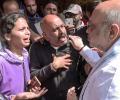
Sushil Nathaniel, an LIC manager from Indore, was shot dead by terrorists in Pahalgam, Kashmir, after being forced to recite the 'Kalma'. His family has demanded the harshest punishment for the assailants. Nathaniel, who was on a family trip to celebrate Easter, was among 26 people killed in the attack. His daughter was injured in the attack, while his wife and son survived.
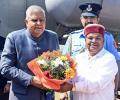
Karnataka Governor Thaawarchand Gehlot has reserved the Bill pertaining to four percent reservation for Muslims in government contracts for the President's assent, citing constitutional concerns. The Bill, which has been a subject of controversy in Karnataka, was passed by both houses of the state legislature amid protests from the opposition BJP. The Governor's decision to reserve the Bill highlights the ongoing debate over the constitutionality of religious-based reservations in India.

A Pune-based woman, whose husband was killed by terrorists in Pahalgam, recounted how she and other women in the group quickly removed bindis from their foreheads and began chanting "Allahu Akbar" when they saw the attackers asking men to recite 'azaan'. But the frantic attempts to hide their religious identity failed to help as the gun-wielding terrorists did not spare the woman's husband and his friend, who was also from Pune. Sangita Ganbote, the wife of Kaustubh Ganbote who was among the 26 persons killed by terrorists at Baisaran near Pahalgam, also said that when a local Muslim man confronted the attackers and asked why they were killing innocent people, they stripped him and shot him dead.
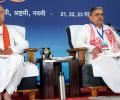
RSS General Secretary Dattatreya Hosabale has criticized the Karnataka government's decision to provide four per cent reservation for Muslims in government contracts, stating that the Constitution does not allow religion-based quotas. He also said that such reservations go against the wishes of B R Ambedkar, the architect of the Indian Constitution. He also spoke about the controversy over Mughal emperor Aurangzeb's grave in Maharashtra, stating that people who went against the ethos of India were made icons. Hosabale lauded figures like Rajput king Maharana Pratap for resisting Mughal emperor Akbar and said those who resisted invaders were also "freedom fighters". He also spoke about the RSS's idea of 'One Nation, One Culture', stating that it draws inspiration from India's rich cultural heritage and ethos.
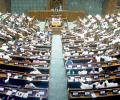
Introducing the bill, Rijiju said the consultation process of the Joint Parliamentary Committee (JPC) was the largest ever exercise carried out by a parliamentary panel in India's democratic history.
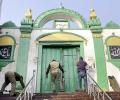
The latest issue of "Organiser", an RSS-linked magazine, has argued that the ongoing dispute over the Shri Harihar Mandir in Sambhal, Uttar Pradesh, is not about religious supremacy but about seeking "civilisational justice" by uncovering historical truth. The editorial, penned by Prafulla Ketkar, editor of "Organiser", contends that the debate should not be limited to a Hindu-Muslim perspective but should encompass a wider discussion on historical truths and social justice. The magazine further criticizes the Congress's handling of caste and religious issues, accusing it of whitewashing historical injustices and promoting a false narrative about Mughal rulers.

The Delhi assembly results have underscored that a section of Arvind Kejriwal's committed supporters abandoned him because they were let down by his refusal to take a stand on crucial issues that impinge on the security and Constitutionally enshrined rights of the people, notes Nilanjan Mukhopadhyay.
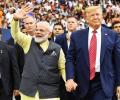
After being sworn in as the 47th president of the United States, Trump started his inaugural address with a sentence that echoed Modi's coinage some years ago, notes Modi biographer Nilanjan Mukhopadhyay.

A bench of Justices Sanjiv Khanna and Sanjay Kumar issued notice to the Chembur Trombay Education Society, which runs the 'N G Acharya and D K Marathe College', and sought its response by November 18.

All We Imagine As Light remains heart-warmingly affecting because you know experiences like this are few and far between. Payal Kapadia's film-making voice must be cherished, asserts Mayur Sanap.

The police condemned the unprovoked, unacceptable attack on an individual's religious identity and added that stern legal action is being initiated.
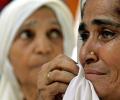
As a consequence of prominence given to the brutality during those few days, a very important aspect of that episode got almost glossed over. This was the intervention by a very significant section of people who restored faith in humanity, and conveyed the message that only a small section of Indians, that too politically backed, were consumed by anti-Sikh majoritarianism. The overlooked facet of the events of 1984 was the story of significant sections of the city's populace, public figures and nondescript ones, stepping out hand-in-hand, to first stand with little but bravery in hands, in the way of attackers, and thereafter to provide immediate relief to those who lives were uprooted and who lost family members in the violence, recalls Nilanjan Mukhopadhyay.

From the time he first rose to prominence during the movement against the then UPA government, Arvind Kejriwal has regularly grabbed headlines for his surprise moves and decisions. Here are 10 such instances.

Modi can abandon the path of Hindutva only at risk to his position within his own fraternity. But if he pursues a hard line, he faces the risk of being hauled up by his coalition-partners. For the first time in a decade, Modi is not in enviable situation, observes Nilanjan Mukhopadhyay.

'There might be some internal tussles that can be expected between any two persons in any party.' 'But I do not see any tussle which might weaken the possibility of dictatorship.'
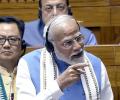
Modi's inability to make peace with a renewed Opposition will only embolden his coalition partners and it is just a matter of time before they begin asking probing questions besides politely disagreeing with his tactics, predicts Nilanjan Mukhopadhyay.
 © 2026 Rediff.com - Investor Information - Advertise with us - Disclaimer - Privacy Policy - Sitemap - Feedback - About us - Terms of use - Grievances