
Bessent indicated that the U.S. is evaluating the status of Iranian oil as the current campaign progresses.

Whether Trump will actually press ahead with the oil sanctions remains unclear, since keeping Russian oil out of the world market risks high oil prices which could boomerang on the US economy and be damaging politically for Trump, points out Ambassador M K Bhadrakumar.

The United States has announced new sanctions targeting Iran's 'shadow oil economy,' accusing Tehran of using illicit oil revenues to fund the Islamic Revolutionary Guard Corps (IRGC) and its regional activities.

In a major shift in Middle Eastern energy and security dynamics, the US Department of the Treasury on Monday issued a temporary 60-day general licence authorising transactions related to the production, delivery, and sale of Iranian crude oil, petrochemicals, and petroleum products.

US Secretary of State Marco Rubio on Tuesday said the United States would prefer to end its extension of waivers on Russian oil "as soon as possible", while noting that such decisions ultimately rest with the US Treasury Department.

India's crude oil imports from Russia reached a record high of approximately 2.73 million barrels per day (mbpd) in June, driven by discounts of $2-5 a barrel. This surge comes as the West Asia crisis disrupted supplies from traditional sources and China reduced its own purchases, leading Russia to offer more favourable terms to India.

India bought 1.87 million barrels of Russian oil per day in May so far, meeting approximately 40 per cent of its oil imports.

In a statement issued by Iran's consulate in Mumbai, it said, "At present, Iran essentially has no floating crude or surplus available for international markets. The US Treasury Secretary's remarks appear aimed at reassuring buyers and managing market sentiment."

The United States and Iran have reached an agreement in principle to immediately and permanently halt all military operations, lift sanctions, and work towards a comprehensive final agreement within 60 days, including a significant reconstruction package for Iran.

India will continue to purchase Russian oil based on commercial viability and energy security needs, irrespective of US sanctions waivers, according to a senior petroleum ministry official.
The United States has extended a waiver from sanctions on Russian oil already at sea by one month, according to an official statement from the US Department of the Treasury.

The US has seized an oil tanker, 'Skywave', linked to Iran in the Indian Ocean, as part of efforts to disrupt Iran's oil shipments and enforce sanctions. The vessel was part of a network transporting sanctioned Iranian crude oil, with the seizure occurring amid heightened tensions between Washington and Tehran.

The United States has temporarily lifted sanctions on the sale of Iranian oil already in transit to ease soaring global crude prices, making 140 million barrels available to the market.
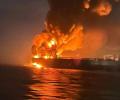
An oil tanker carrying 24 Indian seafarers reported a fire off the coast of Oman, with all crew members confirmed safe. The incident occurred amidst renewed hostilities between Israel and Iran, who exchanged attacks on petrochemical facilities.

India significantly increased its crude oil imports from Russia and the United Arab Emirates in June, securing supplies as the Strait of Hormuz began to reopen, with Russian barrels remaining attractive due to discounts and UAE supplies offsetting earlier uncertainties.

Formerly Iran's second-largest oil customer, Indian financial institutions were forced to withhold crude oil payments following the 2018 US sanctions.

The United States has announced it will not renew sanctions exemptions for the purchase of Russian and Iranian oil, ending a 30-day waiver that allowed some countries, including India, to continue importing Russian oil despite sanctions related to the Ukraine war.

The United States has extended a waiver from sanctions to allow countries to buy petroleum products from Russia by a month, days after it ruled out renewal of the special measure.

Indian refiners have access to only limited Iranian volumes compared with Russian oil, and even the barrels on offer come with 'too many hassles'.

British armed forces, including Royal Marine Commandos, intercepted the Russian shadow fleet oil tanker SMYRTOS in the English Channel, marking the UK's first such operation. The action aims to disrupt Russia's funding for its war in Ukraine, with the UK government highlighting the shadow fleet's role in sustaining Moscow's military efforts.

A US-sanctioned tanker carrying Iranian crude oil is heading to India, marking the resumption of oil imports from Iran after seven years.

External Affairs Minister S Jaishankar has strongly defended India's decision to purchase Russian crude oil, stating that the country's energy choices are based on cost and availability, and highlighting the West's 'hypocrisy' in criticising India while historically supplying weapons used against it.

A US-sanctioned tanker carrying Iranian crude oil has rerouted mid-voyage from its previously indicated destination of India to China, raising questions about payment issues and the future of India's Iranian oil imports.

India has refuted claims of payment issues hindering crude oil imports from Iran, clarifying that refiners have the flexibility to source oil from various global suppliers. The Ministry of Petroleum and Natural Gas addressed reports of a tanker rerouting to China, emphasising standard industry practices and secured oil requirements.

Sanctioning Russian oil would have led to a sharp surge in oil prices to above $80 per barrel levels, which would impact pump prices in the US ahead of midterm elections next year.

United States President Donald Trump and Iranian President Masoud Pezeshkian have virtually signed a 14-point memorandum of understanding (MoU) to end hostilities, reopen the Strait of Hormuz, and begin a 60-day negotiation process on sanctions and Iran's nuclear programme.

Iran has dismissed US President Donald Trump's assertion that Iran was responsible for a drone attack on Indian ships in the Strait of Hormuz as 'simply baseless'. The Iranian embassy stated that Trump's comments were an attempt to deflect attention from recent US military strikes on merchant vessels in the Gulf of Oman, which resulted in the deaths of three Indian mariners.
A senior government official asserts India's independence in purchasing Russian oil, stating that US sanctions waivers merely remove friction but do not dictate India's energy policy. The official highlights India's commitment to energy security and affordability for its citizens.
Indian refiners are recalibrating their crude sourcing strategy due to supply disruptions in West Asia, leading to Venezuela and Brazil emerging as top five suppliers in April, replacing traditional sources like Iraq and the United States.

India has summoned the US charge d'affaires for the second time this week to protest American Navy strikes on three commercial vessels off the coast of Oman, which resulted in the deaths of three Indian crew members. New Delhi has demanded an end to these attacks, acknowledging that the US Navy targeted the ships, some of which were reportedly non-compliant with US sanctions.

'Every year we import approximately $70 billion worth of gold -- closer to $72 billion in 2025-2026, an all-time record.' 'There is no parallel for this anywhere in the world. And this love for gold will not disappear overnight.'
The US Department of the Treasury on Wednesday imposed sanctions on Russia's two largest oil companies, Rosneft and Lukoil, in an effort to pressure the Kremlin to end its war in Ukraine.
US sanctions against two of Russia's largest oil companies are expected to impact Reliance Industries' crude imports from Russia, while state-run refiners may continue purchases through intermediary traders for now.

India's largest private refiner, Reliance Industries Ltd, successfully navigated a volatile energy market in the last quarter of FY26 by diversifying crude sourcing and demonstrating operational agility, particularly in response to geopolitical disruptions and cost fluctuations.

Venezuela's Interim President Delcy Rodriguez is in New Delhi on her sixth visit to India.

India has expressed 'deep worry' and strongly protested to the US after three merchant ships carrying Indian crew members came under attack from the American military off the coast of Oman in four days, resulting in the deaths of three Indian seafarers.

The US has threatened to prosecute those buying or selling sanctioned Iranian oil and has announced a blockade of the Strait of Hormuz after peace talks failed.

Iran has put forward a comprehensive 10-point framework that it says forms the basis of a complete resolution.

The US Central Command (CENTCOM) confirmed striking the Guinea-Bissau-flagged oil tanker MT Jalveer, carrying 20 Indian seafarers, in the Gulf of Oman for allegedly violating the US blockade against Iran. This incident marks the third commercial vessel attacked by US forces in the region this week, with three Indian seafarers previously losing their lives in an attack on the MT Settebello.

Reliance Industries Ltd, India's largest buyer of Russian oil and most impacted by the latest US sanctions, on Friday said it will comply with all applicable restrictions and will adjust its refinery operations to meet compliance requirements.
