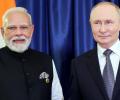
The Russian cabinet has cleared the signing of a memorandum of understanding (MoU) to deepen bilateral cooperation with India in civil nuclear energy during President Vladimir Putin's visit to the country.

Researchers at IIT Guwahati have developed a method to enhance cement mortar, making it stronger, more durable, and capable of blocking harmful radiation, with the goal of improving the safety of nuclear facilities.

India and Canada solidify their partnership with a landmark uranium supply agreement and discussions to finalise a comprehensive economic partnership, signaling stronger ties and cooperation on key global issues.
Prime Minister Narendra Modi urged industry and start-ups to focus on quality and make excellence a benchmark in manufacturing. He also lauded the start-up ecosystem and greeted the nation on National Voters Day and Republic Day.

India and Israel have elevated their relationship to a special strategic partnership, focusing on enhanced cooperation in trade, technology, and defense, while also addressing regional peace initiatives.

External Affairs Minister S Jaishankar and US Secretary of State Marco Rubio discussed cooperation in trade, critical minerals, nuclear energy, and defence, reaffirming commitment to a free and open Indo-Pacific.

India and Canada are negotiating a long-term uranium supply agreement worth $2.8 billion. They are also exploring expanded civil nuclear cooperation after the passage of the SHANTI Bill.

India's nuclear energy share in total installed capacity remains limited, fluctuating between 1.9 per cent and 2.9 per cent from FY10 to FY24.

The operator's liability in the case of an incident is limited to 3,000 crore for reactors with thermal power above 3,600 Megawatt; 1,500 crore for reactors with thermal power between 1,500 Mw and 3,600 Mw; 750 crore for reactors with thermal power between 750 Mw and 1,500 Mw; 300 crore for reactors with thermal power between 150 Mw and 750 Mw; and 100 crore for reactors having thermal power up to 150 Mw, fuel cycle facilities other than spent fuel reprocessing plants and transportation of nuclear materials.

A nationwide strike called by central trade unions saw a mixed response across India, impacting various sectors and states differently, with some areas experiencing disruptions while others remained largely unaffected.

Sustaining 8 per cent-plus growth rates is necessary if we are to reach high-income status by 2047, points out Amitabh Kant.

Prime Minister Narendra Modi stayed calm, avoided public confrontation, and focused on India's long-term interests to steady ties with the United States.
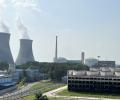
Government sources said amendments were being considered to the Atomic Energy Act to allow private sector participation and the Civil Liability for Nuclear Damage Act to limit the liability on suppliers of equipment to build atomic energy plants.
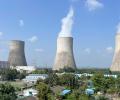
The Bill is likely to pave the way for amending two existing legislations -- the Atomic Energy Act 1962, and the Civil Liability for Nuclear Damage Act 2010.

The Indian government has introduced a bill to overhaul the civil nuclear sector, allowing private participation and establishing a new liability regime. The SHANTI Bill, 2025, aims to repeal existing acts and address industry concerns.

Over the years, India-EU ties have grown, and covered trade, investment, climate change, science and technology, space, digital, mobility, and connectivity.

Construction major L&T is gearing up to expand its footprint in the global nuclear supply chain, a senior company official has said, while calling for amendments to key legislations on the domestic front to pave the way for the entry of private players and foreign capital necessary for capacity enhancement.

India and Russia are expected to unveil a major nuclear energy partnership during Vladimir Putin's visit, potentially involving Russian small modular reactors and expanded cooperation as India pushes toward its 100-GW nuclear goal by 2047.

The power sector presents a puzzle. A fast-growing economy should be aligned to higher power demand but that hasn't been the case in the financial year 2026 till date (FY26TD).
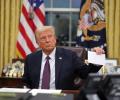
US President Donald Trump signed the National Defence Authorisation Act for Fiscal Year 2026 into law, highlighting broadened engagement with India and addressing the challenge posed by China in the Indo-Pacific region.

Officials said the government is keen to conform to the convention of the Union Budget for 2026-2027 being presented on February 1 despite it falling on a Sunday in 2026.
Russia has offered India cooperation in localising large and small nuclear power plants as part of a civil nuclear energy collaboration between the two countries. The offer was made during a meeting at the IAEA General Conference in Vienna.

Russian President Vladimir Putin will make a two-day visit to India from December 4 to hold annual summit talks with Prime Minister Narendra Modi that is expected to produce a plethora of significant outcomes, including in the defence sphere, to further solidify the bilateral strategic ties.
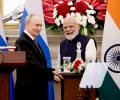
India and Russia have solidified a five-year plan to enhance their economic and trade partnership, while also addressing the ongoing conflict in Ukraine and the threat of terrorism.

The Russians have termed Putin's visit to India, his first to this country since the outbreak of the Russia-Ukraine war, as 'Druzhba Dosti', which means 'friendship' in Russian and Hindi respectively.

Fuel loading at India's first prototype fast-breeder reactor in Kalpakkam is expected to start next week, marking a significant step in the country's nuclear program.

On the table are additional batches of S-400 surface-to-air missile systems from Russia, which India used with immense success during Operation Sindoor. India could buy at least two squadrons of Su-57 fighter jets plus joint production of S-500 air defence systems.

The enduring relationship between the two countries have survived the disintegration of the erstwhile USSR in 1991, the end of the Cold War and the regime change in both countries, points out Rup Narayan Das.
High energy costs, long a drag on India's manufacturing competitiveness, are finally easing. Power and fuel expenses accounted for 1.98 per cent of net sales in 2024-25, the lowest level in data compiled by the Centre for Monitoring Indian Economy (CMIE) over the past two decades.

With the regulatory approval from the US Department of Energy in its kitty, Indian multinational conglomerate L&T is planning to focus on manufacturing small modular reactors (SMRs) to play a leading role in the commercialisation of nuclear energy in India.

'Crude oil prices are around $66-67 per barrel now but could fall to $55-60 if global disturbances ease.'

Prime Minister Narendra Modi condemned the violation of Qatar's sovereignty following Israeli air strikes on Doha, targeting Hamas leaders. He conveyed India's deep concern to the Emir of Qatar and reiterated support for peace and stability in the region.

Addressing the nation on 79th Independence Day, Modi said the time has come to undertake reforms in GST as the indirect tax regime has completed 8 years.
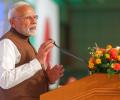
Showcasing India as an attractive investment destination, Modi said the country has political and economic stability as well as transparency and predictability in policy decisions.
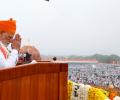
Prime Minister Narendra Modi addressed the nation on Independence Day, focusing on economic growth, self-reliance, and national security. He emphasized manufacturing quality products at affordable prices, supporting farmers, and combating terrorism and infiltration.
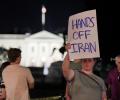
Following attacks on Iranian nuclear sites, including Fordow, Isfahan, and Natanz, the Atomic Energy Organisation of Iran (AEOI) has stated that the attacks are a violation of international law and that Iran's nuclear industry will continue its development.
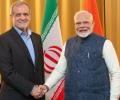
'Within minutes, my mobile began ringing. It was National Security Adviser Brajesh Mishra, asking why the Iranians were complaining.' 'I explained that we had only restated our position in the light of the conclusion reached by the IAEA, but will remain helpful to Iran to reach a consensus.' 'Then came a call from Foreign Secretary Kamal Sibal, repeating what Mishra said about the Iranian complaint.' 'I was very impressed that Iran was able to reach two top officials in India to intervene at short notice,' recalls Ambassador T P Sreenivasan.
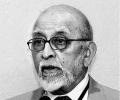
M R Srinivasan focused on the peaceful use of nuclear power at a time when the popular view among the 'hawks' was that India should build a nuclear arsenal as a deterrent.
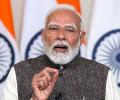
India on Saturday announced plans to amend its nuclear liability law and set up a nuclear energy mission, a move that came ahead of Prime Minister Narendra Modi's likely visit to the United States.
Ushering in reforms, Union Finance Minister Nirmala Sitharaman on Saturday proposed to open up the nuclear power sector for private players and announced a Rs 20,000 crore Nuclear Energy Mission for research in the field, with an aim to set up five small and modular reactors by 2033.
 © 2026 Rediff.com - Investor Information - Advertise with us - Disclaimer - Privacy Policy - Sitemap - Feedback - About us - Terms of use - Grievances