
The formulations in the declaration in reference to terrorism is going to be to our "satisfaction", Dammu Ravi, secretary (economic relations) in the external affairs ministry said on Monday.

Whether the ambitious targets are achievable is a moot question as India's earlier target was 20,000 MW of nuclear power by 2020.
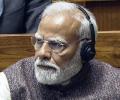
Prime Minister Narendra Modi has lauded the Union Budget as a "people's budget" that fulfills the dreams of every Indian and said that it is a "force-multiplier" that will boost consumption, investment and growth. He highlighted a host of measures for different sectors, including welfare initiatives for gig workers, tax relief for the middle class, and support for the manufacturing sector.

Even as the Indo-US nuclear deal is gathering dust on the backburner because of stiff opposition from the Left parties, Congress president and chairperson of United Progressive Alliance Sonia Gandhi on Friday underlined the importance of nuclear energy for the country at this juncture.
In spite of increasing opposition from the Left Front to the India-United States nuclear agreement, Prime Minister Manmohan Singh on Monday said that his government is committed to developing nuclear energy as a clean source of electricity."Our government is committed to developing nuclear energy as a clean source of electricity," Singh said after laying the foundation stone of the 1500 MW Pragati Phase three-gas power project at Bawana.
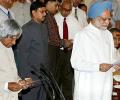
The landmark India-US civil nuclear deal of 2008, brokered during Manmohan Singh's tenure as Prime Minister, is seen as a crowning achievement in his foreign policy legacy. The agreement ended India's nuclear isolation, fostered a strategic partnership with the US, and opened doors to advanced technologies and defense cooperation. This historic deal also laid the groundwork for India's engagement with the global nuclear community.

The agreement provides for extensive cooperation in the civil nuclear energy sector including in research and development for peaceful uses of nuclear energy, they said.
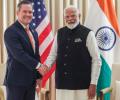
Prime Minister Narendra Modi said he had a 'fruitful meeting' with United States National Security Advisor Michael Waltz and they discussed defence, technology and security areas, which are important aspects of the India-US ties.

'It is typical of China's strategic deception of making virtue out of necessity,' observes Rup Narayan Das.
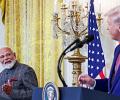
Prime Minister Narendra Modi and US President Donald Trump have vowed to move forward with plans to work together to build US-designed nuclear reactors in India. The decision was made during their meeting at the White House, where they also agreed to significantly expand energy cooperation. The move comes after India announced plans to amend its nuclear liability law and the Atomic Energy Act, which had previously been obstacles to the implementation of the US-India civil nuclear deal.
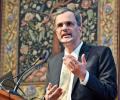
There is a "misperception" among the administration around deregulation, wherein digitisation is confused with deregulation, Chief Economic Advisor V Anantha Nageswaran said on Tuesday. Speaking at an event organised by alternative investment industry's lobby grouping IVCA in Mumbai, Nageswaran stressed that what is essential is to do away with needless regulations, whether they are to be complied with online or offline.
Proposals are being worked upon at the Copenhagen summit to cut the greenhouse gas emissions in the atmosphere, prominent among which is the use of nuclear energy.

The Reserve Bank should focus on making liquidity easier rather than cutting rates if the intent is to drive growth, Axis Bank's chief economist Neelkanth Mishra said on Tuesday. Mishra, who is also a part-time member of the Economic Advisory Council to the PM, said the rate cut announced earlier this month or even the subsequent ones if they were to come will not end up increasing borrowings as the scarce liquidity will hamper transmission.
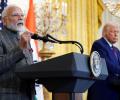
Prime Minister Narendra Modi said on Thursday that India and the United States have set a $500 billion target for bilateral trade by 2030 and added that the teams of two nations will work together to finalise a mutually beneficial trade agreement.
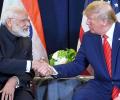
It would be the prime minister's first bilateral visit to the US after Trump became president for a second term.

'He was deeply committed to nurturing young talent and encouraging interdisciplinary collaboration.'
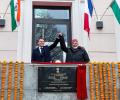
Prime Minister Narendra Modi and French President Emmanuel Macron have called for enhancing trade and investment ties between their countries and committed to further deepening their engagement in the Indo-Pacific. They discussed a full spectrum of bilateral relations, including key global and regional issues, and stressed the urgent need for reform in the United Nations Security Council. The leaders also underscored their commitment to ensuring the global AI sector can drive positive social, economic, and environmental outcomes.
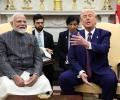
'Trump administration wanted a positive tone at this summit, but there was still some anxiety that there could be some awkward moments -- and there were not.'
Had it not been for the global concern with respect to 'climate change', the nuclear states with a large stockpile of weapons would not have allowed other countries to adopt nuclear energy, said Dr Anil Kakodkar, member of the Atomic Energy Commission.
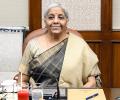
While the capital spending is being maintained at 3.1 per cent of the GDP, a little more would have boosted economic growth even further, suggests Rajiv Memani.
The chairman of India's Atomic Energy Commission makes a case for nuclear energy saying all other forms of power gerenration will not be able to meet the country's staggering demand.
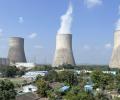
In a significant move, the United States on Wednesday removed restrictions on three Indian nuclear entities, over a week after National Security Advisor Jake Sullivan announced that Washington was finalising steps to 'remove' hurdles for civil nuclear partnership between Indian and American firms.
India on Thursday said it will scale up nuclear energy production to 60,000 megawatts by 2030 after signing the pending N-deals with more countries.

Budget 2025 lays down a transformational roadmap for India's digital and economic future, focusing on AI-driven enterprise modernisation, workforce skilling, and sustainable innovation. With bold investments in AI, digital infrastructure, and ease of doing business, the government has set the stage for businesses to scale, innovate and compete on a global level.

These are the highlights of the Union Budget 2025-26 presented by Finance Minister Nirmala Sitharaman in Parliament on Saturday.
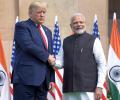
Prime Minister Narendra Modi will pay a two-day working visit to the US from February 12 during which he will meet President Donald Trump, the external affairs ministry announced. The visit will give further impetus and direction to India-US bilateral relationship. Prior to his US visit, Modi will be in France from February 10-12 to co-chair the AI Action Summit with French President Emmanuel Macron. He will also visit Cadarache, the site of the International Thermonuclear Experimental Reactor of which India is a partner. During his visit to France from February 10-12, Modi and Macron will also address the India-France CEOs forum. The prime minister and Macron will travel to Marseille where they will inaugurate the Consulate General of India. The leaders will also visit the war cemetery and pay tribute to the sacrifices made by Indian soldiers in World War 1. Modi and Macron will visit Cadarache, the site of the International Thermonuclear Experimental Reactor (ITER). There has been a very close rapport between Trump and Modi, dating back to the US leader's first term. There is a clear convergence of interests between the two countries in several areas, including trade, investment, technology, defense cooperation, counterterrorism, Indo-Pacific security, and people-to-people relations.

"The new structure will substantially reduce taxes on the middle class and leave more money in their hands, boosting household consumption, savings and investment," Sitharaman said presenting what was dubbed as 'reformist' budget for the next fiscal in Lok Sabha.
India will be identifying and separating its civilian and military nuclear facilities and programmes in a phased manner.
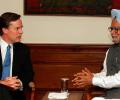
The India-US nuclear deal was aimed at ending India's nuclear isolation and nuclear apartheid, recalls Rup Narayan Das.

The Indian government has come out with a nice name for its tried and tested 220MW pressurised heavy water reactor -- Bharat Small Reactor.
Within days of India approaching International Atomic Energy Agency for country-specific safeguards for nuclear power plants, the ministry issued advertisements in newspapers explaining what the uranium extracted energy can do to the nation's energy security. Energy-hungry India has a huge unmet power demand and the heavily subsidised diesel is being used as fuel to generate electricity.

If it was Andhra Pradesh last Budget, it's poll-bound Bihar that has now turned to Centre with a list of demands. How the NDA government is delivering on promises.
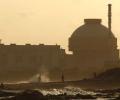
The Indian Nuclear Energy Pool, meant to insure risks from nuclear reactors, may take longer to be set up. While the idea of forming a pool was mooted earlier this year, it has reached a deadlock owing to differences among the stakeholders on certain clauses.
With business worth billions of dollars to be gained from India, American groups are working overtime to facilitate the United States' participation in the Asian powerhouse's nuclear sector, says a Washington Post report.
Presenting the Union Budget, Sitharaman announced that the government will partner with the private sector to set up Bharat Small Reactors and in the research and development of small modular reactors.
Director General of World Nuclear Association John Ritch welcomed the initiatives designed to end India's isolation.
India needs to recognise and address challenges posed by its dependence on China for critical minerals and examine the implications of phasing down coal on bank balance sheets as it accelerates its green transition, the government's Economic Survey 2023-24 tabled in Parliament on Monday said. As part of its national plan to contribute to meeting the global goal of limiting the average temperature rise to 1.5 degrees Celsius, India has committed to reducing emissions by 45 per cent below 2005 levels by 2030, achieving 50 per cent cumulative electric installed capacity from non-fossil fuel-based energy resources, and creating a carbon sink of 2.5 to 3 gigatons of CO2 equivalent through additional forest and tree cover.

India is also likely to push for a Free Trade Agreement with the Eurasian Economic Zone and is sharing details of the study it conducted in this regard.

India on Tuesday said cooperation in peaceful uses of nuclear technology is an important pillar of the multifaceted cooperation with Russia, which offered help in building small tropical nuclear power stations.

The Summit would begin on the second day with the prime minister interacting with Russian and Indian CEOs.
 © 2026 Rediff.com - Investor Information - Advertise with us - Disclaimer - Privacy Policy - Sitemap - Feedback - About us - Terms of use - Grievances