

The government on Monday introduced a new bill in the Lok Sabha that seeks to overhaul laws governing India's civil nuclear sector by opening it up to private participation and putting in place a new liability regime, in a bid to address concerns voiced by the industry partners.
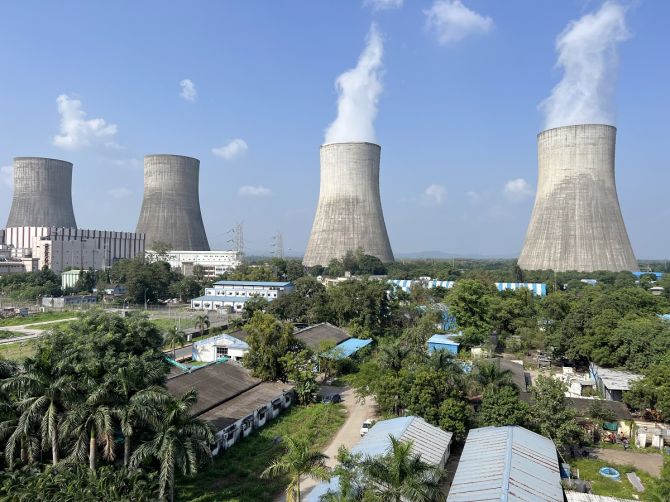
The Sustainable Harnessing and Advancement of Nuclear Energy for Transforming India (SHANTI) Bill, 2025 also seeks to repeal the Atomic Energy Act, 1962 and the Civil Liability for Nuclear Damage Act, 2010, seen as a stumbling block for the growth of the sector.
"The Bill seeks to provide for a pragmatic civil liability regime for nuclear damage and to confer statutory status to the Atomic Energy Regulatory Board," Minister of State in PMO Jitendra Singh said.
The Bill exempts suppliers of equipment for nuclear power plants from liability for a nuclear incident, which has been limited to the operators, except in cases caused by "a grave natural disaster of an exceptional character, an act of armed conflict, hostility, civil war, and insurrection or terrorism".
However, the operator won't be liable for damages in "under-construction nuclear installation itself and any other nuclear installation including a nuclear installation under construction, on the site where such installation is located, any property on the same site which is used or to be used in connection with any such installation; or the means of transport upon which the nuclear material involved was carried at the time of nuclear incident."
"The maximum amount of liability in respect of each nuclear incident shall be the rupee equivalent of three hundred million Special Drawing Rights or such higher amount as the central government may, by notification, specify," the legislation adds.
Special drawing rights are supplementary foreign exchange reserve assets defined and maintained by the International Monetary Fund.
The new legislation is aligned to achieve the objectives of increasing the share of nuclear energy in the total energy mix of India, facilitate innovation in nuclear science and technology, expand its use in non-power applications and continue to honour India's obligations towards safety, security, safeguards and towards nuclear liability, Singh said.
The Bill seeks to provide for the establishment of the Atomic Energy Redressal Advisory Council for the redressal of disputes.
It also grants statutory powers to the Atomic Energy Regulatory Board, the nuclear sector regulator, which was set up through an executive order under the Atomic Energy Act of 1962.
Its provisions seek to impose stringent penalties on any person involved in the breach or violation of the law. The penalty varies from Rs 5 lakh for minor breaches to a maximum of Rs one crore for severe violations.
The Bill proposes that, besides the government-owned or government-controlled department, institution or corporations, any company under Section 2(20) of the 2013 Companies Act would be eligible to apply to the central government for a licence to build, own, operate or decommission a nuclear power plant or reactor.
However, private companies incorporated outside India will not be allowed.
Private companies can also apply to obtain a licence for the fabrication of nuclear fuel, including conversion, refining and enrichment of uranium-235 up to such threshold value, or production, use, processing or disposal of other prescribed substances, as may be notified by the Centre.
They will also be allowed transportation or storage of nuclear fuel or spent fuel, import or export, acquisition or possession of nuclear fuel or prescribed equipment, any technology or software that may be used for the development, production or use of nuclear energy.


 © 2026