
Pakistan and the Maldives have signed 20 Memorandums of Understanding (MoUs) covering defence, maritime security, artificial intelligence, trade, and other sectors during Maldivian President Mohamed Muizzu's three-day visit to Islamabad. The agreements aim to significantly boost bilateral cooperation and trade, with Pakistan also offering technical expertise and educational opportunities.

India and Japan have signed a Memorandum of Arrangement on maritime security cooperation, committing to deepen defence ties and oppose unilateral actions that impede freedom of navigation in the Indo-Pacific, a move seen as directed at China's increasing military presence.

External Affairs Minister S Jaishankar has affirmed India's commitment to ensuring issues like a free, open, and rule-based maritime order, seafarer safety, and countering terror financing receive due attention at the UN Security Council during its 2028-29 term.

India's foreign secretary Vikram Misri on Thursday participated in a high-level meeting hosted by the United Kingdom on the evolving situation in West Asia, underlining concerns over maritime security, energy supply disruptions and the need for diplomatic de-escalation.
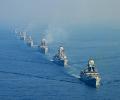
India may have a vast coastline and a strategic location, but it will become a true maritime nation only when its people understand, value and actively participate in the maritime ecosystem, asserts Vice Admiral Biswajit Dasgupta (retd).

Two merchant vessels with 22 Indian crew members were attacked in the Strait of Hormuz. One ship, MT Petro Dolphin, was hit by a drone, leaving two Indian seafarers missing. Another, MT Valthera, was struck by a projectile, but all 11 Indian crew are safe. India has strongly condemned the attacks, prioritising the safety of its seafarers and calling for de-escalation and upholding freedom of navigation.

The UK has successfully test-fired a US torpedo from an undersea drone, marking a significant advancement in submarine technology for the AUKUS partners (UK, US, Australia). This development coincides with Prime Minister Andy Burnham's visit to the UN General Assembly, where he is discussing global challenges like AI, the Ukraine conflict, and West Asia security with international leaders, and announced the UK will host the G20 Leaders' Summit in Manchester next November.

Late last year, the Cabinet Committee on Security had cleared the proposal for the creation of the post.

The Indian Navy has commissioned INS Mangrol, its third anti-submarine warfare shallow water craft (ASW-SWC), in Mumbai. Built by Cochin Shipyard Limited, the vessel is designed to enhance India's ability to detect and counter submarine threats, especially in shallow coastal waters. Its induction is seen as vital amidst rising geopolitical tensions and increased submarine activity in the Indian Ocean, reinforcing India's indigenous shipbuilding capabilities and maritime security.

India has strongly condemned an attack on a Panama-flagged commercial vessel, MT On Peace, in the Strait of Hormuz, which resulted in injuries to 11 Indian crew members. The Ministry of External Affairs called for an immediate cessation of such attacks, emphasising the need to restore navigation and commerce through international waterways. Omani authorities assisted in evacuating and treating the injured sailors.
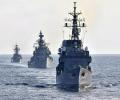
National Security Advisor Ajit Doval on Thursday called for seamless coordination among various agencies involved in protecting India's maritime interests in the face of emerging security challenges and increasing rivalries and competitions in the Indian Ocean.
With a view to creating a central command to focus on maritime security in the wake of Mumbai terror strikes, the Union Shipping Ministry is mulling the formation of a Bureau of Maritime Security, Union Shipping Minister T R Baalu said on Tuesday.The Ministry would make a proposal soon to the cabinet, which would decide on setting up of this central agency, he told reporters in Chennai on the sidelines of a seminar on maritime security.

External Affairs Minister S Jaishankar, addressing the UN General Assembly, condemned the targeting of commercial shipping and seafarers in the Gulf, calling it "simply unacceptable." He also voiced deep concern over the "weaponisation of everything," which he stated has severe consequences for Global South nations, impacting peace, progress, and development globally. India urged restraint, de-escalation, and protection of civilians, while also highlighting the 4F crisis (food, fuel, fertiliser, finance) faced by developing countries.

Maintaining that maritime security was the new government's top priority, Defence Minister Arun Jaitley on Saturday stressed the need for hastening delivery of ships to step up surveillance and secure the vast coastline.

The political confidence required to place high-end Japanese aircraft and personnel on Indian soil is itself a data point.
It indicates a level of trust that would have been difficult to imagine when India-Japan defence ties were largely symbolic, explains Varun Arya.

India has once again raised alarms over the escalation in the security situation in the Red Sea area and strongly condemned Houthi strikes targeting Saudi Arabian territory, "including on civilians and economic assets."

India and Australia have signed significant agreements covering civil nuclear energy, maritime security, and critical minerals, reinforcing their partnership's role in ensuring a peaceful Indo-Pacific. The pacts facilitate uranium supply from Australia to India and enhance cooperation in defence, cyber, and critical technologies.

External Affairs Minister S Jaishankar has emphasised India's commitment to safe maritime transit and condemned attacks on merchant shipping amidst the ongoing West Asia conflict and global energy market disruptions.

Ukrainian President Volodymyr Zelenskyy stated on Wednesday that Ukraine stands prepared to freeze the conflict along the current front line and transition towards diplomatic negotiations as part of initiatives to end the war with Russia.dukr
With the Mumbai terror attacks exposing lack of coordination among security agencies, India today completely overhauled its coastal security apparatus and handed over the overall responsibility of maritime security to the Navy.
Indian telecom gear maker Signaltron and semiconductor firm Signalchip have partnered with Indonesia's sovereign research body PRT BRIN to develop and deploy advanced telecom technologies, including 4G, 5G, and future 6G, specifically tailored for Indonesia's unique archipelagic geography to connect underserved regions.

An Indian Navy sailor, Pradeep Mukherjee, has been arrested by the Andhra Pradesh Police Counter Intelligence cell for allegedly transmitting classified maritime intelligence to a Pakistani operative. The espionage operation reportedly involved a social media "honey-trap" where a female Pakistani intelligence operative extracted sensitive data on naval assets and operations from Mukherjee.

The Indian Navy is enhancing its operational capabilities across all domains, including air, underwater, AI, and quantum technology, to become a multi-domain network force. Vice Chief of Naval Staff, Vice Admiral Ajay Kochhar, highlighted lessons from recent conflicts, the exploration of directed-energy weapon systems, and significant procurement plans, including 42 new platforms on order and RFPs issued for LPDs and next-generation frigates. The Navy's focus on indigenous innovation and technology absorption, guided by "scale, sophistication, speed, and spiral development," aims to meet evolving operational requirements and protect maritime interests, especially amidst ongoing global crises.

India has condemned an attack on a Panama-flagged oil tanker off the coast of Oman, which resulted in one Indian seafarer going missing and 13 others being rescued. The Ministry of External Affairs is closely monitoring the situation and coordinating with Omani authorities for search and rescue operations, while also reiterating calls for de-escalation and safe navigation in the region.

Any military response to a cross-border terror attack from Pakistan will have to take into account the new alignments beginning to take shape in the region, points out former foreign secretary Shyam Saran.

The economic fallout of the West Asia crisis, the prevailing security situation in the Indo-Pacific and ways to boost cooperation in critical minerals and technology are expected to top the agenda at a crucial meeting of the Quad foreign ministers on Tuesday.

In his statement while chairing the debate on "Enhancing Maritime Security - A Case for International Cooperation" via video conferencing, Modi highlighted that maritime routes were being misused for terrorism and piracy.

Two commercial vessels, an oil tanker and a cargo ship, carrying a total of 22 Indian nationals, were hijacked by armed pirates in separate incidents off Yemen and Somalia. All Indian crew members on both vessels are reported to be safe, according to the latest information from the shipping ministry and the External Affairs Ministry.

An Indian sailor was killed and several others rescued during an anti-piracy operation in Somalia. Security forces retook control of the hijacked fuel tanker MT Honour 25, apprehending 16 suspected pirates. Other Indian seafarers from different vessels were also safely repatriated amidst a resurgence of piracy in the region.

India has accumulated experience organically and in public, through blood, sweat and toil -- one commissioning and one agreement at a time -- and is called a regional power. China has accumulated hulls, by misdirecting its industrial capacity, and is mistakenly called a superpower. The Indo-Japan defence agreement pushes this theory to its limits without ever naming the dragon in the room, points out Dr Abhishek Puri.

Defence Minister Rajnath Singh will commission Mahendragiri, the sixth Project 17A indigenous stealth frigate, into the Indian Navy's Eastern Fleet in Visakhapatnam on Saturday, marking another milestone in India's journey towards defence self-reliance and indigenous warship construction.

'In the current environment, India is effectively paying a premium for supply security and diversification.'

Navigating this geopolitical minefield requires a cold-blooded blend of immediate tactical pleading, structural domestic diversification, and aggressive collective resistance, suggests Ambassador Rajasekhar.

India and Australia on Wednesday decided to bolster defence ties, as they acknowledged that maritime security and freedom of navigation is critical for the growth and prosperity of Asia Pacific and Indian Ocean regions, at a time when China's postures in the seas have caused concerns.
Minister of State for Home Affairs Mullappally Ramachandran told the Rajya Sabha about India's efforts to boost maritime security and stated that an amount of Rs 260 crore has been allocated to tackle this problem.
While maritime security continues to be one of India's biggest headaches, the de-motivation and fatigue that has set in the officers with the duty to man the coasts leading to lack of coordination with fishermen, are making matters worse. Vicky Nanjappa reports.

The Gulf countries on Monday welcomed a peace deal reached between the US and Iran to end their conflict and called for protection of maritime routes and freedom of international navigation, including the uninterrupted flow of traffic through the Strait of Hormuz.
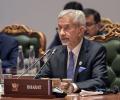
India has expressed serious concerns about the West Asia crisis and its potential impact on energy supplies and maritime stability, urging BRICS nations to find practical solutions to geopolitical challenges and unilateral sanctions.
Five Indian nationals aboard a Kuwait-flagged tanker were safely shifted ashore after the vessel was struck by a projectile in the Strait of Hormuz, the Embassy of India in Oman said.

Forty-two naval vessels are already on order, while the navy has the government's initial go-ahead to procure another 78 ships and submarines and 120 fast interceptor craft, worth approximately Rs 2.41 trillion.
