
Twenty-seven Maoists surrendered to police in Ranchi, Jharkhand, as part of 'Operation Navjeevan'. The rebels laid down their arms before senior officers, with authorities appealing to others to return to the mainstream.

As the March 31 deadline arrives, a wave of Maoist surrenders suggests insurgency's end, but political and social concerns remain.

Odisha's Director General of Police (DGP) YB Khurania announced that 77 Maoists have surrendered to police in the state between January 2025 and March 2025. He also noted that 23 Maoists from Odisha surrendered in Chhattisgarh during the same period, and 27 Maoists were killed in encounters with security forces.

108 Maoists surrendered in Chhattisgarh's Bastar district, yielding a large cache of weapons and cash. The surrender highlights the government's success in combating Left Wing Extremism and the weakening of Maoist ideology.

Odisha Police have declared an end to the Left Wing Extremism (LWE) threat in the state, announcing the closure of the Maoist surrender window and a shift in focus to eliminating remaining insurgents in Kandhamal district.

A woman Maoist leader carrying a bounty of Rs 15 lakh was arrested in Kolkata, while another red rebel surrendered before the police, a senior officer said.

210 Maoist cadres, including a Central Committee member, surrendered to authorities in Chhattisgarh's Jagdalpur, marking the "largest mass surrender" in the state's anti-Naxal operations. The surrendered Naxalites carried a collective bounty of Rs 9.18 crore and handed over 153 weapons. Chief Minister Vishnu Deo Sai hailed the development as a historic moment for Chhattisgarh and the nation.

In a significant victory for the government's anti-Naxal efforts, 108 Maoists, including 44 women, surrendered in Chhattisgarh's Bastar district, citing disillusionment and the appeal of rehabilitation programs. The surrender also led to the recovery of a large cache of weapons and valuables.

A combination of security pressure and rehabilitation efforts has significantly weakened Naxalism in India, leading to numerous surrenders and the elimination of key leaders.

Security forces in Odisha's Kandhamal district seized a significant cache of arms and ammunition from a Maoist dump. The operation was launched based on information obtained from surrendered Maoists, leading to the recovery of a self-loading rifle, guns, detonators, and a grenade. This follows a similar seizure along the Odisha-Andhra Pradesh border recently.
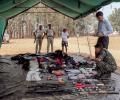
A wanted Maoist leader allegedly killed his commander for planning to surrender to the Odisha Police, revealing internal conflicts within the group.

Five Naxal functionaries, carrying a total bounty of Rs 38 lakh, surrendered in Gadchiroli district, Maharashtra. Additionally, eight Maoists from Maharashtra, Telangana, and Chhattisgarh were arrested during joint operations with the CRPF.
A senior Maoist commander, Papa Rao, surrendered with his team in Chhattisgarh, signalling a significant blow to Left-Wing Extremism in the region. This event underscores the impact of sustained security pressure and rehabilitation efforts on the Maoist movement.
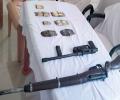
Fifteen Naxalites, including a veteran ultra with a significant bounty, surrendered in Chhattisgarh, effectively dismantling the Maoist movement in the Raipur-Sambalpur region.

'The biggest game changer has been the belief among Maoists that they can surrender and join the mainstream'

'They are not abandoning their ideology. They now believe it is better to pursue their goals through the Constitution rather than from the barrel of a gun -- even if the ideology itself remains intact.'
Jharkhand police arrested five members of the banned Maoist outfit Tritiya Sammelan Prastuti Committee (TSPC) in Chatra district and a PLFI area commander surrendered in Khunti.

Top Maoist commander Thippiri Tirupati alias Devji has surrendered to police, marking a significant blow to the outlawed organisation. His surrender comes ahead of the Union government's deadline to eliminate Naxalism.
Chhattisgarh Deputy Chief Minister Vijay Sharma announces the impending surrender of senior Maoist commander Papa Rao and his team, a significant step towards eradicating Naxalism in the state.
The Lok Sabha will hold a discussion on efforts to eliminate left-wing extremism (LWE) in India, ahead of the government's deadline. The debate will cover the government's strategy, review of affected regions, and future plans, including potential withdrawal of security forces and launch of welfare schemes.
Gadchiroli police recovered and destroyed items used in the manufacture of weapons, secretly buried by Maoists in a forest area.

Top Maoist commander Thippiri Tirupati, known as Devuji, surrendered to Telangana police after over four decades of underground life, citing health issues and a desire to continue his political career within the legal framework.

Union Home Minister Amit Shah announces the surrender of 258 Maoists in Chhattisgarh and Maharashtra, reiterating the government's commitment to eradicating Naxalism by March 2026.
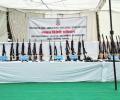
Police in Chhattisgarh's Bijapur district have recovered a cache of explosives, weapons, and equipment allegedly hidden by Maoists in a forested hill area.
Police in Chhattisgarh's Bijapur district have recovered a cache of explosives, weapons, and equipment allegedly hidden by Maoists in a forested hill area.

Three senior leaders of the banned CPI (Maoist) surrendered to the Telangana police. The leaders cited health issues, ideological differences, and changing socio-political circumstances as reasons for their surrender. The Telangana DGP appealed to other underground Maoist cadres to return to the mainstream.

'Sujatha's decision to surrender reflects the deep crisis of confidence that the Maoist ranks are facing in recent times.'

A woman Maoist carrying a reward of Rs 5 lakh was killed in an encounter with security personnel in Chhattisgarh's Kanker district.

Forty-one Naxalites, including 32 carrying a reward of Rs 1.19 crore, surrendered in Chhattisgarh's Bijapur district, citing the government's surrender policy and rehabilitation efforts.

'The watershed moment was June 22, 2024, when the divisional in-charge of Gadchiroli, Giridhar Tumreti, who was their senior-most commander, along with his wife, came forward to surrender before the then deputy chief minister and home minister Devendra Fadnavis.'

Telangana Police's Special Intelligence Branch, led by officer B Sumathi, successfully negotiated the surrender of top Maoist commander Thippiri Tirupati alias Devuji and other Maoist leaders, marking a significant victory for the state.
Fifteen Naxalites, including a Special Zonal Committee-level member, surrendered to security forces in Chhattisgarh's Mahasamund district, marking a significant development in the state's efforts to combat Naxalism.
Eleven Naxalites, including five senior operatives with a combined bounty of Rs 68 lakh, have surrendered to police and CRPF forces in Gadchiroli district, Maharashtra, marking a significant blow to Left Wing Extremism in the region.

Three District Reserve Guard personnel were killed and another injured in an IED blast in Chhattisgarh's Kanker district while attempting to neutralise it.
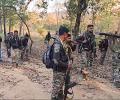
A Naxalite carrying a bounty of Rs 5 lakh was killed in an encounter with security personnel in Chhattisgarh's Sukma district, just days before the Centre's deadline to eliminate Left Wing Extremism.
'For the remaining Maoist cadres, they shall soon confront one of two outcomes: Either surrender or face neutralisation.'
Chhattisgarh Deputy Chief Minister Vijay Sharma met surrendered Naxalites at a rehabilitation center in Sukma, offering them a visit to the state assembly and directing officials to improve their living conditions and opportunities.
After more than four decades, Chhattisgarh's Bastar region has been declared free of Left-Wing Extremism (LWE), marking the end of the armed Maoist rebellion in the area. The decline is attributed to sustained security operations, improved governance, and socio-economic development initiatives.

Odisha Chief Minister Mohan Charan Majhi announced significant progress in combating Maoist insurgency, stating it will soon be a thing of the past. He also addressed concerns about crimes against women, highlighting the government's commitment to justice and a zero-tolerance policy.
