
An encounter with terrorists at a cafe.
"Our effort is to open up as soon as possible. Maybe, we will start our operation tomorrow only," the cafe's owner Farhang Jehani told PTI.
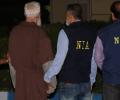
Tahawwur Hussain Rana, a key accused in the 26/11 Mumbai terror attack case, had helped co-conspirator David Coleman Headley to obtain an Indian visa, a Mumbai police official familiar with the probe said. Rana was arrested by the National Investigation Agency (NIA) on Thursday evening following his extradition from the United States. Rana, who had served in the Pakistan Army medical corps, had emigrated to Canada in the late 1990s and started an immigration consultancy firm. He later moved to the US and set up an office in Chicago. Through his firm, Rana gave cover to Headley to carry out reconnaissance mission in Mumbai prior to the November 2008 attacks and helped him get a ten-year visa extension. During his stay in India, Headley used the front of running an immigration business and was in regular contact with Rana. There were more than 230 phone calls between the two during this period. Rana was also in touch with 'Major Iqbal', another co-conspirator of the attacks during this period, as per the NIA charge sheet. Rana himself visited India in November 2008. As per the charge sheet filed by Mumbai Police against Rana in 2023 in the 26/11 attack case, he lived in a hotel in Powai, and had a discussion about crowded places in South Mumbai with a person who has been listed as a witness in the case. Subsequently, some of these places were targeted by the Pakistani terrorists during the deadly attacks that claimed 166 lives.

Tahawwur Hussain Rana, a Pakistan-born Canadian national and close associate of David Coleman Headley, could be extradited to India in connection with the 26/11 Mumbai terror attacks. Rana's travel history in parts of north and south India before the attacks in 2008 is expected to provide crucial leads for the investigation. His extradition would mark the third person to be tried in India for the attacks, after Ajmal Kasab and Zabiuddin Ansari alias Abu Jundal.
Tahawwur Hussain Rana, a Canadian national accused of involvement in the 2008 Mumbai terror attacks, has been extradited to India from the United States. Rana's interrogation is expected to shed light on the role of Pakistani state actors in the attacks, which claimed 166 lives. Indian authorities are particularly interested in his travels across India in the days leading up to the attacks, including visits to Hapur, Agra, Delhi, Kochi, Ahmedabad, and Mumbai. Rana's extradition follows a lengthy legal battle, with the US Supreme Court ultimately denying his application to challenge it. Rana is known to be associated with Pakistani-American terrorist David Coleman Headley, one of the main conspirators of the 26/11 attacks. The investigation into the Mumbai attacks has implicated senior members of terror outfits Lashkar-e-Taiba (LeT) and Harkat-ul Jihadi Islami (HuJI), as well as officials from Pakistan's Inter-Services Intelligence (ISI).
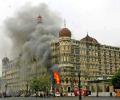
Tahawwur Rana, accused of involvement in the 2008 Mumbai terror attacks, is expected to be extradited to India from the United States soon. The US Supreme Court denied his last-ditch effort to stop his extradition, moving him closer to being handed over to Indian authorities. Rana's extradition is expected to help probe agencies expose the role of Pakistani state actors behind the attacks and shed new light on the investigation. He is associated with Pakistani-American terrorist David Coleman Headley, one of the main conspirators of the 26/11 attacks.
Tahawwur Hussain Rana, a key accused in the 26/11 Mumbai terror attacks, was brought to India on Thursday after being "successfully extradited " from the US, the National Investigation Agency (NIA) said. The 64-year-old Canadian citizen of Pakistani origin landed in Delhi in a special plane on Thursday evening, ending days of speculation of when and how he will be extradited, officials said. The NIA said in a statement that it had secured the successful extradition after years of sustained and concerted efforts to bring to justice the key conspirator behind the 2008 mayhem that claimed 166 lives. Rana is accused of conspiring with David Coleman Headley alias Daood Gilani, and operatives of designated terrorist organisations Lashkar-e-Taiba (LeT) and Harkat-ul-Jihadi Islami (HUJI) along with other Pakistan-based co-conspirators, to carry out the the three-day terror siege of India's financial capital.

Maharashtra Governor Ramesh Bais and Chief Minister Eknath Shinde on Sunday paid floral tributes to the martyrs who laid down their lives while fighting terrorists who attacked the metropolis on this day 15 years ago.
Ram Gopal Varma's latest directorial offering traces the events of the 2008 terrorist attacks in Mumbai.
26/11 survivor Anamika Gupta on her unforgettable encounters with the terrorists.
Two families struggle to make ends meet and face a harsh life after losing their breadwinners.

"Her testimony today is a stark reminder to the Council and the international community that justice is yet to be delivered to the victims of several terrorist incidents, including the 26/11 Mumbai attacks," he said in a statement to the Security Council in his national capacity.

Pakistani-origin Canadian businessman Tahawwur Rana, a key accused in the 26/11 terror attacks case, stayed at a hotel in Mumbai's Powai area for two days in November 2008 ahead of the attacks, where he discussed about the crowded places in south Mumbai with a witness in the case, the police said on Tuesday.
Pravin Pandurang Sawant was on patrol duty when two Pakistani terrorists walked into Colaba's Leopold Cafe on the night of November 26, 2008. One of the bullets hit his leg during the attack and changed his life forever. Today, Sawant cannot walk without the help of a stick, forcing the police department to transfer him from 'frontline' duty to a desk job.
The elite Indian counter-terror force National Security Guard celebrated its 25th anniversary at a function in Haryana on Friday. On Friday, the commandos presented a spectacular display of their firepower and skill as they recreated the scene of the 26/11 Mumbai terror attacks.
Standing shattered behind the Gateway of India with soot marred walls, bullet riddled doors, broken window panes and splinter marks, the terrorist-hit structures are now the most sought after tourist destinations in the city.Welcome to the world of 'disaster tourism' as many call it, where Taj Mahal and Oberoi Hotel along with Nariman House and of course the Leopold Cafe have become the favourite spots to be thronged by the average Mumbaikar.

'Remembering the bravehearts and the innocent civilians who lost their lives'
Ajmal Kasab, the lone terrorist arrested during the terror attack on Mumbai in November 2008, on Friday told a special court hearing the 26/11 terror case that he was not aware of the attacks at Hotel Taj, Hotel Oberoi, Nariman House and Leopold Cafe in Mumbai. "I also do not know the people who had fired and exploded bombs at these places on November 26, 2008," Kasab said in reply to questions put to him by Judge M L Tahiliyani.
A year after the 26/11 carnage, girls at the YWCA hostel in Colaba are still hounded by the horrifying memories of three sleepless nights when terror unfolded barely a few meters away in their backyard at Leopold Cafe and the iconic Taj.
Juergen and Daphne Schmidt had planned a trip to India for over 25 years -- an exciting, hectic trip that was to end with a dinner at the Leopold cafe in Mumbai on the night of November 26, 2008.
The Melbourne, Australia-born Roberts who, since escaping from Pentridge Prison has made a new life in India and who, famously, wrote his best-selling novel Shantaram seated in a corner table of Leopold's Cafe in South Mumbai, makes an eloquent plea on behalf of the country that changed him from convicted bank robber to much lionized author
Guns boom in Mumbai: Be a Citizen Reporter

Had the terrorists come five hours earlier, I wouldn't be here talking to you," says Gregory David Roberts, the Australian author of the novel Shantaram, oft-considered a foreigner's Ode to Mumbai. "We were here in the evening, then left for the airport, as we had to fly to Australia that night for business."

The staccato burst of gunfire at the Chhatrapati Shivaji Terminus in Mumbai at 9.21 pm on Wednesday night hardly gave an inkling of the shape of things to come up in the next two to three hours.
A Chuck Norris-look-alike, an immigrant labourer and a Man-U fan have just this one thing to say on the first anniversary of 26/11: It's important to defy terrorism. Rediff. com's Prasanna Zore and Abhishek Mande get a sense of the Mood on the first anniversary of the 26/11 attacks.
Sultanpur, a village in Maharashtra with a population of around 1,000 and 600 houses, will now be known as 'Rahul Nagar' as the local residents have changed its name in memory of its native, who laid down his life while fighting terrorists during the 26/11 Mumbai attacks in 2008.

Ten terrorists of Pakistan-based Lashkar-e-Taiba carried out 12 coordinated shooting and bombing attacks lasting four days across Mumbai. At least 166 people, including six Americans and nine terrorists, were killed and over 300 others were injured in the attacks which began on November 26, 2008.
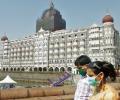
"Twelve years after India's worst terror attack on Mumbai, two Taj hotels -- Colaba and Bandra have received a terror threat from Karachi. "I have had detailed discussions on beefing up security arrangements with both Maharashtra DGP and Mumbai Commissioner of Police," Deshmukh said.

'If we have to restrict and fight terrorism, first and foremost, we have to ensure communal harmony in the country.'

Veteran industrialist Ratan Tata, who headed Tata group whose iconic hotel in Mumbai was one of the sites of the 26/11 terror attacks, on Thursday penned a heartfelt tribute saying the wanton destruction that took place 12 years ago will never be forgotten.

Floral tributes were paid on Friday to the martyrs who laid down their lives while fighting terrorists who attacked Mumbai on November 26, 2008.

'Their sacrifice will never be erased from the memory of time and history'

The seventh anniversary of the 26/11 Mumbai terror attacks, which had claimed lives of 166 people and left hundreds injured, would be observed on Thursday.

Ten years back, 10 Lashkar-e-Taiba terrorists sailed into Mumbai from Karachi and carried out coordinated attacks that lasted three days. The terrorists carried out bomb explosions and holding innocents hostage as a fight back by security forces continued for the next 60 hours. Taj Mahal Palace hotel, Chhatrapati Shivaji Terminus railway station, Leopold Cafe were targetted in the attack that made headlines across the world.

Maharashtra Chief Minister Devendra Fadnavis along with other ministers and the Mumbai police, on Thursday paid homage to the martyrs on the seventh anniversary of the horrific terror attack of 26/11.
26/11 survivor Anamika Gupta on her unforgettable encounters with the terrorists.
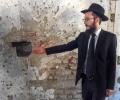
The outreach centre -- one of the sites of the 26/11 attack -- will be turned into a memorial dedicated to all the victims.

Among those who remembered the slain bravehearts, who fell to bullets of Pakistani terrorists while repulsing the deadly attack on this day 11 years ago, were their kin, politicians, government officials, sports persons and common citizens.

'Crores are spent on Martyrs Day and on lighting candles, but people don't respect living soldiers who are heroes.'
First person account: To say the entire stretch is ripe for a stampede is putting it mildly.
