Justice Gavai's comment came while the apex court bench, also comprising Justice Augustine George Masih, was considering a fresh plea seeking an inquiry into the recent violence in West Bengal during anti-Waqf law protests.
The Supreme Court of India has declined to interfere with the bail granted to 17 members of the Popular Front of India (PFI) in connection with the 2022 murder of Rashtriya Swayamsevak Sangh (RSS) leader Srinivasan in Kerala. The court noted that the Kerala High Court, which granted bail, has the power to revoke it if the conditions are violated. The NIA had sought cancellation of the bail, alleging the accused had violated bail conditions and contacted witnesses. The accused are also facing trial for allegedly instigating communal violence in Kerala and other parts of the country.

The Supreme Court of India has dismissed a public interest litigation (PIL) seeking to make dowry harassment and maintenance provisions "gender neutral." The court stated that it cannot legislate law and it is the responsibility of Parliament to look into such matters. The PIL, filed by an NGO, argued that these provisions are often misused to harass husbands and their families. The court, however, emphasized that every case must be judged on its own merits, and that the provisions are intended to protect women and children. The court also noted that the allegation of misuse was vague and that such claims should be examined on a case-by-case basis.

Skymet expects a good monsoon over western and southern India.

The Supreme Court of India began hearing a batch of petitions challenging the constitutional validity of the Waqf (Amendment) Act, 2025. The bench, led by Chief Justice Sanjiv Khanna, asked both sides to address whether the court should entertain the petitions or relegate them to the high court. The hearing is underway with senior advocate Kapil Sibal arguing for the petitioners. The act, which was passed by Parliament following heated debates, has been challenged by various parties including AIMIM leader Asaduddin Owaisi, All India Muslim Personal Law Board (AIMPLB), and Jamiat Ulama-i-Hind.

From the Sensex pack, Tata Consultancy Services, HCL Technologies, Tech Mahindra, Infosys, Tata Motors, Bajaj Finance, Kotak Mahindra Bank, Mahindra & Mahindra, Bharti Airtel and Maruti Suzuki India, Tata Steel were the major laggards. PowerGrid, Sun Pharmaceuticals, UltraTech Cement, NTPC, Asian Paints, Nestle India, Titan, IndusInd Bank and Axis Bank were among the gainers.
The Supreme Court of India has ruled that governors cannot indefinitely delay giving assent to bills passed by state legislatures, setting a timeline of one to three months for their actions. The court said the governor must act "as soon as possible" and that failure to comply with the timeline will make their inaction subject to judicial review. The ruling comes as several opposition-ruled states have accused governors of delaying assent to bills passed by their assemblies.
The Supreme Court of India has dismissed a petition filed by an NGO challenging the construction of a renewable energy project at the Jayakwadi Dam in Maharashtra. The court criticized the NGO for opposing the project, stating that it would be detrimental to the country's progress if every project was resisted. The court also raised questions about the NGO's bona fides and funding, suggesting that it may have been influenced by a company that lost the tender for the project. The project, a floating solar power plant, was approved by the National Green Tribunal (NGT) and the Ministry of Environment, Forests and Climate Change. The NGT had previously dismissed the NGO's plea, stating that it could not find any law prohibiting such activities in the eco-sensitive zone. The Supreme Court upheld the NGT's decision, finding no grounds to interfere.
The Supreme Court of India will likely hear a batch of petitions challenging the constitutional validity of the Waqf (Amendment) Act, 2025 on April 15. The Act, which came into force on April 8, has been met with widespread criticism from various stakeholders, including politicians, the All India Muslim Personal Law Board (AIMPLB), and Jamiat Ulama-i-Hind. They argue that the law is discriminatory and violates the fundamental rights guaranteed under Articles 25 and 26 of the Constitution. The petitions allege that the amendments give the government more control over the administration of Waqf, effectively sidelining the Muslim minority from managing their own religious endowments.
The Supreme Court on Monday agreed to consider listing for urgent hearing the petitions challenging the constitutional validity of the Waqf (Amendment) Act, 2025.

A three-judge Supreme Court bench will hear petitions challenging the constitutional validity of the Waqf (Amendment) Act, 2025, on April 16. The petitions, including those by politicians and the All India Muslim Personal Law Board (AIMPLB) and Jamiat Ulama-i-Hind, were filed in the top court challenging the validity of the newly-enacted law. The Centre has filed a caveat in the apex court, seeking a hearing before any order is passed.
The Supreme Court is scheduled to hear on March 18 a plea seeking to debar from polls, candidates charged with serious offences. The plea, filed by advocate Ashwini Kumar Upadhyay, seeks directions to the Centre and the Election Commission of India (ECI) to restrain such candidates put on trial for serious offences. The plea alleges that despite recommendations of the Law Commission of India and court's previous directions, the Centre and the ECI did not act. The plea also highlights the increasing number of MPs with declared serious criminal cases since 2009, with one MP declaring 204 criminal cases against him, including culpable homicide, house trespass, robbery, criminal intimidation, etc. It claims that political parties are competing with each other in a race to the bottom as they couldn't afford to leave their competitors free to recruit persons with criminal antecedents.
"It is shocking that the Supreme Court is adjudicating bail pleas in cases that should be disposed of at the trial court level. The system is being burdened unnecessarily," Justice Oka said while hearing a bail plea.

BYD's new charging system is capable of up to 1000kW charging speeds which may be achievable in China, the carmaker's home market, but such high charging speed is not available in India.
The Supreme Court of India has decided to issue a showcause notice to senior advocate Rishi Malhotra, asking why the designation conferred upon him by the apex court should not be revoked. The decision comes in the wake of allegations of misconduct against Malhotra, including suppressing material facts in multiple cases and making misleading statements despite warnings from the court. The full court, convened by Chief Justice Sanjiv Khanna, has decided to give Malhotra one more opportunity to explain his conduct before stripping him of the senior designation. The court has expressed concerns about the effectiveness of the senior designation system and whether it ensures that only deserving advocates are being designated.

Telecom operator Bharti Airtel on Tuesday said it has partnered with Elon Musk's SpaceX for providing Starlink's high-speed internet services to its customers in India. This agreement is subject to SpaceX receiving authorisations to sell Starlink's satellite communications-based services in India, Airtel said in a statement.
The Supreme Court of India has expressed concern over the erosion of the family institution, stating that people in India, while valuing the concept of 'vasudhaiva kutumbakam' (the world is one family), are failing to maintain unity even within their immediate families. This observation came in a case involving a dispute between a mother and her eldest son over property and family relations.
Legal experts had deplored the observation of the Allahabad high xourt on what constitutes a rape charge, calling for a restraint by judges and underlining the drop in public confidence in the judiciary due to such statements.
A bench of Justices B R Gavai and Augustine George Masih observed it was pained to say that some of the observations made in the high court order depicted total insensitiveness and an inhuman approach.
The Supreme Court of India has directed the Odisha government to decide within six weeks on a plea for remission filed by Ravindra Pal alias Dara Singh, who is serving a life sentence for the murders of Australian missionary Graham Stuart Staines and his two sons in 1999. Singh, who has spent over 24 years in prison, claims to have "repented" his actions and seeks an opportunity to reform his character. The court issued the notice after Singh argued that he has already served more than the required period of sentence and that his right to liberty is being jeopardized by the delay in processing his plea.

The Boxing Federation of India will hold its election on March 28 to elect new office bearers for the next four years.

Dhawan also highlighted Rohit Sharma's influence on young players, particularly the openers, emphasising how his vast experience helps shape their game.
The Supreme Court of India has overturned an order by the National Green Tribunal (NGT) that halted construction activities at Auroville in Chennai. The court emphasized the need for a "golden balance" between the right to development and the right to a clean environment, upholding the principle of sustainable development. The decision comes as a victory for the Auroville Foundation, which had challenged the NGT order, and highlights the ongoing debate about balancing environmental concerns with economic growth in India.
The Supreme Court of India has formed a National Task Force (NTF) to address the growing concern of student suicides in higher educational institutions. The court took note of the recurring cases and directed Delhi Police to register FIRs on the complaints of families of two students who died by suicide at IIT Delhi in 2023. The NTF, chaired by former apex court judge Justice S Ravindra Bhat, will prepare a comprehensive report, including the identification of causes leading to suicides, analysis of existing regulations, and recommendations for strengthening protections. The NTF will also have the authority to conduct surprise inspections of higher educational institutions and make further recommendations to ensure a holistic approach to addressing mental health concerns and eliminating suicides.

BCCI could opt for a neutral venue with Pakistan unlikely to travel to India.
'If we stay silent now, we betray the very foundation of justice in this country.'
The Supreme Court of India has sought the government's response on a Public Interest Litigation (PIL) that challenges the appointment process of the Comptroller and Auditor General of India (CAG), arguing it's unconstitutional. The PIL, filed by the Centre for Public Interest Litigation, claims the current process, solely through executive appointment by the Prime Minister, undermines the CAG's independence and violates constitutional principles. The court, while acknowledging the importance of institutional trust, questioned the extent to which it should intervene in the appointment process and whether this would constitute rewriting constitutional provisions. The PIL suggests the CAG's appointment should be similar to other independent bodies, with a selection committee comprising the Prime Minister, Leader of the Opposition, and Chief Justice of India. The case has implications for the independence and transparency of India's audit system.
The Supreme Court of India has upheld a Bombay High Court order reinstating a woman as the sarpanch of a Maharashtra village, stating that bureaucrats cannot be allowed to "frustrate grassroot democracy." The court criticized instances of bureaucrats misbehaving with elected representatives and attempting to disqualify them by reopening old cases. The case involved Kalavati Rajendra Kokale, whose resignation from the sarpanch's post was withdrawn, but the Raigad district collector declared a vacancy and conducted a fresh election. The court found the collector's actions illegal and upheld Kokale's reinstatement, highlighting the importance of respecting the democratic process and elected representatives at the grassroots level.
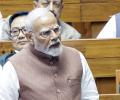
Besides the not-so-hidden unease between Modi and Adityanath, Modi chose to address the Lok Sabha to ensure that he could personally claim all the kudos, observes Nilanjan Mukhopadhyay.
The Supreme Court of India has ordered all high courts to ensure that civil courts under their jurisdiction decide execution petitions within six months, failing which presiding officers will be held accountable. The court cited the significant delay in resolving such petitions, which are filed to enforce decrees in civil disputes, and noted that this delay undermines the purpose of the decree itself. The verdict stems from a 1980 civil dispute from Tamil Nadu, highlighting the long-standing issue of delayed execution proceedings in India's legal system.

'Half the tournament we had lost when we announced the 15-member squad, and I am saying this from day one.'

Shanto said they are "not thinking of Bumrah or any other individual."
The Supreme Court of India granted custody of a man suffering from cerebral palsy to his mother, a US national, after determining it was in his best interest due to his inability to make independent decisions. The court overruled a Madras High Court decision, finding the lower court's interaction with the son insufficient to assess his needs. The Supreme Court emphasized the son's limited cognitive capacity and the availability of specialized support in the US, where he had completed most of his schooling.

Shoaib Akhtar didn't pull any punches as he blasted Pakistan's 'brainless and clueless' team management following the six-wicket loss to India in the ICC Champions Trophy.

Pakistan has the upper hand in the Champions Trophy, winning three of the five matches against India.
The Supreme Court has quashed a chargesheet against a retired Army officer in an alleged rape case, calling it an "abuse of process of law". The court found that the complainant's testimony showed no offense and the FIR deserved to be quashed. The court also noted that the Delhi High Court erred in its decision of not quashing the chargesheet. The complainant, a woman, had filed multiple FIRs against different persons, allegedly blackmailing them for money. The court concluded that the former Army officer was a "victim of an unscrupulous abuser" of law whose modus operandi was to extort money by misusing the rape and molestation laws.
The Supreme Court of India has ruled that courts should not hesitate to deny liberty to accused individuals in order to ensure a corruption-free society. The court's statement came while upholding the dismissal of an anticipatory bail plea in a corruption case against a public official. The court highlighted the dangers of corruption and emphasized that the presumption of innocence alone cannot be the sole consideration for granting bail in such cases.
The Supreme Court of India has assured the creation of a robust mechanism to address the alarming number of suicides occurring in Indian Institutes of Technology (IITs) and Indian Institutes of Management (IIMs). The court was informed that 18 suicides had taken place in these institutions over the past 14 months. The court has also directed the University Grants Commission (UGC) to finalize draft regulations aimed at combating caste-based discrimination in educational institutions.

'Right now, the vibe is fantastic, and everyone is enjoying it.'

The Supreme Court of India has emphasized the importance of individual liberty, setting aside a Himachal Pradesh High Court order that cancelled bail for an accused in an attempt-to-murder case. The Supreme Court found no material to support the cancellation, stating that courts should be cautious about interfering with an individual's freedom.
 © 2026 Rediff.com - Investor Information - Advertise with us - Disclaimer - Privacy Policy - Sitemap - Feedback - About us - Terms of use - Grievances