
Even as Prime Minister Nawaz Sharif headed to the United States for the 70th session of the UNGA and for bilateral meetings to be held on the sidelines of the multilateral summit, back home all that is expected of him is to internationalise the Kashmir issue, or as Pakistan puts it, the 'Kashmir dispute'.

Nadeem Hotiana, Pakistan Embassy spokesman in Washington, confirmed the country was now looking for a paid lobbyist "but has not yet taken any decision", the Dawn reported.

In a veiled reference to Pakistan, India said perpetrators of violence in Afghanistan must not be allowed safe havens in its neighbourhood, as it slammed the United Nations Security Council's sanctions regime for not designating the leader of Taliban as terrorist, calling such an approach a "mystery."
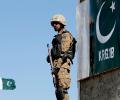
'If push comes to shove, Pakistan does have the capability to make it difficult for the US and NATO forces to make even a withdrawal of troops out of Afghanistan in orderly fashion,' says Ambassador M K Bhadrakumar.

'China's growing nexus with Pakistan and the two countries' unresolved territorial disputes with India continue to pose a formidable national security threat to India,' says Brigadier Gurmeet Kanwal (retd).
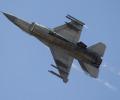
Diplomatic and Congressional sources tell Rediff.com that for all intents and purposes, the F-16 sale is dead.

The declaration also names Pak-based terror groups like LeT and JeM.

Senator John Cornyn, founder and Republican co-chair of the Senate India Caucus, strongly defends his vote against a resolution to block sale of American-made F-16s to Pakistan.

The State Department and the White House too said that the US expects Pakistan to take decisive action against terrorists operating from its soil.

'Part of the problem lies in the US failure to stay focused on the goal of convincing Pakistan to crack down on terrorists that attack India.'

'His secretary of defence nominee, General James Mattis, says he expects Pakistan to take action against terrorists operating from its soil.' 'Any pressure the US can bring on the Pakistani regime terror-wise would pay dividends for India.'

Pakistan's new Army Chief has begun setting the stage to act against groups like LeT and JeM

Karzai has steadfastly opposed direct talks between the US and the Taliban, wanting Afghan ownership of the "reconciliation process", as the reintegration of the Taliban into the mainstream is referred to.
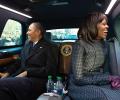
US President Barack Obama told Prime Minister Narendra Modi, when the two met on the sidelines of the East Asia Summit in Myanmar in November 2014, how he barely had two years left to his presidential term and so much to do. The wish list included getting his daughters to see a tiger in the wild and the Taj Mahal.

Sharif raises Kashmir issue at UNGA, renews plebiscite demand.

The United States, which spends billions monitoring adversaries like Al Qaeda, North Korea and Iran, pays an equal amount of attention on ally Pakistan and has ramped up surveillance of its nuclear arms, according to a report.

Swaraj said there is scope to do a lot more and this would be an important element of their deliberations.

Countries in the region like Afghanistan, Pakistan and Maldives face serious existential threats from a mix of terrorist groups active in the region and elsewhere

India and France on Monday inked an Inter-Governmental Agreement on the sale of 36 French fighter jets, Rafale, but were unable to sign the final deal due to some "financial" aspects, which are expected to be sorted out in "couple of days".
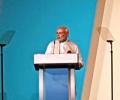
"In the flux and transition of our times, the most critical need in this region is to uphold and strengthen the rules and norms that must define our collective behaviour," he said.

Immediately after India launched its surgical strikes, sources said, it had informed the US of its action.

Narendra Modi's positive engagement with Barack Obama has well and truly washed away the doubts and slights of the past.

As Afghanistan gradually realises that there can be no long-term stability in the country as long as Pakistan is involved, the time has come for India to register its solidarity when it would be most appreciated, says former foreign secretary Shyam Saran.

What India has failed to acknowledge is that sub-conventional war is the name of the game and irregular forces have emerged with greater strategic value over conventional and even nuclear forces, and reliance purely on conventional force and diplomacy is grossly inadequate, says Lt Gen Prakash Katoch (retired).

Just for a moment, says Kamaraj Gopalan, consider the possibility: Dawood Ibrahim captured a few days before the next general election. It would be Dr Singh and the Congress's Osama moment. What answer could Narendra Modi possibly have to that?

'The creation of Pakistan was integral to Britain's grand strategy.' 'If they were to ever leave India, Britain's military planners had made it clear that they needed to retain a foothold in the NWFP and Baluchistan because that would provide the means to retain control of Iran, Iraq, Kuwait, the UAE, Bahrain and Qatar.'

Bharatiya Janata Party President Rajnath Singh, while keynoting a Capitol Hill conference on the topic of India, Afghanistan and Regional Security, has said that as long as Pakistan offers safe havens to the Taliban and terrorist groups within its territory, the United States-led war on terrorism would be a failure.

Friday's incident at Herat has dampened somewhat the spirit behind the invitation. It reminds Modi much before he officially becomes prime minister, of the challenge that awaits his government, says Sheela Bhatt/Rediff.com
Pakistan's hawkish Army chief Gen Ashfaq Parvez Kayani, who did little to change the force's India-centric stance, will leave the world's sixth-largest army grappling with a host of security challenges when he steps down on Friday.

'This is the first time the US has formally recognised the threat India faces from terrorist organisations based in Pakistan.'

A grieving Pakistan's policy shift towards the Taliban has comes at a great cost, says Shahzad Raza.

The prime minister and president stated their intention to expand defence co-operation to bolster national, regional and global security.

'We are completely engaged in fighting poverty; alas, our neighbour Pakistan seems only engaged in fighting us.'

'We're going to see a defence relationship that really takes off -- now that India is a major defence partner of the US, the sky is the limit for arms sales.' 'The economic partnership will lag behind the security relationship, but the meeting and joint statement give cause to believe that it will progress more robustly than many of us would have expected.'
India must watch for signs after Peshawar that Pakistan is waking up to the dangers of Islamism, muses Ajai Shukla
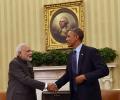
Furthering Indo-US cooperation on terrorism, Prime Minister Narendra Modi and President Barack Obama on Tuesday agreed to make "joint and concerted efforts" to dismantle safe havens for terror and criminal networks like Lashkar-e-Tayib, Jaish-e-Mohammad, Dawood-company, Al Qaeda and the Haqqani network.

'Omar Khorsani has called repeatedly for the most barbaric of attacks. He is very adept on social media. He is, in other words, eerily similar to the ISIS leader Baghdadi.' 'The crux of the army's 'strategic asset' policy -- its policy of regarding militants as those that can help Pakistan pursue its regional interests -- is that Pakistan needs help in weakening India or in keeping its presence minimal in the region.' Michael Kugelman reveals what the world can expect next from the Tehreek-e-Taliban Pakistan, the terrorists responsible for the Peshawar school massacre.

'What is the ISI doing and why can't they understand for their own interest that bringing stability to the region will help all the countries become prosperous, whereas a continuation of incitement will only lead to misery for all.'

The joint statement issued after Prime Minister Narendra Modi and President Barack Obama's first-ever summit is high on intent and ambition. Notably missing from the statement is India's refusal to be America's partner in its war against ISIS.

'The Senators were playing safe, not angering either the pro-India lobby or the pro-Pakistan lobby, but perhaps more importantly, the military-industrial complex -- the most powerful lobby of all -- which the majority of Senators are beholden to in terms of largesse to their campaign coffers.'
 © 2026 Rediff.com - Advertise with us - Disclaimer - Privacy Policy - Sitemap - Feedback - About us - Terms of use - Grievances