
The Delhi government is developing a drone policy focused on creating research clusters, establishing testing facilities, enabling drone use in traffic management, and providing subsidies to support the drone ecosystem.
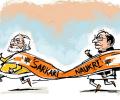
The Delhi government is set to introduce a comprehensive drone policy aimed at creating over 1,000 jobs and regulating drone operations. The policy will focus on establishing research clusters, flight testing facilities, and providing subsidies, while also addressing drone usage for government purposes like traffic management and surveillance, considering the city's extensive 'no drone zones'.

A new study predicts a 55 per cent surge in drone deployment across India's logistics and clean tech sectors over the next three years, driven by rapid digitalisation and the need for faster, more sustainable solutions. The Indian logistics market is projected to nearly double to USD 428.7 billion by 2033, highlighting a significant transformation in these key industries.

The Delhi Development Authority (DDA) has introduced a new Standard Operating Procedure (SOP) to tackle land encroachment and unauthorised constructions in the capital. Following Lieutenant Governor Taranjit Singh Sandhu's directive for "zero tolerance," the SOP mandates demolition within 72 hours of detection by dedicated Quick Response Teams and flying squads. The policy also incorporates technology like geo-tagging and drone inspections, alongside continuous monitoring to prevent re-encroachment.

History may remember Takaichi Sanae not as the leader who simply accelerated Japanese rearmament, but as one who governed during Japan's transition from an industrial-age security model to a post-industrial strategic member of the global order, points out Varun Arya.

Union Home Minister Amit Shah on Thursday said the Centre is committed to curbing unnatural demographic growth caused by abnormal factors, such as infiltration, with a ruthless approach and a quadrangular security grid has been created for the purpose, transforming India's approach from reactive to proactive.

'Why not aspire for 8 or 9 or even 10 per cent?'
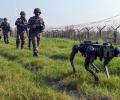
Union Home Minister Amit Shah announced the launch of a tech-enabled 'smart border' project to secure India's borders with Pakistan and Bangladesh. The project aims to stop infiltration and combat demographic changes.
The policy unveiled by the home ministry is based on seven key pillars to counter the terror threats emanating from India or abroad -- prevention, responses, aggregating internal capacities, human rights and "Rule of Law"-based processes.

The Quad grouping has expanded cooperation in critical minerals and energy, while unveiling new measures to boost maritime surveillance and port infrastructure across the Indo-Pacific. This move comes against the backdrop of China's growing military posturing in the region, with ministers reiterating strong opposition to destabilising actions and expressing serious concerns over militarisation of disputed features.

The purge in Washington does not pause the war. Strikes continue, Hormuz remains closed, and Brent crude is still dancing around $109 a barrel. For India, the command chaos in the Pentagon is another layer of uncertainty piled on five weeks of conflict that was already straining every buffer Delhi has.

Fight on toward goals that keep receding, or exit with most objectives unmet. Trump is agitated, his poll numbers falling below the Plimsoll line, his base fractured between those who back the war and those who remember that he campaigned on ending them.

'The entire US ecosystem built over decades at the bases in the Gulf region, especially the UAE, costing trillions of dollars have been decimated, dealing a mortal blow to the US Central Command's war capability,' points out Ambassador M K Bhadrakumar.

'The natural barrier that is Aravalli, you are demolishing it, then who will stop the desert?' 'In future, I predict that people will roam around with oxygen cylinders in Delhi because they won't be able to breathe.'
'Some success has been achieved in raising the costs of terrorism for Pakistan.'

For weeks, the war skirted the edge of catastrophe without tipping over. Missiles flew, there was much destruction, commanders were assassinated, cities across the Gulf and even in Israel struggled to absorb the shock. But one line held: Energy infrastructure, the arteries of the global economy, remained largely untouched. That is no longer true. Prem Panicker continues his must read daily blog on the Gulf War.

Trump may strike. He may announce productive talks and extend again. He may do both at the same time. Iran will not open the Strait on someone else's terms, so no matter what happens, that problem will remain unsolved. And the IRGC will still be collecting its $2 million toll from every ship bold enough to ask permission to pass.

The 'rescue' operation occurred within kilometres of Iran's underground tunnel complex at Isfahan, assessed by the IAEA and US intelligence as holding a substantial portion of the country's 60 per cent enriched uranium stockpile. Retired senior US military officers have highlighted that the mission's footprint -- hundreds of special operators, multiple heavy-lift aircraft deep inside Iran -- appears outsized for recovering a single airman. Prem Panicker continues his must read blog on the Iran War.

The United States, which entered this war in expectation of a short, sharp win along the Venezuela model, is now preparing for deeper involvement in a conflict it does not fully control, without the allies it typically relies on, against an adversary that is not behaving as expected, in a global environment that is already absorbing economic shock. Prem Panicker continues his must read daily blog on the Gulf War.
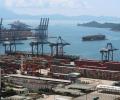
With the Iran war escalating sharply and crisis deepening in the global energy market, India on Monday unveiled a coordinated plan to support exporters and shippers caught in the fallout.
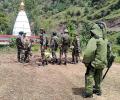
'Unfortunately, India and Pakistan could learn a 'lesson' from this conflict that will make them more likely to use these weapons against each other in the future.' 'Rounds of missile and drone attacks could be more routine features of their hostility, just like artillery fire has become a familiar fact of life along the Line of Control.'

'Should China's interest in the Teesta River projects be approved, it would likely result in heightened Chinese presence near the Siliguri corridor.'
The Congress party has criticized Prime Minister Narendra Modi following repeated claims by former US President Donald Trump that he brokered peace between India and Pakistan.
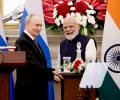
India and Russia have called for an uncompromising global fight against terrorism without hidden agendas and double standards. Prime Minister Narendra Modi asserted that the menace is a direct attack on the values of humanity.

'If a common man wants to buy an air purifier for Rs 10,000, then he will have to shell out Rs 11,800 with 18 percent GST.' 'If he is charged GST at 5 percent the same air purifier will cost Rs 10,500.' 'This saves a one time amount of Rs 1,300 -- and that too just to breathe clean air.'
In 2025, India launched Operation Sindoor, a multi-domain combat mission against Pakistan in response to cross-border terrorism. The operation involved precision strikes, military retaliation, and diplomatic measures, marking a significant shift in India's security policy.
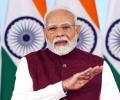
Presenting the full text of Prime Minister Narendra Modi's address to the nation on May 12, 2025, in which he dictated India's new doctrines on countering terrorism.
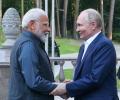
The Indian government is dealing with the matter having in mind the national interests of this country in the first place, he said.
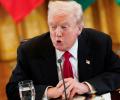
United States President Donald Trump said he could travel to India next year, emphasising that Indian Prime Minister Narendra Modi 'wants' him to visit while calling him a 'great man' and a friend.
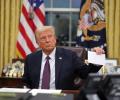
US President Donald Trump claimed India will stop buying oil from Russia, while also stating China will cut back substantially. He also discussed the conflict between India and Pakistan, reiterating his claim of helping settle the conflict.

Prime Minister Narendra Modi launched a sharp critique of the RJD, emphasizing the hardships faced by women in Bihar under its governance. He highlighted the current government's initiatives for women's empowerment and urged them to prevent the RJD's return to power.

'Modi's a great leader... But I don't understand why he's getting into bed with Putin and Xi Jinping...'

While the Saudi drone strike has put the focus back on anti-drone measures, caution also stems from the fact that India has a number of large oil refining assets close to India-Pakistan border.
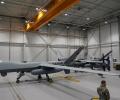
The Agency said it has delivered the required certification notifying Congress of this possible sale on Thursday.
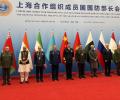
In his address, Singh said there should be "no double standards" in combating terrorism and urged the SCO member nations to condemn the menace with unity.

Trump has repeatedly claimed that he "helped settle" the tensions between India and Pakistan and that he told the nuclear-armed South Asian neighbours that America would do a "lot of trade" with them if they stopped the conflict.

Asserting that India will not tolerate any 'nuclear blackmail', Prime Minister Narendra Modi on Monday said operations against Pakistan have only been kept in abeyance and the future will depend on their behaviour.

The Congress party also called for a special session of Parliament to evaluate the situation in detail, to identify any mistakes that were made, and to ensure that they are not repeated in the future.

The two weeks that EPS took fending off the Sengottaiyan rebellion has since become lost time for the AIADMK as that was also the time Vijay took to go all-out against Stalin and the DMK, observes N Sathiya Moorthy.
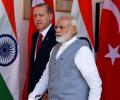
India-Turkiye ties are strained over Ankara's Islamabad tilt, its arms links with Pakistan, and fallout from the Pahalgam terror attack.
