
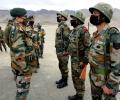
The visit is also aimed at boosting morale of the army personnel engaged in the seven-week bitter border faceoff with the Chinese troops in the region, sources added.
Sources said the process of disengagement along the Line of Actual Control is "complex", and in such a context, speculative and unsubstantiated reports need to be avoided.
This is the third round of Corps Commander-level talks being held. The first two rounds had taken place in Moldo on the Chinese side of the LAC.
As per the sources, the discussions between the two sides include pulling back tanks and armoured vehicles from their present positions, and some development in this regard is likely to take place in the next few days.

'As Indians, we should be claiming and celebrating 'Bhartiyata' rather than seeking commitment to beliefs which are divisive and exclusionary.'
The Indian side also told the Chinese delegation that the talks on disengagement should include Depsang as well as all face-off sites, insisting that it should be a simultaneous process and not a selective one.

'Everytime the Chinese raised the issue of our patrol crossing the line, I told them let's not fight over a line that does not exist yet.' 'Commanders resolved such situations sitting across the table, sometimes we posed veiled threats about creating problems elsewhere along the 800 km frontier as a tit-for-tat.'
Sources said India will not lower its guard and will maintain the current state of very high-level of combat readiness in eastern Ladakh till there are visible changes in the ground situation.
The focus of the deliberations was on finalising modalities for disengagement of troops in eastern Ladakh.

It is learnt that the Indian delegation insisted on a time-bound implementation of the agreement finalised during the extensive talks between External Affairs Minister S Jaishankar and his Chinese counterpart Wang Yi in Moscow on September 10 on the sidelines of a Shanghai Cooperation Organisation(SCO) meet.

The marathon fourth round of Lt Gen-level talks also focussed on steps for pulling back large number of troops and weapons from rear bases along the Line of Actual Control in eastern Ladakh.

Official sources said withdrawal of tanks and other armoured elements from certain friction points is nearing completion while pulling back of troops from the North bank areas is being undertaken.

The agenda of the talks will be to firm up a roadmap for disengagement of troops from all the friction points in eastern Ladakh, the sources said.
'Having tied himself in knots, he just might take a decision which is dangerous, one that could take his nation to war.'

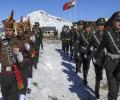
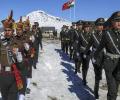
It was a scene of bonhomie as the border personnel of India and China met to mark the Republic Day in Chushul belt along the Line of Actual Control in Ladakh, putting behind the tension over recent incursions by the People's Liberation Army in the area.

Indian Army officers are convinced China is maintaining the pretence of dialogue and negotiations in order to create the opportunity to occupy more Indian territory. Senior Indian planners apprehend this might be a Chinese ploy to divert attention from Depsang, in Northern Ladakh, which might be China's actual target.
The seventh round of military talks between India and China held on Monday was "positive and constructive", and both sides agreed to earnestly implement the understanding reached by their leaders to not turn differences into disputes, a joint statement by the two armies said on Tuesday.
As the border standoff entered the sixth month, an early resolution to the row appeared dim with close to 100,000 Indian and Chinese troops remaining deployed in the high-altitude region and showing readiness for a long-haul. There is no official word on the talks yet but sources said the agenda was to finalise a roadmap for disengagement of troops from all the friction points.
'Today, our vast green pastures where local herders used to take their cattle to graze have been taken over by the Chinese.' 'The people in the Galwan Valley have lost their lands where their cattle used to graze.'

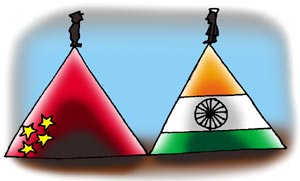
India must break out of this strategic triangulation between China and Pakistan. We need to settle our issues with one of the two, notes Shekhar Gupta.

It is the first highest level face-to-face meeting between the two sides after the border row escalated in eastern Ladakh in early May.
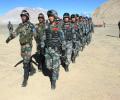
During the course of the intense and complex negotiations between senior commanders of the two armies that ended at 2 am on Wednesday, the Indian delegation also apprised the Chinese PLA about the "red lines" and conveyed that the onus was largely on China to improve the overall situation in the region, the sources said.

'The Pangong Tso lake is frozen from September-October to February-March. The windchill factor is phenomenal. The night temperature goes to minus 40. The area is like a barren desert. You are out in the open with no trees or bushes to take cover.'

The move comes amid hectic diplomatic manoeuvring between the two countries over a host of issues like Nuclear Suppliers Group and designation of Masood Azhar as a terrorist by the United Nations.
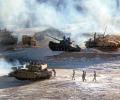
'We must be careful because China has not given its design in Eastern Ladakh.'

General T N Raina was an iconic Indian military leader whose contributions to the nation should be more widely known, notes Lieutenant General Syed Ata Hasnain (retd).

The MEA spokesperson further said the actions and behaviour of the Chinese side since earlier this year along the LAC have been in "clear violation" of the bilateral agreements and protocols concluded between the two countries to ensure peace and tranquility on the border.

Army Spokesperson Colonel Aman Anand said troops from China's People's Liberation Army (PLA) 'violated' the consensus arrived at during military and diplomatic engagements on the ongoing standoff in eastern Ladakh, and carried out provocative military movements to change the status quo.

'The missile mounted near Kailash-Mansarovar is called DF-21. It is a medium-range, 2,200 kilometres ballistic missile. Its advantage is that it can cover all cities of north India, including New Delhi'

Chinese army personnel on Monday joined their Indian counterparts in celebrating the country's Independence Day at Chushul in Leh area, a defence spokesman said in Srinagar.\n\n
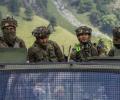
'A breakthrough in eastern Ladakh leading to disengagement and creation of a buffer zone will obviate the need of military deployment through the winter months ahead,' notes Ambassador M K Bhadrakumar.
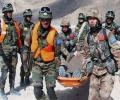
'For the moment in Eastern Ladakh, it is unlikely there will be any more escalation of this conflict,' observes Colonel S Dinny (retd) who served as Commanding Officer of an infantry battalion deployed in the Pangong Tso area.
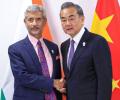
The joint statement said Jaishankar and Wang agreed that both sides should take guidance from the series of consensus reached between leaders of the two countries on developing India-China relations, including not allowing differences to become disputes.
'Once accession to Pakistan appeared unlikely, the British instituted Operations Gulmarg and Datta Khel respectively to foil possible accession to India.'
A new Border Personnel Meeting point was on Saturday operationalised at Daulat Beg Oldie along the Line of Actual Control in Ladakh sector, which would serve as the northern-most meeting point between armies of India and China.
The day-long exercise held "is part of the ongoing initiatives being taken by India and China to ensure greater interaction between troops stationed along the Line of Actual Control.
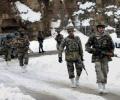
'The Chinese have been moving in step by step; inch by inch for the last 40 years.'
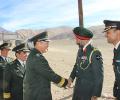
Amidst reports of Chinese incursions, the Peoples Liberation Army and the Indian Army on Sunday decided to uphold treaties and agreements signed between the governments of the two sides to maintain peace and tranquility along the Line of Actual Control.
'China is concerned about its impact within Tibet.'
Did Xi deliver a message to Modi at Mamallapuram, which though couched in a velvet glove was time-bound? What was that message? It is clear Indian/Israeli/US spy satellites would not have missed detecting Chinese troop movements towards the Ladakh-Tibet frontier. Then why did some important functionaries in the Government of India choose to only ask the Russians about this in April 2020? Was Russian reassurance of Chinese troop movements being part of a routine exercise the reason that the Leh-based XIV Corps did not mobilise itself for its annual summer exercises near the LAC? A fascinating excerpt from Iqbal Chand Malhotra's new book Red Fear: The China Threat.
 © 2026 Rediff.com - Investor Information - Advertise with us - Disclaimer - Privacy Policy - Sitemap - Feedback - About us - Terms of use - Grievances