
Until Delhi and Beijing resolve outstanding border issues within an accelerated time frame, standoffs like Doklam will be repeated across various peaks along the Himalayas, says Mathew Maavak.

'The Modi government's greatest blunder is to exploit sensitive external relations in its domestic politics,' says Shekhar Gupta.

India on Thursday completely rejected as "baseless and unsubstantiated" allegations levelled by Pakistan against eight officials of the Indian high commission in Islamabad and strongly protested the manner in which their names and photos were published, compromising their security.

'Either China is building regional transport infrastructure long before it needs it, or this is in a chain of Chinese investments with more strategic than economic intent,' says T N Ninan.
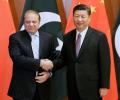
The master plan reveals a far more expansive project involving Chinese penetration into Pakistan's agriculture, industry, telecommunications, surveillance and intelligence networks and even leisure and popular culture.
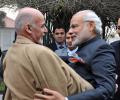
'Foreign ministry sources in Delhi discount the official version of the story, in which Modi made an impromptu request to stop over at Lahore, during the course of a birthday telephone call to Nawaz Sharif. In fact, this stopover had been carefully considered in Delhi, as a way to galvanise the peace process further.'

The stakes are high and it is not certain that slow-moving foreign office bureaucracies can measure up to the challenges being thrown up, says Hardeep S Puri.

'One lesson to emerge out of the Modi-Putin summit is that India can be more self-confident that it possesses inherent strengths to leverage its interlocutors to influence Pakistani policies,' says Ambassador M K Bhadrakumar.
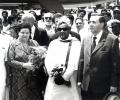
'I was present at a meeting where he decided to permit the IAF to strike at Pakistan positions in Kargil, with the caveat that they should not cross the LoC.' 'Confident that the Indian Army would succeed, Mr Vajpayee was positioning himself to tell the world after the Kargil conflict was won that India did not violate the 'sanctity' of the LoC,' recalls Ambassador G Parthasarathy, who served as India's envoy in Islamabad in that eventful year, 1999.

'The men in black suits and hair dye in Beijing have not only completely blown the cover story of "peaceful rise," but have managed to antagonise regional powers in the Indo-Pacific.'

In an exclusive interview given to ANI in Geneva, Daud said that the formation of a government in exile is possible and remained positive that there is no doubt about it.
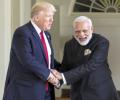
'The Modi government would chaff at the very idea of holding talks with Pakistan, facilitated by Washington and under close US monitoring, when the 2019 poll is sailing into view.' 'But in politics and diplomacy, there may be moments when drinking from the chalice of poison is necessary,' says Ambassador M K Bhadrakumar.

Modi, who is undertaking his first visit to China as prime minister, will reach the ancient city of Xi'an, the home town of President Xi Jinping, for a summit meeting, an unusual departure from normal protocol and seen as a reciprocal gesture by the Chinese leader who was hosted by Modi in Ahmedabad when he visited India in September last year.
'The choice of Dhoka La for the intrusion by Chinese troops is significant and suggests a twin objective of pressuring Thimpu to allow Beijing to establish an embassy there and reinforcing Chinese claims on Arunachal Pradesh,' warns former RA&W officer Jayadev Ranade.

Two years into power, there is very little to show for the Modi government by way of 'achievements' on the foreign policy front, and his China, Pakistan policies are gasping for breath, says Ambassador M K Bhadrakumar.

India has said that it is 'untenable' that 137 developing nations are represented by only one permanent member in the UNSC

'China has refused to act upon the threat posed by Pakistan using terrorism as an instrument of its foreign policy.' says Rajeev Sharma.

Javadekar was at the event, where presence of his ministerial colleague V K Singh last year had drawn flak from the media, for around 20 minutes, and extended his 'best wishes' to the Pakistani people on the sidelines.

India is playing its South China Sea card by restarting oil exploration off Vietnam coast despite China's objections as a calculated geopolitical move to force Beijing to make "compromises" on border issue and its close ties with Pakistan, a state-run Chinese think-tank has said.

'Will Muhammad Habib Zahir -- who was part of the team that arrested Kulbhushan Jadhav and went missing in Nepal -- figure in a Jadhav-for-Zahir deal?' asks Aditi Phadnis.
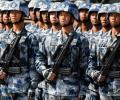
While China's nationalistic tabloid Global Times said India should be taught a 'bitter lesson', another official newspaper, China Daily, said India should look in the mirror.
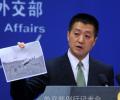
Chinese Foreign Ministry spokesman Lu Kang displayed a photograph of Indian 'incursion' into Donglong area.

'That the two sides allowed such a situation to arise exposed the level of inaction and inefficiency in China-India border management.' 'The Modi-Xi meeting in Xiamen initiated a process to to avert such contingencies in the future.'
The Modi government's appalling inefficiency and lack of purpose stand exposed, says Ambassador M K Bhadrakumar.

'Against the backdrop of difficult administrative, political and economic problems, Imran's temperament and staying power will be the subject of intense expectation and public scrutiny,' says Rana Banerji, who headed the Pakistan Desk at the Research and Analysis Wing, India's external intelligence agency.

While some say an agreement was reached over the Panama Papers, others suggest that Nawaz Sharif may have handed the CPEC to the military in exchange for his survival.

The CPEC poses a clear and imminent danger to Indian security interests, says Kulbir Krishan.

General Bajwa, who commanded the 10 Corps that looks after Pakistan's border with India, is unlikely to change his army's and nation's policy on Kashmir,' says Ambassador M K Bhadrakumar.
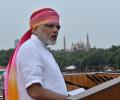
Modi talking about Balochistan, PoK and Gilgit is a tectonic shift in India's policy towards Pakistan, says Abhay Jere.
India brought in more troops after the destruction of two of its bunkers and "aggressive tactics" adopted by the Chinese People's Liberation Army

In 2013, a total of 28,481 Indian websites were hacked

The Dalai Lama's Arunachal visit is not likely to derail the relationship but it is enough to signal the Chinese that India is also willing to flash the Tibet/Taiwan card should the need arise, says Sana Hashmi.

New Delhi and Beijing are the only two regional capitals that have commented on US President Donald Trump's speech on August 21 outlining the way forward in Afghanistan. The Indian foreign ministry statement was effusive in praise, while the Chinese statement has been one of cautious and guarded hope. Delhi has identified itself with Trump's Afghan strategy, whereas the Chinese stance is calibrated -- observant and objective, keeping a distance, says Ambassador M K Bhadrakumar.

If China's behaviour in the past on ticklish issues is any indication then China could eventually support India's NSG application, says Rup Narayan Das.

'Its internal economic rot and corrupt political elite have made the resurgent supremacy of the military establishment more invincible,' says Sunil Sethi.
'No dialogue with India can be successful without the Kashmir on the agenda'

'It will be foolhardy to overlook that this stunning shift in China's stance comes as the culmination of the severely damaged India-China relationship under the present government,' says Ambassador M K Bhadrakumar.

On his recent visit to China, the President made eminently sensible suggestions to improve relations except that they can't work in the present atmosphere.

'China's growing nexus with Pakistan and the two countries' unresolved territorial disputes with India continue to pose a formidable national security threat to India,' says Brigadier Gurmeet Kanwal (retd).

Jaishankar's talks with Yang and later in the Strategic Dialogue were expected to cover the key India-China differences like China blocking India's bid to join the NSG and UN ban on Azhar.
 © 2026 Rediff.com - Investor Information - Advertise with us - Disclaimer - Privacy Policy - Sitemap - Feedback - About us - Terms of use - Grievances