
'This campaign reeks of communalism, which is why it is being opposed.'
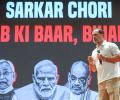
'Rahul Gandhi's problem is that he doesn't think big.' 'He looks more like an activist, while politics is like a game of chess. You attack and then defend and have a game-plan.'
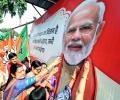
The National Democratic Alliance was set to sweep the Bihar assembly polls, surging ahead in over 200 of 243 seats on Friday with the Bharatiya Janata Party emerging as single largest party with about 90 per cent strike rate, reaffirming the popularity and campaign clout of Prime Minister Narendra Modi, who was the face of the ruling alliance through the poll battle in the highly sensitive political state.

'In times of adversity, families unite, but the reverse is happening in the Lalu family.'

A clash erupted between police and protesters in Bareilly after a demonstration in support of the 'I Love Muhammad' campaign was postponed. The postponement, announced by Maulana Tauqeer Raza, led to anger and stone-pelting, prompting police intervention.

Confusion prevailing in the Indian National Developmental Inclusive Alliance (INDIA) showed little signs of let up on Saturday, with just two days to go before the filing of nomination papers for the second and final phase of assembly elections comes to a close.

With nominations for the first phase of Bihar elections closing soon, the INDIA bloc is struggling to finalize seat sharing, while the NDA has announced its candidates. Key political figures are actively campaigning.

'What must the Indian Air Force pilots -- who destroyed terror bases in Pakistan using BrahMos missiles' -- be thinking?'

An analysis of the upcoming Bihar elections, focusing on the key players, alliances, and issues that will shape the outcome. The article examines the strength of the ruling NDA coalition led by Nitish Kumar and the challenge posed by the RJD-led Mahagathbandhan, as well as the potential impact of Prashant Kishor's Jan Suraaj Party.

AIMIM's Bihar state president Akhtarul Iman, the party's lone MLA in the state, has written to RJD president Lalu Prasad, formally requesting inclusion in the grand alliance.

The Lok Sabha witnessed chaotic scenes as opposition members protested the introduction of three draft laws, leading to torn bills, sloganeering, and adjournments.

Union Minister Amit Shah on Wednesday introduced three Bills in Lok Sabha for the removal of prime minister, chief ministers and ministers arrested on serious criminal charges for 30 days, drawing fierce protests from the Opposition as the draft laws were referred to a Joint Committee of Parliament. Three House marshals formed a protective ring around Shah. Even after the House was adjourned, the Opposition members continued with the sloganeering.

All India Majlis-e-Ittehadul Muslimeen MP Asaduddin Owaisi, part of the all-party delegation led by Bharatiya Janata Party MP Baijayant Panda, said that terrorist groups wrongly use religion to justify killing innocent people.
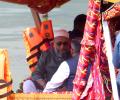
On Tuesday, May 6, 2025, All India Majlis-E-Ittehadul Muslimeen chief Asaduddin Owaisi, MP, visited Srinagar and took a ride in a shikara on Dal Lake. Owaisi has repeatedly denounced the terrorists who murdered 26 tourists at Pahalgam two weeks ago; he has also vociferously condemned Pakistan for its sponsorship of terrorism in India.
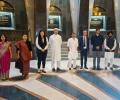
Terrorism is a global menace to be addressed by humanity in unison was the all-party delegation's message to Algeria as it concluded its visit to the North African country on Sunday.
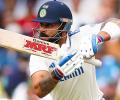
Asaduddin Owaisi, once known more for his fiery medium fast bowling than for his fiery oratory, recalls besting future India paceman Venkatesh Prasad in an inter-university final match in the early 90s.

The Bombay High Court acquitted all 12 accused in the 2006 Mumbai train blasts case, citing a failure by the prosecution to prove their guilt and raising serious concerns about the investigation and evidence presented.
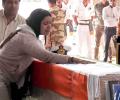
'Operation Sindoor is still ongoing. The Prime Minister himself said that blood and water cannot flow together, that talks and terrorism cannot go together. So how can we have a cricket match with a country that indulges in terrorism?'
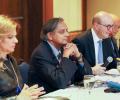
Fifty-nine members of delegations visiting 33 world capitals, reaching millions of people, giving one message, in one language, in one voice -- is an unprecedented world movement, observes former BJP MP Tarun Vijay, former Chief Editor, Panchjanya, the RSS weekly.
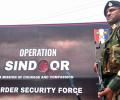
Their shared brief: To assert India's case with clarity, rebut hostile narratives, and secure enduring partnerships for global counter-terror cooperation.

AIMIM chief Asaduddin Owaisi slammed Pakistani politician Bilawal Bhutto-Zardari for his "blood would flow in rivers" remark and called former cricketer Shahid Afridi a "joker" for his comment on the Pahalgam terror attack. Owaisi also supported India's decision to suspend the Indus Waters Treaty and called for Pakistan to be placed on the FATF grey list. He also advocated for cyber attacks against Pakistan.
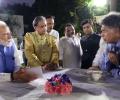
Prime Minister Narendra Modi on Tuesday said he was proud of the manner in which the multi-party delegations presented India's views in various countries on the need to eradicate the menace of terrorism following the Pahalgam attack and Operation Sindoor.
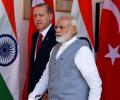
India-Turkiye ties are strained over Ankara's Islamabad tilt, its arms links with Pakistan, and fallout from the Pahalgam terror attack.

He added, "You can never trust Pakistan as long as the Pakistani deep state, Pakistani ISI, Pakistani military's objective is to destabilise Bharat."
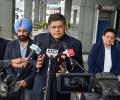
'It is high time that the 'war on terror' is removed from our diplomatic toolbox.' 'Certainly, our parliamentarians have no role in it,' asserts Ambassador M K Bhadrakumar.

The Supreme Court on Friday refused to entertain a fresh plea challenging constitutional validity of the Waqf (Amendment) Act, 2025.
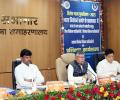
'The Election Commission is conducting the National Register of Citizens in Bihar through the backdoor.'
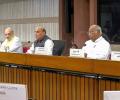
The Indian government briefed an all-party meeting on Thursday on the success of "Operation Sindoor", the retaliatory airstrikes against Pakistan following the Pahalgam terror attack. Top government functionaries and opposition leaders met for a second time in a fortnight amid rising tensions between India and Pakistan. The meeting was chaired by Union Home Minister Rajnath Singh and attended by several prominent leaders from various political parties. The government highlighted the strikes on nine terror targets in Pakistan and Pakistan-occupied Kashmir, including the Jaish-e-Mohammad stronghold of Bahawalpur and Lashkar-e-Taiba's base Muridke.
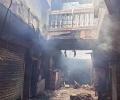
For the 17 people who perished in a blaze near the historic Charminar in Hyderabad on Sunday, the house located in a tunnel-like alley with a narrow entrance and staircase proved to be the death trap as it prevented them from escaping to safety.
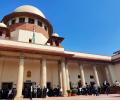
The Supreme Court on Monday agreed to consider listing for urgent hearing the petitions challenging the constitutional validity of the Waqf (Amendment) Act, 2025.

Several petitions were filed in the apex court challenging the Act, contending that it was discriminatory towards the Muslim community and violated their fundamental rights.
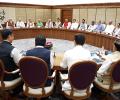
The diplomatic exercise aimed at presenting India's stance against Pakistan on terror comes in the wake of Operation Sindoor -- the Indian offensive against terror camps in Pakistan and Pakistan-occupied Kashmir following the April 22 terror attack in Pahalgam in which 26 people, mostly tourists, were killed.
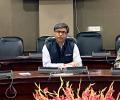
The sources said Misri reiterated the government's stand that the decision to stop military actions was taken at a bilateral level, as some opposition members questioned US President Donald Trump's repeated assertions about his administration's role in stopping the conflict.

The government will send seven all-party delegations to key partner countries, including members of the United Nations Security Council, later this month to convey India's message of zero tolerance against terrorism following the Pahalgam terror attack and Operation Sindoor.
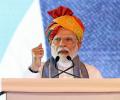
'Such a remark does not behove the Prime Minister. Also, you have brought the country's youth to this point. There are no jobs. The only option is to fix punctures or sell fritters. Muslims don't just make punctures. I can list what Muslims have made'

A blaze triggered by a suspected short circuit in a building near the iconic Charminar here on Sunday left 17 people dead, with a majority of them being children.

The Congress party has accused the BJP of engaging in "damage control" after the party distanced itself from comments made by two of its MPs, Nishikant Dubey and Dinesh Sharma, criticizing the Supreme Court. Congress general secretary Jairam Ramesh stated that the BJP's clarification was merely an attempt to mitigate the damage caused by the MPs' remarks and that the party's actions were hypocritical, given the silence of the BJP president on similar comments made by other party members.
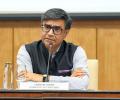
Foreign Secretary Vikram Misri, who faced trolling on social media in the wake of India and Pakistan reaching an understanding on May 10 to halt all military actions, has received support from veteran diplomat Nirupama Menon Rao, a body of Indian diplomats and a host of politicians from several parties.
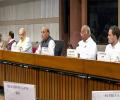
The delegations led by Baijayant Panda, Ravi Shankar Prasad (both Bharatiya Janata Party), Sanjay Kumar Jha (Janata Dal-United), Shrikant Shinde (Shiv Sena), Shashi Tharoor (Congress), Kanimozhi (Dravida Munnetra Kazhagam) and Supriya Sule (Nationalist Congress Party-Sharad Pawar) will visit a total of 32 countries and the EU headquarters in Brussels, Belgium.
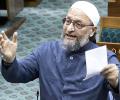
A court in Bareilly has directed All India Majlis-e-Ittehadul Muslimeen supremo Asaduddin Owaisi to appear before it over a plea that claimed he had violated the Constitution by raising a slogan hailing Palestine in Parliament.
 © 2026 Rediff.com - Advertise with us - Disclaimer - Privacy Policy - Sitemap - Feedback - About us - Terms of use - Grievances