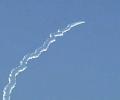
India on Monday successfully launched the first technology demonstrator of indigenously made Reusable Launch Vehicle, capable of launching satellites into orbit around earth and then re-enter the atmosphere, from Sriharikota in Andhra Pradesh.

'We have all the technologies available, but it should be converted to something that can be commercially viable.'

India's heavy-lift rocket GSLV MkIII, carrying communication satellite GSAT-19.

Countdown began on Thursday for the launch of the latest navigation satellite that will make India on par with the GPS of the US.

"I am extremely happy to announce that GSLV Mark III successfully injected Chandrayaan 2 in the defined orbit, infact the orbit is 6,000 km more than what was intended," Sivan said.

ISRO needs next generation launchers and new facilities to manufacture and launch them.

The Indian Space Research Organisation has resolved to alight its lander on the lunar surface with Chandrayaan-3 in addition to a maiden solar expedition in 2020.

India's ambitious space mission to explore planet Mars would be launched on November 5 from the spaceport of Sriharikota, ISRO announced on Tuesday.

ISRO has released the footage of the injection of PSLV-37 which launched a record 104 nano-satellites overseas customers into the orbit in blocks in a series of separations.

The countdown began at 6.27 am for the launch on board ISRO's third generation workhorse Polar Satellite Launch Vehicle, in its 47th flight, ISRO said.

This would be the 44th flight of the PSLV and the third launch by ISRO this year.

Andhra Pradesh Chief Minister N Chandrababu Naidu on Monday met the victims of the building collapse incident in Chennai and promised to provide necessary medical care and relief on a "war-footing" for them.
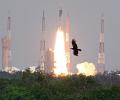
The BJP hit back accusing the Congress of drawing the issue into political arena.

Indian skipper Virat Kohli, on Monday, lauded ace sprinter Hima Das for winning five gold medals in a span of 20 days.

The image shows a part of Indore with the Holkar Cricket Stadium in the centre.

They made history for India and the world.

The stage is set for the launch of India's satellite IRNSS-1D on Saturday from Sriharikota onboard workhorse PSLV-C27 that would pave the way for the country's own navigation system on par with the GPS of United States.

The director suggested that he is ready to go if provided with a room and a ticket.

The 3,423 kg GSAT-29 carries Ka and Ku band high throughput transponders intended to meet the communication requirements of users, including in the North East and in Jammu and Kashmir.

The announcement comes two days ahead of the proposed historic launch of the ISRO's 100th satellite along with 30 others in a single mission from Sriharikota.
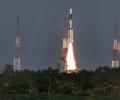
The satellite will enable a full range of services to neighbours including the areas of telecommunication, television, direct-to-home, VSATs, tele-education and tele-medicine.

The launch of IRNSS IC, the third of seven satellites in the series to put in place India's navigation system at par with US' Global Positioning System, that was deferred following a technical snag has been rescheduled for October 16.
Here's a breakdown of how the series of events unfolded at the Satish Dhawan Space Centre at Sriharikota
With a mission life of ten years, INSAT-4CR will carry 12 high-power Ku-band transponders designed to provide Direct-to-Home television services, facilitating video picture transmission and digital satellite news gathering.
It is raining heavily at Sriharikota where the Satish Dhawan Space Centre is located
For carrying the 360-kg Italian satellite, meant for astronomical studies, Indian Space Department's commercial wing Antrix Corporation would receive a fee from the Italian space agency.

Some abandoned boats have been recovered in the Sir Creek area, Lt Gen S K Saini, GOC-in-C of the Army's Southern Command, told reporters at an event near Pune.

The mission life of the 2,250kg GSAT-7A, built by ISRO, is eight years. It will provide communication capability to users in Ku-band over the Indian region.
ISRO chief's comments came after NASA said that it had found the remains of the Vikram lander by its Lunar Reconnaissance Orbiter and credited the discovery to Chennai-based amateur astronomer and engineer Shanmuga Subramanium.

The mission has three modules - Orbiter, Lander (Vikram) and Rover (Pragyan)
The PSLV-C8 rocket will make its first commercial launch with an Italian astronomical satellite on board.
INSAT-4CR is similar to INSAT-4C, which was lost during the unsuccessful launch last year.
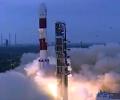
RESOURCESAT-2A, intended for resource monitoring, is a follow-on mission to RESOURCESAT-1 and RESOURCESAT-2, launched in 2003 and 2011 respectively. It is intended to continue the remote sensing data services to global users provided by RESOURCESAT-1 and 2.

The successful orbiting of the satellites by the Polar Satellite Launch Vehicle PSLV C-40 comes four months after the Indian space Research Organisation's mission to launch backup navigation spacecraft IRNSS-1H onboard PSLV-39 ended in a rare failure.
India on Monday successfully launched five foreign satellites from four countries on board PSLV-C23 rocket which placed them in orbit, an achievement described by Prime Minister Narendra Modi as an 'endorsement' of the country's space capabilities.
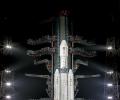
The Indian Space Research Organisation on Thursday launched its first experimental suborbital flight. Here are five things you need to know about the GSLV Mark III mission.

Here's a recap of moments captured in India in the past 24 hours.

India performed yet another space feat on Wednesday when the Indian Space Research Organisation launched a record 104 satellites into orbit from Sriharikota, Andhra Pradesh, something no other country has done before.
There is a lot of buzz at Sriharikota where the Indian Space Research Organisation prepares to launch the ambitious Rs 450 crore Mars mission called the Mangalyan.
