
In a New Year gift to the nation, the Indian Space Research Organisation on Sunday successfully launched a Geosynchronous Satellite Launch Vehicle with an indigenous cryogenic engine from the spaceport of Satish Dhawan Space Centre in Sriharikota, entering a select club of nations.
In a landmark journey into a new era of space application, India successfully launched its first dedicated navigation satellite using the Polar Satellite Launch Vehicle, which blasted off from the Satish Dhawan Space Centre in Sriharikota, Andhra Pradesh.
The Polar Satellite Launch Vehicle is carrying 1360-kg satellite 'Resourcesat -I'.
ISRO has put out stunning photos of the launch of GSLV-D5. The vehicle smoothly lifted off to space from Sriharikota on Sunday afternoon and put India into the elite 'cryogenic club'.
Security has been beefed up at the Satish Dhawan Space Centre at Sriharikota in Andhra Pradesh in the wake of credible intelligence that the high-profile place is under the radar of Pakistan-based terror groups.
India's ambitious Mars Orbiter Mission will send a spacecraft hurtling into space on a 400-million-kilometre journey that will last a year. The blast off is on Tuesday afternoon.

The ISRO is aiming for a soft landing of the lander in the South Pole region of the moon where no country has gone so far.

Microsat-R, an imaging satellite, is meant for military purposes, but the ISRO did not give any details about it.
A symbol of self-reliance, India's space endeavours are a model for public-private partnership.

The Indian space agency is all set to embark on its most complex mission.
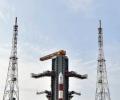
Here are some things you must know about this significant launch and why this satellite is a big deal for India.
India's Mars Orbiter Mission, which will look for scope of life on the red planet, will be a reality in either October or November as the Indian Space Research Organisation unveiled the mission on Wednesday.
.jpg)
The 56 and-a-half hour countdown for the launch of India's first space mission to Mars, slated for November 5, commenced on Sunday at the Satish Dhawan Space Centre in Sriharikota.
A country that can launch a 229-tonne rocket with seven international satellites into space does not need to import trucks, howitzers or helicopters, says Claude Arpi, who was present at the PSLV launch in Sriharikota on Monday.

The British-built Strand-1 spacecraft, developed by scientists in Surrey, was sent into orbit from Sriharikota in India to test the capabilities of many standard smartphone components for a space environment.

"I remember Chandrayaan-2's launch was earlier scheduled on July 15. I was there in Sriharikota. I saw the massive carrier, 'Bahubali', from close proximity.

The landing on the moon near the South Pole, an uncharted territory so far, would be on September 6 or 7, Sivan told reporters, as the Indian space agency is all set to embark on its most complex mission.

India is the fourth country to demonstrate the flight testing of Scramjet Engine after the United States, Russia and European Space Agency.
Indo-French satellite 'SARAL', aimed at oceanographic studies, would be launched along with a mix of six foreign mini and micro satellites on board PSLV-C20 from the spaceport of Sriharikota on February 25.

The polar satellite launch vehicle-C42 launch vehicle carrying the two satellites blasted off from the first launchpad at the Satish Dhawan Space Centre at 10.08 pm.

PSLV C-29 blasted off from the Satish Dhawan Space Centre, about 110 km from Chennai, at 6 pm and released the six satellites one by one into a 550 km circular orbit.

Scientists also expressed the hope that any technical problem will be sorted out by ISRO, and the mission will be launched successfully.

A US court has asked Antrix Corporation, the commercial arm of Indian Space Research Organisation, to pay a compensation of USD 1.2 billion to a Bengaluru-based startup, Devas Multimedia, for cancelling a satellite deal in 2005.
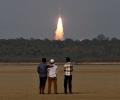
'The goal seems to be that we do not invest further in our system to make our system more accurate and more reliable or more global in reach,' an ISRO source tells Shivanand Kanavi.
It was a historic day for the Indian Research Space Organisation on Sunday, says Vicky Nanjappa
ISRO sources said that with Sunday's mission, the agency has launched 62 satellites, one space recovery module and 37 rockets, making it a grand 100
ISRO plans to launch 720-kg SPOT-6 remote sensing satellite from France (built by ASTRIUM SAS) and a 15-kg Japanese spacecraft Protiers on board the home-grown Polar Satellite Launch Vehicle (PSLV-C21) in the second week of September, in a major milestone of sorts.

The 1,858 kg spacecraft, the country's first microwave remote sensing satellite, was injected into orbit by the Polar Satellite Launch Vehicle about 19 minutes after a perfect lift off at 5.47 am at the end of the 71-hour countdown from the Satish Dhawan Space Centre, around 90 km from Chennai.

India's Mars Orbiter Mission is slated to be launched on October 28 after a national committee of experts gave the go ahead for the Rs 450 crore ambitious venture after threadbare deliberations.
According to ISRO officials, Earth bound orbit is a phase during which the spacecraft will remain in the Earth's sphere of influence.
India's Polar Satellite Launch vehicle-C16 rocket on Wednesday successfully launched into orbit the latest remote sensing satellite Resourcesat-2 that would study and help manage natural resources along with two nano satellites.

Swapnila said they saw the GSLV Mk-III rocket that will launch the mission into space. "It was so huge," she added.
In a jolt to India's space programme on Saturday, the launch of a communication satellite aboard a home-grown vehicle failed after the rocket exploded midair minutes after the lift-off from the spaceport in Sriharikota.
Indian Space Research Organisation is using the most powerful configuration of its rocket Polar Satellite Launch Vehicle to launch a communication satellite from Sriharikota on July 15, as it braces for the nearly Rs 200 crore mission.

Military use apart, the new satellite would be useful for urban and rural applications, coastal land use and regulation, utility management and various related applications.

Congratulate ISRO and its brilliant scientists for positioning the country in an elite group of nations exploring outer space.

The 43.43 metre tall rocket lifted off at 5.28 pm from the second launch pad at the Satish Dhawan Space Centre in Sriharikota
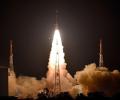
"I am really grateful to the entire ISRO family for having worked this hard and making IRNSS-1I a success," said the space centre's chief K Sivan.
