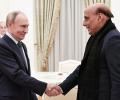
'Friendship between our countries is higher than the highest mountain and deeper than the deepest ocean,' the defence minister told the Russian president.

Putin is keen on establishing a good personal rapport with Trump and anchor a meaningful US-Russia partnership, realistic enough to accept that Trump is as good an American president as Russia would ever get, observes Ambassador M K Bhadrakumar.
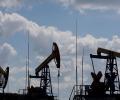
Two days after Russian President Vladimir Putin concluded his visit to India, during which he assured that Moscow would remain a reliable energy supplier, the Kremlin on Monday said that India, as a sovereign nation, is free to buy oil from sources it deems beneficial. It expressed confidence that New Delhi will continue to prioritise its economic interests.

The Rose Monday Parade is the highlight of Germany's carnival celebrations, particularly in cities like Cologne, Dusseldorf and Mainz.

Egypt, Pakistan, Saudi Arabia and Turkey met in Islamabad in what analysts say is the formal opening of a new diplomatic formation that could reshape the post-war regional order. Their immediate goal is a ceasefire; their larger ambition is to ensure that neither Iran nor Israel emerges from this war in a dominant position. Pakistan's foreign minister then flew directly to Beijing and mooted a Chinese role as guarantor of any eventual agreement. Prem Panicker continues his must read daily blog on the Gulf War.
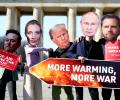
mir Putin and far right German politician Alice Weidel at a protest at the Brandenburg Gate in Berlin, Germany, February 20, 2025.

Putin's State visit will centre on fixing the huge India-Russia trade imbalance, with both sides pushing to lower duties, ease non-tariff barriers, and seal a landmark mobility pact to send more Indian workers to Russia.
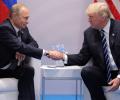
Trump said that he and Putin agreed to have their respective teams start negotiations immediately and begin by calling Ukraine President Volodymyr Zelenskyy regarding the conversation.

The 98th Academy Awards was a mix of high fashion, subdued politics, flashes of humour and emotions running high.
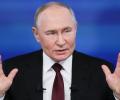
Russian President Vladimir Putin while speaking at his annual end-of-the-year news conference said that he was ready to discuss the possibility of reaching a compromise in talks with United States President-elect Donald Trump on the issue of Ukraine, Al Jazeera reported.

Russian President Vladimir Putin is expected to travel to India next year as part of the established framework for reciprocal annual engagements between the leaders of the two nations, the Kremlin has said.

'Much will depend on the position of the United States.' 'It will have to be seen to what extent the US will be more interested in achieving some form of a deal and to what extent Israel will be allowed to continue to carry out both airstrikes and the killing of Iranian officials.'
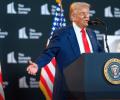
The comments come ahead of Trump's high-profile meeting with Russian President Vladimir Putin, scheduled for Friday in Anchorage, Alaska.
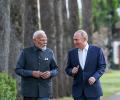
Speaking at a joint press conference with Belarus President Alexander Lukashenko on Thursday, Putin said that Russia agrees with the proposals to cease hostilities but "proceeds from the assumption that this cessation should lead to long-term peace and eliminate the root causes of the crisis."
Trump has made clear his intention to mediate a resolution between the two nations, emphasising the need for a swift de-escalation of violence.
President Vladimir Putin announced that Russia has successfully tested the Poseidon, a nuclear-powered submersible drone with unlimited range, along with updates on the Sarmat missile and Burevestnik cruise missile.
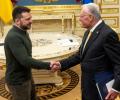
United States President Donald Trump's special envoy for Russia-Ukraine negotiations, Keith Kellogg, has been excluded from high-level discussions aimed at ending the war in Ukraine, according to a report in NBC News.

The United States, which entered this war in expectation of a short, sharp win along the Venezuela model, is now preparing for deeper involvement in a conflict it does not fully control, without the allies it typically relies on, against an adversary that is not behaving as expected, in a global environment that is already absorbing economic shock. Prem Panicker continues his must read daily blog on the Gulf War.

India and Russia have agreed to encourage joint manufacturing of military hardware and spare parts in India, aiming to improve maintenance of Russian-origin defence equipment and boost overall bilateral defence cooperation.
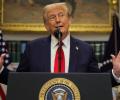
United States President Donald Trump has warned his Russian counterpart Vladimir Putin to end the 'ridiculous war' in Ukraine or face high tariffs and further sanctions.

Prime Minister Narendra Modi is visiting Japan and China to further national interests and build cooperation for regional and global peace.
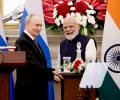
India and Russia have called for an uncompromising global fight against terrorism without hidden agendas and double standards. Prime Minister Narendra Modi asserted that the menace is a direct attack on the values of humanity.

The question is no longer whether the war will expand. It has. The next few days will tell us whether the war stabilises around Hormuz or whether the Strait itself becomes the trigger for a far larger rupture. What to watch for over the next 48 hours is simple: Any move by the US toward direct naval control of the Strait; any credible Iranian attempt to disrupt or mine shipping lanes and, critically, whether energy infrastructure in the Gulf continues to be targeted.If those lines are crossed in tandem, the war will no longer be containable within the region.

What we are watching is something different: A fog manufactured and maintained by the people who started the war, so that the question of why it was started never has to be answered, observes Prem Panicker in his must read blog on the war in the Middle East.

World leaders, including US President Donald Trump, Russian President Vladimir Putin and Israeli Prime Minister Benjamin Netanyahu, condemned the terror attack in Jammu and Kashmir that killed 26 people, expressing solidarity with India. The attack was claimed by The Resistance Front (TRF), a proxy of the Pakistan-based Lashkar-e-Taiba (LeT) terrorist group. The attack came during US Vice President J D Vance's maiden visit to India. Prime Minister Modi, who had arrived in Saudi Arabia on a two-day visit earlier in the day, cut short his visit and departed for New Delhi on Tuesday night following the attack.
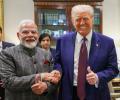
Trump announced that India and the US agreed to a trade deal under which Washington will charge a reduced reciprocal tariff on Delhi, lowering it from 25 per cent to 18 per cent.

Deputy Chairman of Russia's National Security Council Dmitry Medvedev claims military victory in Ukraine is visible and emphasizes the need to plan for the aftermath. He also comments on Donald Trump's desire to be seen as a peacemaker.

'Parents are forced to provide their children to Russian re-education camps in occupied territories and in different parts of Russia, for example, in Chechnya, where Ukrainian children wearing military uniform are taught to use weapons.'

Alekseyev, deputy chief of Russian military intelligence (GRU), has been involved in Russia's military campaigns in Ukraine and Syria. He's also been sanctioned by the US and EU for his role in malicious cyber activities and the nerve agent attack in Salisbury, England.

Both men spent most of their careers in their nations' intelligence services before they ascended to bigger roles -- Doval in the Intelligence Bureau; Putin in the KGB.
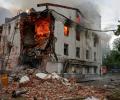
Ukrainian President Volodymyr Zelenskyy on Sunday said that a "dignified end" to the war was possible given that the US was demonstrating a constructive approach.
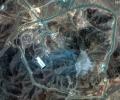
Iran on Sunday vowed to avenge the United States bombing of three of its major nuclear facilities saying the American strikes will have 'everlasting consequences'.

A 500 per cent tariff would effectively shut out India's goods and services exports to the US.

United States President Donald John Trump and Ukrainian President Volodymyr Zelenskyy met for lunch at Trump's Mar-a-Lago club in Palm Beach, Florida, on Sunday. This was their first one-on-one meeting after their disastrous encounter at the White House in March.

Fight on toward goals that keep receding, or exit with most objectives unmet. Trump is agitated, his poll numbers falling below the Plimsoll line, his base fractured between those who back the war and those who remember that he campaigned on ending them.

United States President Donald Trump has said Prime Minister Narendra Modi 'knew he was not happy' with India's purchases of Russian oil and that Washington, DC can raise tariffs on New Delhi 'very quickly'.

Russia's unprecedented rapprochement with North Korea has raised concerns about the re-emergence of a Russia-China-North Korea alliance which could increase the probability of conflict on the Korean Peninsula, explains Dr Rajaram Panda.
During a bilateral lunch with the Ukrainian President in the White House, Trump reiterated his confidence in facilitating an end to the ongoing war.

Israel and the United States had a plan. Iran punched back. And now the Gulf is reeling, the world is beginning to feel the pain and, as on date, no one in Washington or Tel Aviv appears willing to admit that the punch has landed, notes Prem Panicker, continuing his must-read blog on the war in the Middle East.
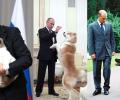
Animal companions are often excellent publicity vehicles for politicians and leaders.
