
The Union Cabinet on Thursday repealed the Tamil Nadu Legislative Council Act, thereby laying the foundation of a political strategy to woo the ruling All India Anna Dravida Munnetra Kazhagam. After Home Minister P Chidambaram proposed the agenda and sought the views of other ministers in the Cabinet, Prime Minister Manmohan Singh gave his go-ahead for the repeal.

The AIADMK is facing a potential split after post-election disagreements, with one faction voting against the government and another defying party orders. Key leaders have been removed from their posts, and accusations are flying between the opposing sides.

Gehlot had on Wednesday refused to deliver the address to the Karnataka legislature, leading to a stalemate over the fate of the customary speech that outlines the government's policies.

Karnataka Governor Thaawarchand Gehlot has refused to address the joint sitting of the state legislature, prompting government intervention. The reasons are unclear, but follow similar incidents in other states.

BJP-ruled states argued in the Supreme Court that governors and the President have autonomy in assenting to bills passed by state assemblies, asserting that courts cannot mandate assent.
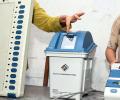
EVMs can't be used in presidential, vice-presidential, or Rajya Sabha polls because they only count simple votes, not the preference-based system needed for these elections.

The Supreme Court has questioned the practice of Governors withholding assent to bills indefinitely, stating that it renders the constitutional provision of 'as soon as possible' meaningless.
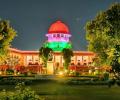
The Centre has told the Supreme Court that imposing fixed timelines on governors and the president to act on bills passed by a state Assembly would amount to one organ of the government assuming powers not vested in it by the Constitution and lead to a "constitutional disorder".

However, Rajya Sabha being a continuing chamber is not subject to dissolution, and bills introduced and pending in this House remain on the live register, unless withdrawn by the government.

The Supreme Court of India has agreed to hear on May 6 the pleas of the Kerala government against the governor over the delay in approving bills passed by the state assembly. The court will consider whether the issues raised in the Kerala petition are covered by a recent judgment on a similar plea by Tamil Nadu, which set timelines for governors and the President on granting assent to bills.
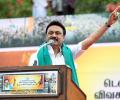
Tamil Nadu Chief Minister M K Stalin has welcomed the Supreme Court's ruling that state governors must give assent to bills passed by state assemblies, calling it a 'historic' victory for all state governments in India. The court's decision came after the Governor of Tamil Nadu, R N Ravi, withheld assent to several bills passed by the state legislature. The court found that the governor's actions were in violation of the Indian Constitution, which mandates that governors must act on the advice of the council of ministers. The ruling is seen as a significant step towards strengthening the federal structure of India.

In a landmark verdict, the Supreme court fixed a timeline for Governor to act on bills passed by the state legislature as it pulled up Tamil Nadu Governor R N Ravi for reserving 10 bills for President's consideration, saying it was against the constitutional provisions.
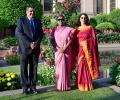
Four days after the top court cleared 10 bills, which were stalled and reserved by Tamil Nadu Governor R N Ravi for the president's consideration, and set a timeline for all governors to act on the bills passed by the state assemblies, the judgement running into 415 pages was uploaded on the apex court's website at 10.54 pm on Friday.

Karnataka has the highest number of medical seats in the country at 11,745, of which 3,750 seats were in government institutions and 7,995 seats were in private colleges.
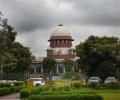
A bench comprising justices J B Pardiwala and R Mahadevan on April 8 gave a huge relief to the Dravida Munnetra Kazhagam-led Tamil Nadu government and cleared 10 state bills which were stalled and reserved by Governor R N Ravi for President's consideration, and also set a timeline for all governors to act on the bills passed by state assemblies.
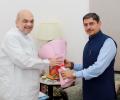
Given the politics behind it all, one possibility is for binding the governor to act according to the decisions of the state government and clarifying his position vis a vis bills and resolutions passed by the state assembly -- or, re-enacted if returned, points out N Sathiya Moorthy.
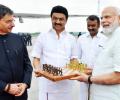
Is Governor Ravi acting without informing/consulting the Centre, or is the BJP leadership unsure of what to do with the DMK in Tamil Nadu? asks N Sathiya Moorthy.
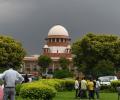
In a significant development, the Supreme Court on Friday agreed to consider the separate pleas of opposition-ruled Kerala and West Bengal, alleging the denial of assent to bills passed by the respective legislative assemblies.

The bench said the report submitted by the special judge indicates that he has 29 cases with him. In many cases, the trial has begun while in many others the trial is yet to begin.
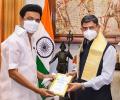
The Supreme Court on Monday agreed to consider a plea of the Tamil Nadu government against the refusal of Governor RN Ravi to appoint senior DMK leader K Ponmudi as a minister in the state cabinet.

The Ministry of Ports, Shipping and Waterways has released a draft to amend the Indian Ports Act, 1908, which aims to bring in sweeping reforms in the sector by bringing non-major ports into the national fold, creating a new mechanism for resolution of disputes, and empowering maritime state development council (MSDC). The draft bill will see comments from stakeholders before being tabled in Parliament. "The Indian Ports Act, 1908 is more than 110 years old. It has become imperative that the Act is revamped to reflect the present-day frameworks, incorporate India's international obligations, address emerging environmental concerns, and aid the consultative development of the ports sector in the national interest," the shipping ministry said.

The state government said these bills had been pending with the governor for as long as about two years and his action "subverted" the functioning of the state legislature, rendering its very existence "ineffective and otiose".

'Mr Attorney General, we are seriously concerned about the conduct of the governor. We did not want to say it out loud in court, but he is defying the Supreme Court of India.'

The bill to amend the law governing Waqf boards proposes far-reaching changes in the Wakf Act, 1995, including ensuring the representation of Muslim women and non-Muslims in such bodies.

The BJP continuing to look at the Dravidian polity through the religious prism has not worked in Tamil Nadu whereas it has yielded political and electoral results across much of the rest of the country, observes N Sathiya Moorthy.

Is it is necessary to play divisive politics to succeed in the next general elections? asks Dr Sudhir Bisht.

A bench of Chief Justice DY Chandrachud and Justices PS Narasimha and JB Pardiwala was told by solicitor general Tushar Mehta that he had some discussion with the governor on the issue and would make a statement on the next date of hearing.
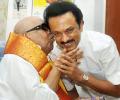
'With the deaths of Jayalalithaa and Karunanidhi, the BJP and Congress thought that they had a chance.' 'They have conceded that power is with the Dravidian parties.'

The value of the vote of a member of Parliament has gone down to 700 from 708 in the presidential poll scheduled for July 18 due to the absence of a legislative assembly in Jammu and Kashmir.

On the night of July 5, the Tigers launched their first kamikaze operation. Miller took the wheels of the explosive-packed truck, smiled at everyone as he turned the ignition key and drove it slowly towards the Sri Lankan military camp. A few moments later all of Jaffna heard a thunderous explosion that brought the complex crashing down in clouds of dust. Miller had given birth to a deadly tactic that Prabhakaran would employ time and again with devastating consequences to Sri Lanka -- and India. A fascinating excerpt from M R Narayan Swamy's must read new book, The Rout Of Prabhakaran.

As per the bill, the salary and allowances of legislators have been raised from Rs 55,000 to Rs 1,05,000 per month, an increase of 90.91 per cent.

The EVMs are based on a technology where they work as aggregator of votes in direct elections such as the Lok Sabha and state assemblies.

The EVMs, officials explained, are not designed to register this system of voting.

The Maharashtra legislative assembly on Thursday unanimously passed a bill which makes Marathi a compulsory subject across all schools in the state. The development came on `Marathi Bhasha Din' (Marathi language day) which is celebrated on February 27, the birth anniversary of poet and Jnanpith award winner late V V Shirwadkar. The state legislative council had passed the legislation, titled `Maharashtra Compulsory Teaching and Learning of Marathi Language in Schools Bill, 2020', on Wednesday.
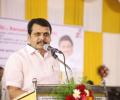
The Madras high court on Tuesday observed that the continuance of V Senthil Balaji as a minister without portfolio in the MK Stalin-led Tamil Nadu cabinet will serve no purpose and it does not augur well with the principles of good governance and purity in administration.

The DMK and its allies submitted a list of pending assembly bills with the Raj Bhavan.

Good intentions and elaborate roadmaps apart, there is an urgent need for the Tamil Nadu chief minister to come up with branded schemes like MGR's meal scheme, asserts N Sathiya Moorthy.

The All India Anna Dravida Munnetra Kazhagam general council meeting on Monday revived the general secretary post, and picked Edappadi K Palaniswami as the interim GS.
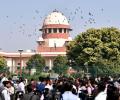
Tamil Nadu's unending legislative fight for exemption from NEET has now flagged the question if it's time to review the Supreme Court's famous verdict in the 'Mandal case', fixing 50-per cent upper-limit for all reservations, asks N Sathiya Moorthy.
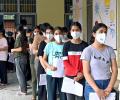
As the petition points out, new medical colleges entail adjunct government hospitals, thus making specialised medical care that much more accessible to the vast majority of population that otherwise could not afford high-cost medical care in the private sector, N Sathiya Moorthy points out.
 © 2026 Rediff.com - Advertise with us - Disclaimer - Privacy Policy - Sitemap - Feedback - About us - Terms of use - Grievances