
External Affairs Minister S Jaishankar on Monday (local time) took a veiled dig at Pakistan and said that it is very difficult to engage with a neighbour, who practises cross-border terrorism against India.
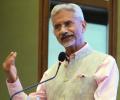
"It finally takes two hands to clap and China too must have the belief in a workable relationship," he said when asked whether the two Asian giants can have a working relationship.
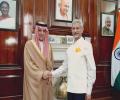
Saudi Arabia's Minister of State for Foreign Affairs Adel Aljubeir visited India on Thursday and held talks with External Affairs Minister S Jaishankar, focusing on de-escalating tensions between India and Pakistan. The visit comes as ties between India and Pakistan have further deteriorated following Indian military strikes on terror infrastructure in Pakistan. Iranian Foreign Minister Abbas Araghchi also arrived in New Delhi on a scheduled visit amidst the escalating tensions.

There is a growing sentiment in the world and the global South in a way embodies it. But there's also political resistance, he said.

Chinese Foreign Minister Wang Yi on Friday met Pakistan Army Chief Asim Munir and discussed regional security, counter-terrorism and matters of mutual interest.

Jaishankar said the US ambassador will say what he feels is the thinking or position of his government.

United States Secretary of State Marco Rubio on Thursday (local time) hailed India as 'one of the top relationships that the US has in the world today' during the Senate confirmation hearing for Sergio Gor, US President Donald Trump's nominee for US Ambassador to India.

Union minister J P Nadda clarified that the Vice President's office was informed about his and Kiren Rijiju's inability to attend a Business Advisory Committee (BAC) meeting convened by Jagdeep Dhankhar before his resignation. This statement follows questions raised by a Congress leader regarding their absence.

'Prime minister is expected to hold some bilateral meetings on the sidelines of the SCO summit.'
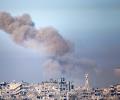
Jaishankar described the October 7 strikes on Israeli cities by Hamas as "terrorism" but at the same time asserted India's long-standing support for a negotiated two-state solution to the Palestine issue.

External Affairs Minister S Jaishankar on Wednesday took a critical view of some of the key decisions made by the Jawaharlal Nehru government, and said one needs to get out of this "cult worship" that the period from 1946 onwards was "great years" and the country did "splendidly".

The National Council of Educational Research and Training (NCERT) is developing a special classroom module on Operation Sindoor to help students learn about India's defence strategy and diplomatic response, according to sources.

'Despite assurance from China, none of the companies have received supplies from Chinese sellers.'
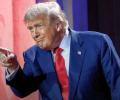
Since May 10, when Trump announced on social media that India and Pakistan had agreed to a "full and immediate" ceasefire after a "long night" of talks mediated by Washington, he has repeated his claim on several occasions.

An earthquake in Afghanistan's east has killed at least 610 people and injured 1,300, a spokesman for the Taliban government said on Monday, PTI has reported quoting AP.

The minister said this underlying resentment and pain of those countries regarding the global economy was building up for the last 15-20 years and the COVID-19 pandemic and the Ukraine conflict resulted in prices of energy and food items going up.

External Affairs Minister S Jaishankar is scheduled to meet United States Secretary of State Antony Blinken in Washington, DC on Thursday, amid the diplomatic rumpus between India and Canada stirred over the killing of a Khalistani separatist.

The external affairs minister also said that India is likely to resume issuance of visas to Canadians if it sees progress in the safety of Indian diplomats in Canada.
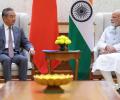
'New Delhi is not naive about its foreign policy choices.'
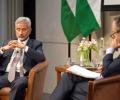
Secularism for India does not mean being non-religious but an equal respect to all faiths, but the "appeasement" government policies of the past made the biggest religion of the country feel like it had to be self-deprecatory in the name of equality, External Affairs Minister S Jaishankar has said.

A meeting with Chinese President Xi Jinping on the sidelines of the SCO summit is being planned.
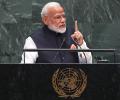
External Affairs Minister S Jaishankar will address the session on September 27

The ruling alliance and the Opposition are set to lock horns over the two issues steeped in national security and foreign policy imperatives.
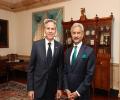
India and the US agreed to continue their cooperation in the areas of defence, space and clean energy as External Affairs Minister S Jaishankar met Secretary of State Antony Blinken here, amid a simmering diplomatic row between India and Canada over the killing of a Khalistani separatist.

"One, we told the Canadians that this is not the Government of India's policy," Jaishankar said. "Two, we told the Canadians saying that look, if you have something specific, if you have something relevant, let us know. We are open to looking at it," Jaishankar said while responding to a question from former US ambassador to India and CFR Distinguished Fellow Kenneth Juster, in his first public comments on the issue.
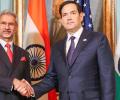
The phone conversation came amid escalating tensions between India and Pakistan over the April 22 terror attack that killed 26 civilians.
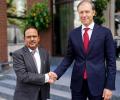
National Security Advisor Ajit Doval met with Russian First Deputy Prime Minister Denis Manturov to discuss bilateral military-technical ties and implementation of joint projects in strategic sectors. The meeting comes amid growing US pressure and tariffs on Indian goods.

The security cover of External Affairs Minister S Jaishankar has been upgraded from the 'Y' category to 'Z', official sources said on Thursday.

Modi has been chairing regular meetings with the top government functionaries involved in the country's military and diplomatic response to the Pahalgam terror attack of April 22.
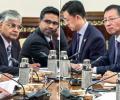
'These efforts by Beijing can be weaponised one day with economic, security and political implications for India.'

External Affairs Minister S Jaishankar has said India faces a 'very complicated challenge' from China, and the Narendra Modi government has taken steps to ensure no attempts are made to change the status quo in the border areas unilaterally.
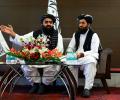
'During the 5-day visit, Amir Khan Muttaqi would have, conceivably, bumped into our powerful security agencies one way or another and some interaction would have ensued, which, in turn, can lead to future dealings.' 'Indeed, this will be the one crucial template of the Indo-Afghan relationship that Pakistan will be monitoring closely,' points Ambassador M K Bhadrakumar.

Nepal has reiterated its claim over the Lipulekh territory, stating it is an inseparable part of the country, after India and China agreed to resume border trade through the area. The Nepalese government has incorporated the territory into its official map and Constitution. India has rejected Nepal's claims, asserting they are not based on historical facts or evidence.

External Affairs Minister S Jaishankar on Tuesday said it was necessary to acknowledge that China will influence India's neighbouring countries, and India must not be scared of such "competitive politics".

External Affairs Minister S Jaishankar on Friday said that the Canadian allegations with regard to the death of a Khalistani separatist was discussed during his meeting with the Secretary of State Tony Blinken a day earlier and noted that the two delegations came out "better informed" after the meeting.

New Delhi 'will have to take a call which supply source suits us the best,' the finance minister said, pointing out that crude oil accounts for the bulk of India's foreign exchange spend.
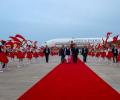
Prime Minister Narendra Modi arrived in China for the Shanghai Cooperation Organisation (SCO) summit. His meeting with President Xi Jinping is significant given global economic concerns.
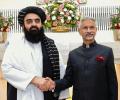
'Pakistan is uncomfortable with the Indian presence in Afghanistan. They want the Taliban to ensure that there is no Indian presence in Afghanistan.'

'Pakistan wanted India out of Afghanistan to which again the Taliban told Pakistan to take a walk.' 'Six months after they came back to power in 2021 India was back in Afghanistan at the request of the Taliban.' 'The Taliban realised that India has no agenda of its own in Afghanistan.'
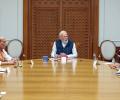
Shah briefed the prime minister on the attack and discussed the measures to be taken in its aftermath.
