S&P Global Ratings on Thursday said the hostilities between India and Pakistan heighten risks to the credit metrics of both countries, and any escalation in clashes would put downward pressure on sovereign credit support.
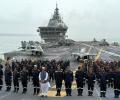
In an interaction with naval warriors on board aircraft carrier INS Vikrant off Goa, Singh sent a stern warning to Islamabad saying India will not hesitate to use the methods to deal with terrorism that Pakistan cannot even think of.

In a post on X, the additional directorate general of public information posted: "Pakistan again violates the Ceasefire Agreement by firing artillery in Bhimber Gali in the Poonch-Rajouri area. Indian Army is responding appropriately in a calibrated manner."
A former Pentagon official, Michael Rubin has said that India targeted terror infrastructure with precision, and it was able to blunt Pakistan's response following the recent strikes.

In a significant shift, Kashmiris from villages once considered strongholds of militancy have joined the condemnation of the recent massacre of 26 people in Pahalgam, raising slogans against terrorism and expressing solidarity with the victims. This unprecedented display of public sentiment across the valley marks a possible turning point in the region's fight against violence.

The Director General of Air Operations said "whatever methods and whatever means we have chosen, it had the desired effects on the enemy targets",
India has reached out to key global powers, including members of the UN Security Council, and apprised them about the reasons behind its military strikes on nine terror targets in Pakistan and Pakistan-occupied-Kashmir in retaliation for the Pahalgam terror attack. New Delhi also conveyed to the countries that it will retaliate if Islamabad escalates the already tense situation.
Indian Air Force S-400 Sudarshan Chakra air defence missile systems were fired last night against targets moving towards India. The targets were successfully neutralised in the operation multiple domain experts told ANI.
'Munir is clearly insecure and hence he needs the prop of a field marshal.'

'The fight against terrorism will continue. We have set a new normal and the new normal is that we will follow an offensive strategy. Wherever terrorists are, we have to kill those terrorists and we have to destroy their infrastructure. So it is still not over but as we speak the ceasefire is still intact'
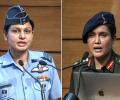
India conducted precision strikes on nine terror targets in Pakistan and Pakistan-Occupied Kashmir, targeting terrorist infrastructure to deter further attacks. The operation, codenamed 'Operation Sindoor', was detailed by two women military officers, Col Sofiya Qureshi and Wing Commander Vyomika Singh, at a press briefing in New Delhi. The officers highlighted the precise nature of the strikes, emphasizing the use of "niche technology weapons" to ensure no collateral damage. The briefing showcased India's military prowess and the growing role of women in the armed forces.

Union Home Minister Amit Shah said on Friday that the Operation Sindoor undertaken by the Indian armed forces in retaliation for the Pahalgam terror attack has "completely exposed" the fact that terrorism in India is sponsored by Pakistan. Shah also said that the operation showed the "firm" political will of Prime Minister Narendra Modi, the "precise" intelligence inputs from agencies, and the "lethal" capabilities of the armed forces. He added that the operation was successful as it used the correct firepower and achieved its aims besides "showing the reality" to Pakistan.

India succeeded in busting the Pakistani narrative on Operation Sindoor, particularly among the Organisation of Islamic Conference (OIC) member nations, where Islamabad sought succour after carrying out terror activities across the border, Shiv Sena leader Shrikant Shinde said.
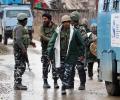
The money was being transported from Punjab to South Kashmir.

New Delhi said if the reports of Azhar's location are correct, then Pakistan's "duplicity" has been exposed as it has been maintaining that the JeM chief is not in that country.

More than 300 flights have been cancelled and at least 25 airports, including Srinagar, have been temporarily shut for operations amid restrictions in the wake of the armed forces launching missile attacks on terror targets in Pakistan on Wednesday morning.

Being a 'fauji' kid, Sofiya Qureshi grew up listening to tales of valour and sacrifice of the army shared by her grandfather, who was a soldier.

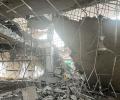
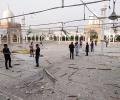
Heavy Pakistani shelling in the border district of Poonch in Jammu and Kashmir left nine people dead and 28 injured. The shelling, described by residents and officials as "barbaric and cowardly", started around 2 am, damaging dozens of residential houses, shops, vehicles, and heritage sites. The incident comes after India launched "Operation Sindoor" in retaliation to the April 22 Pahalgam terror attack. India condemned the act, calling it a cowardly attack on civilians, and reaffirmed that civilian safety remains its top priority.

Unidentified gunmen have shot dead a 'businessman' in Karachi who Indian intelligence officials said was Jaish-e-Mohammed terrorist Mistry Zahoor Ibrahim, involved in the 1999 hijacking of Indian Airlines plane IC-814 and fatal stabbing of passenger Rupin Katyal.

The entire area has been cordoned off while drones and sniffer dogs are being used to sniff out the terrorists that might be hiding in the area, they said.

The Anti-Terrorist Squad of Uttar Pradesh Police on Friday arrested an alleged terrorist linked to Jaish-e-Mohammed, who was tasked with carrying out a fidayeen attack on suspended Bharatiya Janata Party spokesperson Nupur Sharma.

Three Jaish-e-Mohammed militants were killed in the Drach area of Shopian, while a Lashkar-e-Tayiba militant was killed in the Moolu area of the south Kashmir district, the police said.

The NIA on Wednesday filed a charge sheet against eight people allegedly involved in a conspiracy hatched by Pakistan-based Jaish-e-Mohammed to carry out terror acts against security forces in the Valley, an official spokesperson said.
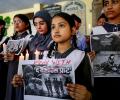
An Indian delegation met top officials of the United Nations Office of Counter-Terrorism (UNOCT) and Counter-Terrorism Committee Executive Directorate here even as New Delhi stepped up efforts to designate The Resistance Front, a Lashkar-e-Tayyaba proxy, as a UN-listed terror outfit for its alleged involvement in the Pahalgam attack.
'The Pakistani State has to realise that the pigeons have come home to roost.'
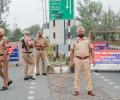
People in some border villages of Ferozepur district in Punjab began moving to safer areas amid soaring tensions between India and Pakistan.
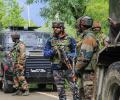
The spokesman said it was learnt that an active terrorist of Hizbul, Farooq Ahmad Bhat, had received directions from terror handlers based in Pakistan to target the members of Panchayati Raj Institutions in Kulgam.

Over 100 terrorists, including high-value targets such as Yusuf Azhar, Abdul Malik Rauf and Mudasir Ahmed, were eliminated during Operation Sindoor on May 7, the Indian military said on Sunday.
India on Friday called on the International Monetary Fund (IMF) to reconsider its $1 billion assistance to Pakistan, suggesting that Islamabad could use it for terror funding.
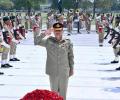
India had better be prepared. Munir could be back at our throats soon, even within the next 12 months, warns Shekhar Gupta.

Executives from India's leading airlines are conducting internal meetings to devise alternative routes for their international flights that currently pass through Pakistani airspace.
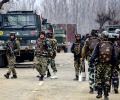
A police spokesman said based on specific input regarding the presence of terrorists in the Mirhama area of Kulgam in south Kashmir, a cordon and search operation was launched by the security forces there.
'Surgical strikes or air strikes, or both, are likely on the table.'
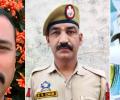
Balwinder Singh Chib, a police officer in Jammu and Kashmir's Kathua district, was killed in an encounter with Pakistani terrorists, continuing a legacy of sacrifice that spans three generations of his family. Chib's great-grandfather and uncle were also martyred in the line of duty, and his brother died during World War I. The family is venerated in their village for their history of patriotism and sacrifice.

The 15-nation body includes China as a permanent veto-wielding member.
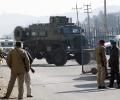
On January 2, 2016, a team of gunmen wearing Indian army fatigues waded through a branch of the Ravi river on the India-Pakistan Punjab border. Arriving on the Indian side, the men hijacked vehicles and drove towards the sprawling Pathankot Air Force base.
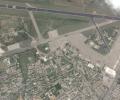
India's strikes on Pakistan damaged runways and structures across at least six airfields, according to a visual analysis by The Washington Post, which experts said were the most significant attacks of their kind in decades of simmering conflict between the two nations.
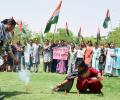
Opposition parties in India, including the Congress, Left parties, Samajwadi Party, Bahujan Samaj Party, Trinamool Congress, Dravida Munnetra Kazhagam, Rashtriya Janata Dal, Shiv Sena (UBT), and NCP (SP), have unanimously hailed the armed forces' "Operation Sindoor", a retaliatory strike against terrorist infrastructure in Pakistan and Pakistan-occupied Kashmir (PoK). The operation, which involved missile and drone strikes, was conducted in response to the April 22 Pahalgam terror attack. Despite political differences, all parties expressed support for the government and the armed forces, stressing the importance of national unity and integrity in the face of terrorism. While emphasizing the need for diplomatic avenues to prevent further escalation, some parties also called for caution in attributing political credit for the strikes.

Arathy, daughter of N Ramachandran who was killed in a terror attack in Kashmir's Pahalgam, welcomed the Indian Army's "Operation Sindoor" and said it was a reply from the women of India. She said the loss cannot be compensated, but the operation is a kind of relief from the government and the army. Arathy's father was killed by terrorists in front of her while holidaying in Kashmir's Pahalgam on April 22.
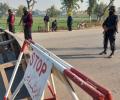
At least 12 persons, including four children, were killed and 30 injured as two explosive-laden vehicles rammed into the boundary wall of the main cantonment in Bannu in northwest Pakistan on Tuesday while the army personnel neutralised at least six terrorists.
