
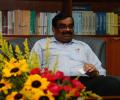
Noted scientist Prof V Ramgopal Rao highlights India's significant progress in higher education and research but points out a critical gap in converting scientific discoveries into market-ready technologies. He advocates for a robust institutional framework, multidisciplinary collaboration, and stronger academia-industry ties to foster innovation and translate research into practical products.

Six faculty members from IIT Madras have been awarded the prestigious ANRF J C Bose Grant, recognising their outstanding research contributions in engineering and science. The highly competitive grant provides Rs 25 lakh annually for five years to support frontier research.
Researchers from IIT Bhubaneswar and Virginia Commonwealth University have theoretically predicted a new two-dimensional material, a FeCl3 monolayer, exhibiting i-wave altermagnetism. This discovery holds significant potential for developing faster, more compact, and energy-efficient electronic devices, including applications in high-density memory, spintronics, and quantum technologies.

Analysts predict that geopolitical developments, particularly surrounding the Strait of Hormuz and the US-Iran standoff, along with crude oil prices, will be the primary factors influencing stock market movement in the coming week. Investors will also monitor foreign institutional flows and the Federal Open Market Committee (FOMC) minutes for signals on the Federal Reserve's policy outlook.
A new study by IIT Kharagpur researchers, published in Nature Communications, reveals that urban growth patterns significantly influence future cooling demand in cities. The research highlights that a city's "thermal memory," shaped by decades of development decisions, impacts its heat burden and energy requirements, independent of global temperature rises. The study analysed 88 Indian cities and a global sample of 52 cities over two decades.
Indian researchers from ICMR-National Institute for Research on Women's Health and IIT Bombay have developed an indigenous "placenta-on-chip" platform. This microphysiological system mimics the human placental barrier, reproducing essential functions like hormone production and nutrient transfer. It offers a simple, scalable tool for studying placental biology, pregnancy complications, and drug effects, aiming to reduce reliance on animal experimentation.
Researchers at IIT-Guwahati have identified a type of blue-green algae (cyanobacteria) that can effectively remove lead from contaminated water. The study highlights the role of exopolysaccharides (EPS) produced by the algae in absorbing lead, with laboratory experiments showing up to 66.2% removal. This discovery offers a promising, naturally abundant solution for water purification, though further validation is needed before commercial application.

The Delhi government's Women and Child Development Department (WCD) has introduced a new internship and research framework, offering students in social work, psychology, and related fields structured field exposure at child care institutions and welfare centres.

Several Indian real estate companies, including BPTP Ltd and Smartworld Developers, are rethinking or shelving their initial public offering (IPO) plans, which were expected to raise around 15,000 crore, due to weaker housing demand, higher costs, and a more cautious investment climate.

IIM Indore will conduct a study on teenage cricket sensation Vaibhav Sooryavanshi to understand the impact of early fame and pressure on child prodigies.
Researchers at MIT World Peace University (MIT-WPU) Pune have developed a new protective enclosure for industrial abrasive saw machines. This innovative technology significantly reduces noise levels by up to 20 dB(A) while also containing sparks, dust, and flying debris, enhancing worker safety and welfare.

'Our research demonstrates the potential of perovskite-based semiconductor technologies for next-generation solar cells and memory devices.'

Researchers at IIT Bombay have developed a novel, low-cost, and highly durable catalyst using cobalt, nickel, phosphate, and graphite. This breakthrough material can accelerate both hydrogen and oxygen generation from water, significantly reducing the production cost of green hydrogen by eliminating the need for expensive noble metals like platinum and iridium.
Researchers have identified a new process, 'chronoferroptosis', where excess iron in neurons reduces their resilience to stress, increasing vulnerability to neurodegenerative diseases. This discovery highlights iron accumulation as a critical target for predicting, preventing, and treating conditions like Alzheimer's.
The ACSEL Technology Forum, a Karnataka government Centre of Excellence in AI, has launched Tathyakosh.in, a digital public good designed to make India's extensive public data more accessible. This platform consolidates over 1.5 million datasets from 458 sources, addressing the challenge of fragmented data discovery across various government and research portals. It aims to benefit researchers, startups, and technology teams in sectors like healthcare, agriculture, and financial inclusion by providing a structured and discoverable data infrastructure.

Researchers at Delhi's Indraprastha Institute of Information Technology have developed 'MutAIverse', a generative AI platform designed to decode DNA damage and identify potential causes of cancer. Tested on head and neck cancer patients in Guwahati, the platform successfully traced exposure to smokeless tobacco as a contributing factor. This innovation aims to shift focus from just diagnosis to understanding causative factors, potentially aiding in prevention and protection.

Analysts predict that crude oil prices and the ongoing US-Iran conflict will be the primary drivers of stock market movements, with investors also closely watching the Jackson Hole symposium for cues on interest rates.
Researchers at IIT-ISM Dhanbad have been granted an Indian patent for an electrochemical reactor designed to recover copper from industrial wastewater. This innovative technology offers an environmentally sustainable solution for resource recovery and wastewater treatment, particularly benefiting the mining and metallurgical sectors.

Researchers at IIT-Guwahati have developed an inexpensive and efficient catalyst for producing hydrogen from water, a crucial step for the National Green Hydrogen Mission and the transition to sustainable energy. The catalyst uses nickel salt and an anthracene-based organic molecule, offering a cleaner alternative to fossil fuel-derived hydrogen.

E-Eye, which cost about Rs 3,500 to develop, can test a sample for around Rs 2, making it particularly suitable for field-level water quality monitoring in areas where access to sophisticated laboratories is limited.

Union Minister Jitendra Singh stated that human-led artificial intelligence will be the defining force in India's journey to becoming a developed nation by 2047. Speaking at the 29th National Conference on e-Governance, he emphasised that technology must strengthen governance without replacing human accountability, advocating for responsible AI deployment with citizens at the centre. The conference concluded with the adoption of the Jaipur Declaration on e-Governance 2026, outlining a roadmap for AI-enabled, data-driven, and secure digital governance.

The National Council of Educational Research and Training has reconstituted the Textbook Development Team for class 11 and 12 political science with a mandate to integrate cultural rootedness, Indian knowledge systems and inclusion, with at least four of the members having direct or indirect links with the RSS.
Researchers at IIT Indore have developed a non-invasive technique to detect early signs of oral cancer using saliva and a swab sample. This method is economical, quick, and aims to make early screening more accessible, especially in rural areas, offering an alternative to painful biopsies. The findings, published in the British Journal of Cancer, show distinctive molecular changes before the disease becomes clinically obvious.
Professor Annapurni Subramaniam, Director of the Indian Institute of Astrophysics (IIA), has been awarded the prestigious COSPAR Vikram Sarabhai Medal for 2026. She is the fourth Indian and first woman scientist from the country to receive this honour, recognised for her outstanding contributions to space research.

High fees do not automatically translate into better teaching or stronger clinical exposure, points out Nayagam PP, career counsellor and founder of EduJob360.
Scientists from Agharkar Research Institute (ARI), Pune, have developed a biodegradable nanocarrier platform for targeted gene therapy in breast cancer. This strategy uses mesoporous silica nanoparticles to deliver siRNA molecules, effectively inhibiting tumour growth and reducing off-target effects, offering a promising new approach to cancer treatment.
Karnataka Chief Minister D K Shivakumar met with AI major Anthropic to discuss a long-term partnership aimed at accelerating AI adoption across governance, education, healthcare, research, and the state's startup ecosystem. The collaboration focuses on deploying AI solutions responsibly, ensuring data privacy, and developing AI-focused skilling programmes and an AI University.
The University of Liverpool and the Indian Institute of Science (IISc) have established a joint seed fund to promote research and innovation collaborations in areas such as AI, biomedicine, quantum technology, and space.
A one-day patent workshop was held at CSIR-NIIST to promote intellectual property awareness and equip researchers and startups with essential knowledge in patent filing and innovation.
Chief Justice of India Surya Kant urged national law universities to proactively lead the integration of technology into the legal system, rather than merely reacting to changes. Speaking at a conclave, he stressed the importance of incorporating academic integrity and responsible AI use into the curriculum, rejecting outright bans on generative AI. The CJI highlighted that law schools must prepare graduates to critically engage with technological tools, ensuring justice, fairness, and human judgment remain central to the evolving legal landscape.
Researchers at IIT (ISM) Dhanbad have developed an ultra-compact wearable antenna, measuring just 5x5x0.75 mm, designed to significantly enhance the performance of future healthcare devices, smart wearables, and wireless body communication systems. This innovation offers high-speed data transmission, wider wireless coverage, and a low Specific Absorption Rate (SAR), making it safe and efficient for prolonged use in Wireless Body Area Networks (WBANs).
New research using zebrafish suggests that changes in gene activity can lead to the hardening of spinal discs, a major cause of neck and back pain. The study identified potential drug targets, including existing osteoporosis medication and pathways related to fat and phosphate metabolism, offering new avenues for treating intervertebral disc degeneration (IVDD) beyond surgery.

BRICS Sports Ministers adopted a Joint Declaration in Visakhapatnam, reaffirming their commitment to strengthen sports cooperation through dialogue and mutual respect. The meeting, held under India's 2026 Chairship, saw Union Minister Dr. Mansukh Mandaviya call for a BRICS Sporting Partnership and introduce three key initiatives: a Working Group on Sports Technology, a Sports Manufacturing Conclave in Udaipur, and Traditional and Indigenous Sports Demonstration Games in Ahmedabad in 2026.
The Sports Authority of India (SAI) has signed a Memorandum of Understanding (MoU) with Japan's University of Tsukuba to facilitate specialised training and exchange programmes for Indian athletes, coaches, and sports scientists. This partnership aims to enhance cooperation in various sports-related fields and boost India's international competitiveness, especially in disciplines like athletics, archery, table tennis, swimming, and judo.

The Union health ministry has deployed a National Joint Outbreak Response Team (NJORT) to Gujarat and Rajasthan to strengthen the response to the ongoing Chandipura Virus Disease (CHPV) outbreak.

Indian benchmark indices closed mixed, with the Sensex gaining 113.61 points to 78,079.96 and the Nifty falling 40.10 points to 24,395.85, as elevated crude prices and ongoing geopolitical uncertainty in the Middle East made investors cautious.
Indian benchmark indices closed mixed, with the Sensex gaining 113.61 points to 78,079.96 and the Nifty falling 40.10 points to 24,395.85, as elevated crude prices and ongoing geopolitical uncertainty in the Middle East made investors cautious.

Prime Minister Narendra Modi has called upon India's youth to dream big, assuring them of government support and resources, including a Rs 1 lakh crore Innovation Fund, to bolster the country's burgeoning startup ecosystem and drive its journey towards becoming a developed nation.

Indian benchmark indices Sensex and Nifty experienced declines in early trade, driven by a surge in Brent crude oil prices above USD 91 per barrel due to escalating tensions between Iran and the US, alongside an increase in US 10-year bond yields. Track Sensex, Nifty on August 18.
Researchers at IIT Indore have developed a groundbreaking method to convert carbon dioxide and glycerol, two common waste materials, into valuable green chemicals like lactic acid and formic acid in just seven minutes. This low-energy process uses a specially designed ruthenium-based catalyst and microwave heating, offering a sustainable solution for waste management and green manufacturing.
