
The Quad grouping has expanded cooperation in critical minerals and energy, while unveiling new measures to boost maritime surveillance and port infrastructure across the Indo-Pacific. This move comes against the backdrop of China's growing military posturing in the region, with ministers reiterating strong opposition to destabilising actions and expressing serious concerns over militarisation of disputed features.

US President Donald Trump is reportedly considering military action against Iran due to stalled negotiations and Tehran's approach to its nuclear issue, according to CNN sources. Divisions within the Trump administration have emerged over the next course of action, with some officials advocating for a more aggressive approach through targeted military strikes.

Far from it; the country's resistance to the US, its nuclear ambitions, and its pursuit of influence and proxies across the Middle East are driven by a constant search for independence and security. Thus, Iran will never capitulate. Trump will learn this home truth ultimately, and it is going to be a humbling personal experience that may even destroy his presidency, predicts Ambassador M K Bhadrakumar.

'FPIs are unlikely to return unless there is equilibrium between valuation premium and earnings growth.'

Iranian Foreign Minister Seyed Abbas Araghchi spoke with Indian counterpart S Jaishankar to discuss the West Asia crisis, following discussions with Russian President Vladimir Putin.
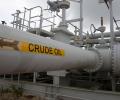
Crude oil prices experienced a significant drop following the announcement of a US-Iran ceasefire and the reopening of the Strait of Hormuz, leading to heavy selling by traders.
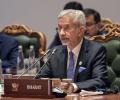
India has expressed serious concerns about the West Asia crisis and its potential impact on energy supplies and maritime stability, urging BRICS nations to find practical solutions to geopolitical challenges and unilateral sanctions.

There are roughly 2,000 ships stranded in the Persian Gulf, carrying more than 20,000 seafarers, according to the International Maritime Organisation, as quoted by The Wall Street Journal.

The Indian rupee is highly vulnerable among Asian currencies, with Barclays and MUFG warning of a potential depreciation towards 100/$ if the West Asia conflict persists, driven by widening current account deficits and elevated crude oil prices.

Indian equity benchmark indices Sensex and Nifty tumbled over 1 per cent for the third consecutive day, driven by a sharp rally in crude oil prices, massive selling in IT stocks, and unabated foreign fund outflows amid ongoing geopolitical tensions in the Middle East.

Israel will continue its offensive in South Lebanon aimed at neutralising the threat from Hezbollah, which is backed by Iran.

US President Donald Trump has threatened to target Iran's civilian energy infrastructure, including power plants, oil wells and Kharg Island, if Tehran does not reopen the Strait of Hormuz.

Indian benchmark stock indices, Sensex and Nifty, recorded their fourth consecutive day of declines, driven by selling in FMCG, financial, and auto sectors. The downturn is attributed to fresh tensions in the Middle East, uncertainty surrounding the US-Iran 60-day ceasefire, and elevated crude oil prices.

Donald Trump has extended the deadline for Iran to reopen the Strait of Hormuz, amid escalating tensions between the two countries. Trump issued a harsh warning to Tehran, threatening to target Iran's energy and civil infrastructure if the Strait is not opened.

Israel's Defence Minister Israel Katz has stated that Israel is prepared to escalate military action against Iran, pending approval from the United States. This comes as US President Donald Trump says he would not use nuclear weapons in any conflict with Iran, while also claiming the US has 'total control' over the Strait of Hormuz.

RBI Governor Sanjay Malhotra stated that the central bank is closely monitoring whether the supply shock from the West Asia conflict will lead to a generalised price rise, potentially necessitating monetary policy action.

US Vice President JD Vance on Friday dismissed reports suggesting that Iran would receive financial incentives merely for signing the peace deal between Washington and Tehran aimed at ending the hostilities in West Asia, calling such claims "fake information".

Gold prices in the national capital surged by Rs 600 to Rs 1.65 lakh per 10 grams, extending gains for the third consecutive day, while silver rebounded by Rs 5,000 to Rs 2.71 lakh per kilogram, driven by geopolitical tensions and inflation concerns.

Crude oil prices have surged to record highs due to escalating tensions between the US and Iran, raising concerns about supply disruptions and market volatility.

Moody's Ratings has reduced India's GDP growth forecast for 2026 to 6 per cent, citing subdued private consumption, capital formation, and industrial activity due to higher energy costs and global uncertainties.

The United States and Iran, with regional mediators, are reportedly discussing a potential 45-day ceasefire to prevent further escalation of conflict, including strikes on Iranian infrastructure and retaliation against Gulf states' facilities.

After the United States and Iran agreed to a two-week ceasefire and expressed hope for lasting peace, Pakistan took much of the credit for playing mediator between the two countries. However, Jonathan Schanzer, Executive Director at the Foundation for Defence of Democracies and former US Treasury counterterrorism analyst, said Pakistan is deeply indebted to China.

Iran has lodged a formal complaint with the United Nations, accusing the US of engaging in 'piracy' following the seizure of Iranian vessels. The complaint was detailed in a letter sent by Iran's UN envoy to the UN Secretary-General and the Security Council.

US President Donald Trump is set to visit China for talks with President Xi Jinping on trade, global issues, and the Gulf war. The visit aims to address trade frictions and other key issues, with high expectations for progress.

Indian benchmark indices Sensex and Nifty experienced declines due to a sharp rally in crude oil prices, continuous foreign fund outflows, and geopolitical uncertainties. Regulatory developments in the banking sector, particularly the implementation of the Expected Credit Loss (ECL) framework, also contributed to the selling pressure.
The Indian rupee weakened against the US dollar due to geopolitical tensions surrounding the Strait of Hormuz and ahead of the Reserve Bank of India's monetary policy review.

India emerged reasonably well from 2025. But now, the oil shock and war-related supply disruptions have again driven funds out of India and significantly weakened the rupee, points out Ajay Chhibber.

Congress leader Rahul Gandhi has warned of a severe economic crisis looming over India, criticising Prime Minister Narendra Modi's economic policies and foreign travels.

Amid rising tensions in West Asia, China is urging all parties to cease military operations, following Trump's appeal for help in securing the Strait of Hormuz.

Ahead of the expiry on Tuesday of the two-week ceasefire declared by US President Donald Trump in the conflict with Iran, US media outlets reported on Sunday that negotiators Steve Witkoff, special envoy for peace missions and Jared Kushner will head to Islamabad for talks with Iran.

Trump has said he would be present at the signing ceremony in Islamabad. Don't be surprised if the Pakistani hosts make it a grand event in the geopolitics of the region. Trump would love that, notes Ambassador M K Bhadrakumar.

Iran on Monday formally rejected a US-proposed ceasefire deal amid the escalating conflict in West Asia, instead unveiling its own 10-point plan aimed at permanently ending the ongoing war, as reported by the Iranian state news agency Islamic Republic News Agency (IRNA).

Iranian President Masoud Pezeshkian has confirmed Tehran's participation in Pakistan-facilitated peace talks with the US in Islamabad, according to Prime Minister Shehbaz Sharif. This development follows a conditional ceasefire agreement and aims to address regional tensions.

The Indian government has increased import duties on gold and silver from 6 per cent to 15 per cent to curb inbound shipments of precious metals amid a rising import bill due to the West Asia crisis.

A social media post by Shehbaz Sharif has triggered widespread debate after an apparent 'draft' message was mistakenly published on X and later edited.

The rupee weakened to a record low against the US dollar due to Gulf tensions, rising oil prices, and foreign capital outflows.

The closure of the Strait of Hormuz has disrupted some 20 per cent of the global flows but even if it opens, damages to production facilities in the region will take time to repair, points out Sunita Narain.

Moody's Ratings has highlighted that Indian banks are among the most exposed in the Asia-Pacific region to the West Asia crisis, primarily due to India's high dependence on energy imports, which could lead to increased inflation, higher interest rates, and strained borrower cash flows.

The US-China rapprochement, however tenuous, is not without implications for India. Both China and Pakistan have become closer to the US, notes Ambassador T P Sreenivasan.

Indian equity benchmarks, Sensex and Nifty, ended lower after a spectacular rally, with the Sensex tumbling 931 points, as renewed tensions in West Asia, particularly the risk to the ceasefire deal after Iran closed the Strait of Hormuz, dampened investor optimism.
