
The climate finance battle once again exposes the deep divide between rich and developing nations.

Mahindra Last Mile Mobility won the Earthshot Prize 2026 in the "Clean Our Air" category for its work on electric rickshaws that makes the vehicles affordable to buy and run and provide sustainable solutions to combat air pollution.

A new study reveals that achieving net-zero emissions involves more than just reducing greenhouse gases; it necessitates considering the broader environmental consequences of the technologies and resources employed. Different clean energy pathways exert varying pressures on mineral, land, and water resources, highlighting the need for a balanced approach to decarbonisation that addresses overall environmental sustainability.

The Indian government has released commemorative postage stamps honouring Dr Ram Bux Singh, known as the "father of modern biogas". Dr Singh made significant contributions to biogas technology in India and globally, including developing early gobar gas plants and establishing Asia's first gobar gas research station. The stamps were released on November 13, alongside a book detailing his legacy and biogas technology.

Prince William and Princess Catherine of Wales are set to conclude their three-day visit to India next week with a meeting with Prime Minister Narendra Modi in New Delhi. Their trip will also include attending the 2026 Earthshot Prize ceremony in Mumbai, focusing on climate action, innovation, and strengthening UK-India ties across various sectors.

Prince William, speaking at the Earthshot Prize 2026 Impact Assembly in Mumbai, lauded India's progress in sustainable development and climate solutions. He highlighted India's achievement of 50% non-fossil fuel electricity capacity ahead of schedule and its innovative Earthshot Prize winners and finalists, showcasing how growth and environmental protection can coexist.

Prime Minister Narendra Modi said a climate deal between the United States and China does not put pressure on India, but that global warming itself was reason to take action.
US President Barack Obama has sought the help of major countries of the world including China and India in addressing the urgent issue of climate change and clean energy.
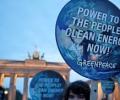
Javadekar was addressing the 18th BASIC ministerial meeting on climate change here which is being attended by ministers of Brazil, China and South Africa.
Clinton has already said that she is visiting New Delhi to start a strategic dialogue which will include issues like climate change and clean energy. To put the issue of climate change on fast track, Clinton will be joined by President Barrack Obama's special envoy for climate change, Todd Stern, who is known as a man in hurry.

The closure of the Strait of Hormuz has disrupted some 20 per cent of the global flows but even if it opens, damages to production facilities in the region will take time to repair, points out Sunita Narain.

Prime Minister Narendra Modi on Tuesday met Microsoft co-founder and billionaire philanthropist Bill Gates on the sidelines of the climate summit here and discussed ways to further sustainable development, steps to mitigate climate change and vaccine research. The meeting between Modi and the American business magnate, whose foundation is focusing on fighting the COVID-19 pandemic, took place after the former launched the Initiative for the Resilient Island States (IRIS) for developing infrastructure of small island nations. Prime Minister Modi expressed appreciation for the work being done by the Bill and Melinda Gates Foundation in India, the Ministry of External Affairs (MEA) said in a statement.

'India will become number one. There is no doubt about it. Andhra Pradesh will be number one in India.'
In his address to the League of Conservation Voters Capital Dinner, Obama said right now, America generates more clean energy than ever before.
Researchers at IIT Indore have developed a groundbreaking method to convert carbon dioxide and glycerol, two common waste materials, into valuable green chemicals like lactic acid and formic acid in just seven minutes. This low-energy process uses a specially designed ruthenium-based catalyst and microwave heating, offering a sustainable solution for waste management and green manufacturing.
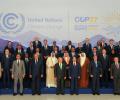
The overwhelming feeling at the end of COP 27 was that despite decades of meetings and landmark accords, like the Paris Agreement, the world was still not doing enough to slow the climate crisis, observes Ambassador T P Sreenivasan.

The feasibility study, to be taken up by a private firm, will be funded by the US Trade and Development Agency aimed at setting up facilities for capturing CBM, commonly known as natural gas. The grants of $524,819 is meant to tap the opportunities in using technologies for capturing natural gas from the coal blocks.

Prime Minister Narendra Modi has announced a significant 24,000 crore Nepalese rupees development package for Nepal, further solidifying bilateral ties and launching key India-assisted projects, including a new cross-border passenger rail link between Ayodhya and Janakpur Dham. This move signals a major reset in relations after a period of strain over border disputes, with both leaders emphasising deep kinship and mutual support.
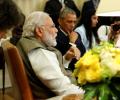
Seeking to boost the strategic ties, India and the US finalised the text of the Logistics Exchange Memorandum of Agreement.

Asserting that India's dedication to climate commitments is evident from its performance, Prime Minister Narendra Modi on Monday hoped that rich countries of G-7 will support India's efforts in combating climate change and invited them to tap the huge market for clean energy technologies emerging in the country. In his remarks at the session on 'Investing in a better Future: Climate, Energy, Health' at G7 Summit, Modi highlighted India's track record and said it has achieved the target of 40 per cent energy-capacity from non-fossil sources nine years before time. "The target of 10 per cent ethanol-blending in petrol has been achieved 5 months before time.

World finance ministers will meet on Oct 7-8 in Lima, Peru, to try to agree on climate change framework.

India has promised to reduce the emission intensity of its growth by 33-35 per cent from 2005 levels by 2030.

In a statement, Energy Secretary Earnest Moniz said this is the most ambitious initiative any president in history has taken to reduce heat-trapping emissions.

Prime Minister Narendra Modi emphasised that it is the responsibility of all to work against global warming.
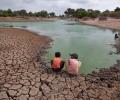
Renewable energy is mistakenly restricted to electricity.
The main "culprit" for CO2 emissions is coal-based energy which has 24 per cent share in India's emissions and 41 per cent worldwide. While coal accounts for 25 per cent of energy, the role of renewables is 13 per cent. Of these, wind, solar and bio masses contribute just 4.1 per cent.

What are the most worrisome aspects of climate change for India? Can they be solved?
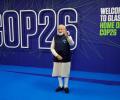
India lost around 38.5 thousand hectares of tropical forest in the last decade. Nearly 14 per cent of the country's tree cover! It is one thing for Modi to announce that India will reach a net-zero level of emissions in 2070. But if it is serious, it needs to start today, points out Ramesh Menon.

'It appears to be a combination: A glacier breaking away, and a dam-like formation downstream reaching capacity and releasing water suddenly.'

Subject to finance & tech from rich countries through an ambitious, fair Paris deal

India hopes to bridge gap with US to buffer against a Paris agreement that restricts country's developmental space.
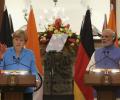
PM said he admires German leadership in clean energy and commitment to combating climate change.
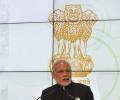
"Climate change is a major global challenge. But it is not of our making," Modi said.

India will publish its revised Nationally Determined Contribution (NDC) for the 2035 period by December, Environment Minister Bhupender Yadav said on Monday, while urging developed nations to achieve net zero targets ahead of their current timelines.
India's jugalbandhi with coal and clean energy is coming unstuck, neither achieving adequate renewable generation nor ensuring sufficient coal-fired power in the quest to become a $5-trillion economy. Six months have elapsed since Prime Minister Narendra Modi announced an ambitious climate agenda for India at COP26 at Glasgow. The net zero emissions target by 2070 is a distant one, but there are nearer-term plans to meet 50 per cent of energy demand with renewables by 2030 by increasing capacity to 450 Gw. A cursory look at the balance sheet of India's climate progress since November reveals ponderous progress towards meeting the renewables target even as the country is scrambling to expand coal-fired generation in the face of a power crisis.
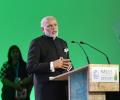
PM Modi cautioned against any unilateral steps that will lead to an economic barrier in the battle against climate change as he hoped that the developed countries would mobilise aid.

White House said Trump strongly believed that protecting environment and 'promoting our economy are not mutually exclusive goals'.

'The Paris Conference is a decisive meeting on climate change.' 'Negotiating an agreement between 196 countries is indeed a challenge.' 'If we go beyond 2°C, the consequences will be extremely difficult to deal with.'The poor are the most vulnerable to the impact of climate change.'
The target is called Intended Nationally Determined Contributions.

With the weaker-than-expected agreement at the recent Climate Change Conference at Lima, there is an urgent need to highlight endeavours in civil society and business for a sustainable global economy with grassroots empowerment, say Rajni Bakshi.
