
India says it cannot accept a project that ignores its core concerns on sovereignty and territorial integrity.

'Unlike Dr Manmohan Singh, who quailed and turned away because the darkness was too frightening, Modi has taken a leap to the other side. He deserves applause for this fearlessness,' says Aditi Phadnis.
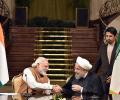
The trilateral alliance between India, Afghanistan and Iran on the strategic Chabahar port is a security threat to Pakistan, defence experts in Islamabad have said and asked the government to use diplomatic manoeuvres to avert falling into an "abyss of isolation".
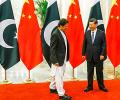
'If a 'two-front war' develops, Iron Brother may only turn out to be a drag on the PLA, since Pakistan is in no position to wage a war with India,' argues Ambassador M K Bhadrakumar.
'Given the present force levels, India cannot fight and win.' 'India can't hope to terminate the conflict on India's terms and impose the nation's will upon the adversaries,' says Brigadier Gurmeet Kanwal (retd).
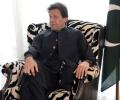
Majority of the 15 members said there should not be any statement or outcome issued after the consultations and their will prevailed, leaving China to come out and make a statement in its national capacity followed by Pakistan.
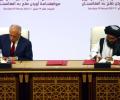
'Pakistan's trump card is that it is the only credible guarantor on the horizon who can reasonably assure the Western world that Afghanistan will not again become the revolving door for international terrorism.' 'Trust Pakistan to play this card optimally,' explains Ambassador M K Bhadrakumar.

'Unlike the Chinese army that has been largely a peace time force, the Indian Army is a battle hardened force,' explains Colonel Anil A Athale (retd).

Brushing aside India's concerns, China on Monday cemented its "all-weather ties" with Pakistan by agreeing to build a strategic $46 billion (Rs 2.9 lakh crore) economic corridor through Pakistan-occupied Kashmir as part of 51 deals signed, expanding the communist giant's influence in the region.

'It has a natural inclination to foster as much competition among civilian politicians as possible.'
We should have anticipated it on August 5 last year, when we made the big changes in J&K. Amit Shah left nothing to chance when he told Parliament that 'we will bring back Aksai Chin even at the cost of our lives'. 'Then, there were the new maps, objections to the CPEC going through Indian territory, the weather reports.' A broad territorial status quo had existed in Ladakh-Aksai Chin since 1962. India made its intention to change this public, notes Shekhar Gupta.
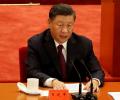
'The world does not care about the tension on our border.' 'India has to emerge as a strong economic power.' 'Respect comes when the world sees a country with a direction and leadership that has a vision,' points out Ramesh Menon.
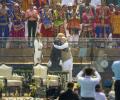
'While high-level interventions may help smoothen inter-State relationships, they cannot fundamentally change the alchemy of such relationships, which are firmly rooted in mutual benefits and mutual interests,' points out Ambassador M K Bhadrakumar.

'The US appears to think that Pakistan is highly vulnerable today due to its economic crisis and one more turn of the screw may bring about desired results,' says Ambassador M K Bhadrakumar.

In an oblique reference to China's Belt and Road Initiative, Prime Minister Narendra Modi on Friday cautioned against rolling out connectivity projects without respecting sovereignty and territorial integrity.

'There were assurances that Jaish-e-Mohammad was being reined in as was the Lashkar-e-Tayiba, but Pakistan's security forces could not risk opening too many dangerous new fronts,' notes former foreign secretary Ambassador Shyam Saran, who has just returned from a visit to Lahore.
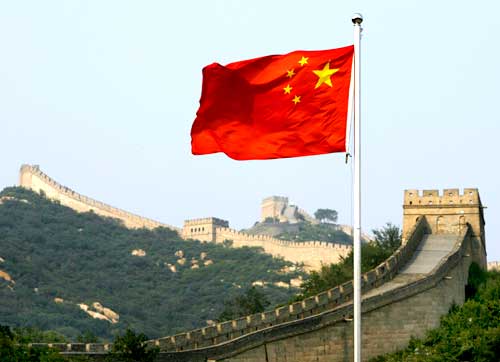
The Chinese envoy recommends an early harvest on the border issue while maintaining peace and tranquillity in the border areas, reports Ajai Shukla.

Pakistan army chief says Islamabad will continue to support the people of Kashmir on the 'diplomatic and ethical' fronts.

They warned that Islamabad wants to send a 'strong message' to India against isolating it on the world stage.

Pakistan made an "error" in ignoring terrorist sanctuaries in its tribal areas, a senior Pakistani diplomat said.
'India will keep trying to avoid conflict.' 'This is the moment when we draw a line in the sand.'

'The Chinese mindset and approach to India is far different from that in Pakistan.' 'This reality makes it possible for us to follow an engagement policy with one, while militating against engagement with the other.'

Considering Modi's style of practicing diplomacy, it is likely that a clear message would be conveyed to China that it is high time Beijing stops using its good relations with Pakistan as a pressure tactic against India. This is imperative not only for strengthening India-China relations at the bilateral level but also for maintaining stability at the regional level, says Sana Hashmi.

The meeting, which comes after the Doklam standoff, is aimed at a working a new paradigm for the bilateral relations for the next 15 years.

As the country readies to go to polls on July 25, one can't deny the role of the military, but there are other factors too.

'Pakistan has worsted India in the Afghan proxy war and the defeat becomes a template of regional politics,' points out Ambassador M K Bhadrakumar.

'New Delhi showed itself willing -- at least for a period -- to tolerate the risk of conflict and to withstand Beijing's implicit and explicit threats.' 'But it also continued to try to cut some kind of deal with China to reduce tensions.'

Important for Chinese President Xi Jinping will be Zhao's discussions on the issues of Tibet and the Dalai Lama and his assessment of the likely results of India's coming national elections, notes former senior RA&W officer and China expert Jayadeva Ranade.

India boycotted the Belt and Road Forum held from May 14-15.
Should India engage Pakistan's generals directly, bypassing Imran? Ambassador G Parthasarathy, India's former high commissioner to Pakistan, ponders Delhi's diplomatic dilemma.

One thing Beijing must understand is that India is not obsessed with being a threat to China but only wants a rightful place for itself in the world, says Sanjeev Nayyar.

'But Russia is well aware of Pakistan's nuisance power on its border.'
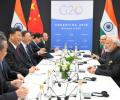
'The reason why we don't have an escalation of war like in 1962 is because in 1962, we didn't have this connectivity.' 'Whereas today, we have lots of incentives to stay stable and connected to China even though we still have that political rivalry.'

Dispelling the notion that India-China are rivals, Bambawale also said there is no "anti-China mentality" in India.

'The men in black suits and hair dye in Beijing have not only completely blown the cover story of "peaceful rise," but have managed to antagonise regional powers in the Indo-Pacific.'

'The China Pakistan Economic Corridor is Pakistan's number one preoccupation today -- and tensions with India and the $46 billion projects simply do not go together,' points out Ambassador M K Bhadrakumar.
The Modi government's appalling inefficiency and lack of purpose stand exposed, says Ambassador M K Bhadrakumar.

'Modi's recent decisions to improve India-China relations, adjust India's neighbourhood policies and to rebalance India's ties with the major powers are linked to his political agenda.' 'Of course, the good part is that this agenda is also in the national interest,' says Ambassador M K Bhadrakumar.

'Imran Khan hopes to fulfill the dreams of the founders of of Pakistan in establishing an Islamic Welfare State.' 'The grave situation of the economy makes realisation of this dream very difficult,' points out Colonel R N Ghosh Dastidar (retd).

General Bajwa, who commanded the 10 Corps that looks after Pakistan's border with India, is unlikely to change his army's and nation's policy on Kashmir,' says Ambassador M K Bhadrakumar.
