
The two leaders shook hands and exchanged pleasantries at the end of the media briefing which was addressed by Chinese President Xi Jinping. China is the host and chair of the SCO.
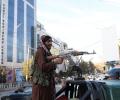
Delhi has come to accept the Taliban takeover in Kabul as a reality and seems increasingly unsure of its dogmatic view of the Taliban as a mere proxy of the Pakistani military and security establishment, observes Ambassador M K Bhadrakumar.

External Affairs Ministry Spokesperson Raveesh Kumar also talked about the China-Pakistan economic corridor in Pakistan-occupied-Kashmir, asserting that India is 'resolutely opposed' to any actions by other countries to change the status quo in the region.
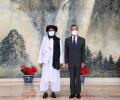
China may accord recognition to the new government in Kabul at an early opportunity, predicts Ambassador M K Bhadrakumar
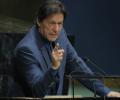
'He has a splendid opportunity to capitalise on the CPEC and turn the economy around decisively, putting Pakistan firmly on a higher growth trajectory.' 'Indeed, under the Imran-Bajwa dispensation, there has been a noticeable whittling down of support to militant groups,' points out Ambassador M K Bhadrakumar.
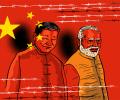
'The government's August 5 decision has impacted India-China relations, but it is not very significant or very different. Things like this have happened in the past.'

Three terrorists attempted a forced entry into the hotel. A guard at the entrance challenged them after which the terrorists opened fire and killed him, the army's media wing Inter-Services Public Relations said.

Jaishankar's talks with Yang and later in the Strategic Dialogue were expected to cover the key India-China differences like China blocking India's bid to join the NSG and UN ban on Azhar.

'A lack of strategic trust and the 'persistent security dilemma' prevails between India and China,' points out Dr Rup Narayan Das.
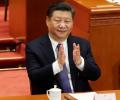
"We should safeguard the sovereignty and territorial integrity of the country and achieve full unification of the motherland. This is the aspiration of all Chinese people. This is also in line with fundamental of the Chinese nation," he said in an apparent reference to Taiwan which China claims as part of it.

The flawed Indian policy toward Afghanistan is missing the woods for the trees. The Modi government doesn't have a 'big picture', observes Ambassador M K Bhadrakumar, who played a stellar role in beginning India's systemic dealings in Afghanistan in 1994.
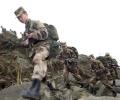
After frequent incursions in Ladakh area, Chinese People's Liberation Army troops have been spotted at forward posts along the Line of Control on the Pakistani side of Kashmir, ringing alarm bells in the security grid.

'India has to ensure its borders are properly sealed and there is no infiltration from PoK.

China will also set up 50 joint laboratories with countries participating in the Belt and Road initiative to enhance cooperation on innovation.
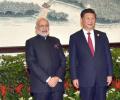
Prime Minister Narendra Modi and Chinese President Xi Jinping have agreed to make efforts to put India-China ties in the "right direction" and to "respect and accommodate" each other's concerns to avoid "impedance" relations, a top Chinese diplomat said on Tuesday.

'India in 2020 is a lot better prepared than in 1962.' 'It is no longer a pushover; and anything other than a crushing Chinese military victory will be a major loss of face for China,' observes Rajeev Srinivasan in the first of a three part column.
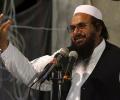
JuD official Ahmad Nadeem later said that the statement 'erroneously' mentioned China's name regarding terrorism in Pakistan.

India has much paranoia in India about a new 'Terroristan' coming up between Pakistan and a Taliban-ruled Afghanistan. Pakistan has zero ability economically, diplomatically, geostrategically or militarily to create one. If they try, it will be great for India as they will destroy themselves yet again, asserts Shekhar Gupta.

'The worst case scenario for Pakistan is a full-scale Taliban takeover of Afghanistan.' 'Pakistani militants would be inspired and emboldened and seek to replicate the Taliban's successes in Pakistan.'
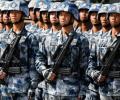
He called for delineation of the 3,488-km Line of Actual Control (LAC) which China has refused earlier.

India's decision to skip the meeting came after a year of bilateral discord over China's stubborn opposition to India's entry into the Nuclear Suppliers' Group and a UN ban against Pakistan-based terrorist group Jaish-e-Mohammed leader Masood Azhar.

The meeting took place two days after a military tribunal sentenced Indian national Kulbhushan Jadav to death on charges of spying

China's closer and enhanced relationship with Pakistan is putting considerable strain in India-China relations, says former RA&W officer Jayadeva Ranade.

'A firm national resolve can only deter and defeat the nefarious designs of the adversary,' notes Rup Narayan Das.

Pak PM Imran Khan said the terror strike was an effort to 'sabotage' the country's economic projects

In a move that is bound to raise hackles in India, Pakistan is working on raising the constitutional status of its occupied Gilgit-Baltistan to address China's concerns over the $46-billion economic corridor through the strategic region.

Chinese President Xi Jinping arrived in Islamabad on Monday on his first visit to Pakistan where he is expected to sign a deal for an economic corridor worth $46 billion and other agreement.

India cannot choose its geography and devise regional strategies to dovetail into the Western Indian Ocean hypothesis conceived in the Pentagon, argues Ambassador M K Bhadrakumar.

'Will Muhammad Habib Zahir -- who was part of the team that arrested Kulbhushan Jadhav and went missing in Nepal -- figure in a Jadhav-for-Zahir deal?' asks Aditi Phadnis.

The developments in Af-Pak region, particularly the fall out of Pak political paralysis, would make President Xi Jinping's task a little more complicated, says Colonel R Hariharan.

The government must figure out what the Chinese game plan is and thwart the endgame before it is upon us, possibly in early winter, advises David Devadas.

The IAF chief also said Pakistan has become a pawn of Chinese policy and its dependence on China would increase further in future. He said India needs to understand the interplay of some major events in its vicinity that would impact the security scenario of the region.

'For this kind of informal summit, I think it is better to leave the leaders much time to discuss whatever they would like to discuss'

'The Indian side has realised that not talking to Pakistan has not served any useful purpose.'

A senior US official said that the plan of establishing OBOR alternative was still 'nascent'.

For Pakistan, 'bending is not an option; either forward or backwards. We bend and we get a kick,' Malik, who retired as defence secretary in 2014, was quoted as saying by the Dawn on Friday during the seminar organised by the Strategic Vision Institute.

War with India is not an option as use of force could only worsen the situation, Pakistan's Prime Minister Nawaz Sharif has said while hoping to resolve all outstanding issues between the two countries.
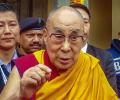
'The logical step is to challenge the very legitimacy of the Chinese claim over Tibet,' recommends Inspector General Gurdip Singh Uban (retd).
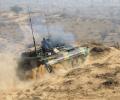
'Should the two armies clash in a conventional battlefield, the advantage will pass more and more to the Indians as the battle progresses,' says Brigadier S K Chatterji (retd).

'Pakistan has employed force to curb Baloch aspirations and rights. There have been charades of giving rights and concessions and packages, but all of them are hollow and meaningless and not even worth the paper these are written on.' 'Pakistan is appeasing China for the investments which will benefit them. The economic corridor with China will not only deprive the Baloch of their land and resources, but will turn them into a minority because of the influx of outsiders.' 'The Balochs want to be masters, not slaves and hired labour in their own land.'
