
Prime Minister Narendra Modi has managed to pull off what was unimaginable a year back -- adopting a much-needed centre-left approach, says Devanik Saha.

Universities must be the bastions of free speech and expression. It must be the arena where diverse and conflicting schools of thought contend. There should be no room for intolerance, prejudice and hatred within the spaces of this institution. Further, it must act as flag-bearer for the coexistence of multiple views, thoughts and philosophies, says Pranab Mukherjee.
The IMF chief listed three key policy areas for women's empowerment as the education, getting a job and having a family.

For an institution looking to revive past glory, the Nalanda University's initial days have been far from glorious.

Malala Yousafzai, the Pakistani teenager shot in the head by the Taliban for campaigning for girls' education, has been named as Britain's most influential Asian by a weekly publication in London.

Rajiv Malhotra's plagiarism may not be as horrifying as impersonating an exam candidate in Indore -- but they're both forms of cheating.

As electoral sails shift in the dynamic political winds of West Bengal, two factors may still change the electoral equations are how the BJP fares this time and how Muslims are going to vote. Mayank Mishra reports.

The stock and foreign exchange markets have had a negative reaction to the government's biggest social security programme, the National Food Security Bill. Food minister K V Thomas questions the rationale behind such a response

Gujarat was among the earliest civilisations in the sub-continent, dating back four millennia.

Laughter was a component of Parmeshar Godrej's large-hearted Punjabi spirit, recalls Sunil Sethi.

It is time to take the sainthood away from Dr Manmohan Singh, says Sudhir Bisht.

India's neglect of villages shows up in many other ways.

'All of Indira Gandhi's bad economic ideas are being strengthened, from nationalised banks to anti-poverty, handout yojanas,' says Shekhar Gupta.
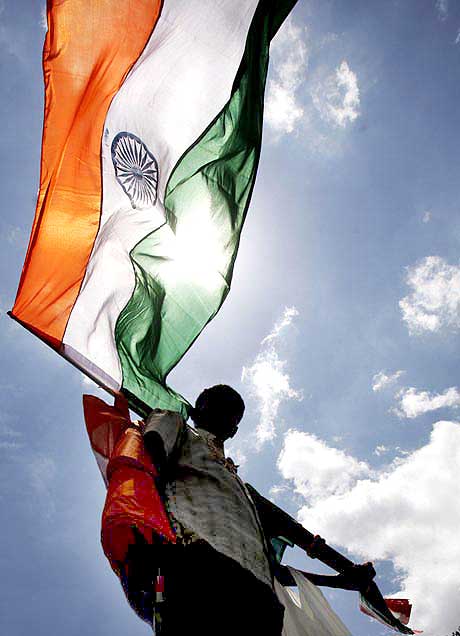
How has the Indian State, in principle and practice, given shape to the essential ingredients of the secular principle and composite culture?

'Those who have followed politics even when there was no Twitter know what the word 'jumlebaaz' means,' says Utkarsh Mishra.

'The writers fear that the fringe is threatening to become the mainstream and the liberal space -- a must for any creative expression -- is fast shrinking,' says Mohammad Asim Siddiqui.

'We have to find a way out of this confrontational politics.'
The nation wants an ex-ante body for endorsing "public purpose" during land acquistion process.

Democracies avoid serious political turbulence only so long as they ensure that the relative level of inequality between the rich and the poor does not become excessively large, says Vice President M Hamid Ansari.

From Aurangzeb to Sangh Parivar, the year 2016 offers plenty of hope in historical and modern literature.

Air India must tighten costs to comes out of the red or it wil perish in no time, says experts.

The economy could return to 8% growth by the end of 2017-2018, says Arvind Panagariya, vice-chairman NITI Aayog.

Not just Article 370 but all such special status articles must go, says T C A Srinivasa-Raghavan
With GDP down by 2 per cent, while 99 per cent of banned notes make way back to the banking system, whom did demonetisation benefit?

'It is extremely important to take back the domain of both religion from the religious bigots and nationalism from the chauvinists, who are spreading hatred.' Sugata Bose, the Harvard historian-turned-MP, who is Netaji's great-nephew, tells Anjali Puri why it is imperative to speak up for India's students.
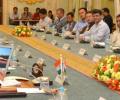
Thirty one outstanding teachers were invited to Rashtrapati Bhavan for a first-ever in-residence programme.
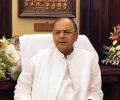
Why do I want to bring corporate tax from 30 per cent to 25 per cent? I have to attract investment in this country -- not just international but domestic.
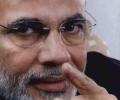
'I see you as a man who has split the nation into two. Vajpayee or even Advani would hold it together. One senses you cannot do this. To heal, to apologise, and to glue together a nation seems beyond you,' Shiv Visvanathan tells the BJP's prime ministerial candidate.

Even in this season of political-peeing-on-lampposts, Rahul Gandhi's statement takes the cake (with due apologies to another astute observer of poverty, the much late Mary Antoinette).


'We are by no means anywhere nearing having external financing difficulties or internal financing difficulties. The government's credit is solid, there is absolutely no difficulty for the government in borrowing and it is borrowing effectively from the public today in a fairly free public debt market,' the RBI governor tells a meeting in Washington, DC

'We have 10 million votes, 15,000 votes per MP constituency. There are certain constituencies who will win by about 5,000 or 6,000 votes. So if we win this case, these 15,000 votes will play crucial roles in at least 50 Lok Sabha constituencies, which can change the dynamics of the entire political system,' Nagender Chindam tells Patrick Ward in an interview.

'India cannot expect to be insulated from the crisis. Europe is India's biggest trading partner with two-way trade of E72.5 billion or Rs 530,000 crore last year,' says Paranjoy Guha Thakurta.

Rajeev Srinivasan on whom the Congress might put forth as its leader in 2014.

We're behaving like frogs in warm water. We swim around untroubled, cooled by our faith in Indian liberal democracy. We are blind to the bubbles popping around us, the bubbles warning of fundamental changes, says Mihir S Sharma.

India's nuclear establishment is continuing its march of folly at the expense of safety in the false belief that atomic power is the energy of the future. It's not. Nuclear power is in relentless global decline, says Praful Bidwai.

'The real test will be in defence-related deals, for instance the Javelin anti-tank missile: Is the US willing to co-develop something with India, on terms that will support the 'Make in India' initiative? Is there defence technology transfer? Or will it dump old junk on India?' asks Rajeev Srinivasan.

Sree Sreenivasan recalls his encounters with the pioneer of sound who passed away on Friday and gives a sense of how many lives he touched -- in big and small ways.
 © 2026 Rediff.com - Advertise with us - Disclaimer - Privacy Policy - Sitemap - Feedback - About us - Terms of use - Grievances