
The Supreme Court has permitted the sale and bursting of green crackers in Delhi-NCR for Diwali, relaxing the ban on green firecrackers as a temporary measure from October 18 to 21. The court has asked pollution control boards to monitor pollution levels and file reports. The order also includes measures to prevent the sale of non-compliant crackers.

Discover the cleanest states in India with the best Air Quality Index (AQI)

Dr Sneha Tirpude, a pulmonologist at Pune's Ruby Hall Clinic, suggests simple measures to protect your lungs when the air quality is poor.
'If we don't control the additional pollutants that come from various human activities then, the pollution level will not come down.'

Developing relations with the Taliban is needed, but plunging headlong into Afghanistan without due thought will be akin to the rooster entering a KFC outlet, warns Lieutenant General Prakash Katoch (Retd).

Heavy rains lashed Delhi, leading to a red alert, traffic snarls, and waterlogging. The IMD predicts continued rainfall.

The first cloud-seeding trial has been conducted in parts of Delhi, including Burari and Karol Bagh areas, aimed at inducing artificial rain to tackle air pollution.

The Supreme Court is considering relaxing the ban on firecrackers in Delhi-NCR ahead of Diwali, citing practical concerns and the need to balance environmental and livelihood interests.

According to Ministry of Earth Science's air quality monitor 'SAFAR', the air quality is likely to improve from Friday onwards due to better wind speed.

As many as 12 flights were diverted at the Delhi airport between 3 pm and 4 pm due to adverse weather conditions, an official said.

The AQI recorded in Mumbai at 8 am was 131, categorised as 'moderate', as per the Central Pollution Control Board.

Delhi's air quality plummeted to alarming levels on Tuesday after 24 days, with many areas witnessing a significant spike in pollution despite the strictest measures, including a ban on construction activities and the entry of trucks into the city, coming into force.

Delhi's air quality deteriorated significantly on Monday, with areas like Dwarka, Mundka and Najafgarh recording an AQI of 500, the worst this season. The city's overall AQI reached 491, triggering the implementation of the Graded Response Action Plan (GRAP) Stage-IV restrictions in Delhi-NCR. Doctors warned of health risks, urging people to wear N95 masks and avoid outdoor activities. The Supreme Court questioned the Delhi government on its anti-pollution measures and warned against scaling down preventive measures without its permission. Delhi Chief Minister Atishi accused the BJP-led central government of political maneuvering while neglecting stubble burning in states it governs. Meanwhile, the city enforced stricter pollution control measures, including a ban on truck entry and suspension of construction activities. Air purifier sales surged, reflecting the public's concern over the severe air pollution.

A UN Security Council report states that The Resistance Front (TRF) claimed responsibility for the Pahalgam terror attack and published a photograph of the attack site. The report also cites assertions that the attack could not have happened without the support of Pakistan-based Lashkar-e-Tayyiba (LeT).
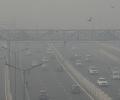
Delhiites continued to breathe toxic air on Tuesday as the air quality edged closer to the severe zone in some areas.
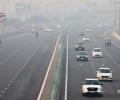
The city's 24-hour Air Quality Index (AQI), recorded at 4 pm daily, stood at 417, making it the worst in the country. On Friday, the AQI level was 396.

The city's air quality dropped to the "very poor" category, with an Air Quality Index of 330 at 10 pm.
Temperatures are likely to remain in a similar range until Thursday, with a gradual fall expected from June 13.

While Delhi was set to host the opening Test against South Africa from November 14-18, it will now host the second Test against West Indies starting October 10.

Iconic landmarks shrouded in smog, casting a hazy veil over their majestic appearances.

The city's 24-hour Air Quality Index, recorded at 4 pm every day, stood at 418, up from 334 the previous day, and it may trigger stringent restrictions under the third stage of the graded response action plan to mitigate hazardous conditions.
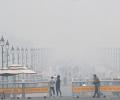
The SC questioned the Delhi government over delay in implementation of stricter anti-pollution measures under GRAP-4, and said it will not allow scaling down of the preventive measures without its prior permission.
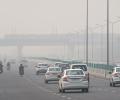
The neighbouring cities of Faridabad (469), Greater Noida (464), Ghaziabad (470), Gurgaon (472) also recorded 'severe' air pollution levels.
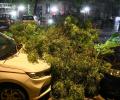
A strong dust storm and gusty winds followed by rain hit Delhi-NCR on Friday evening, causing trees to be uprooted in several parts and leading to traffic congestion. Thunderstorms caused power disruptions in several parts of the city, primarily due to trees and branches falling on electricity cables. The India Meteorological Department (IMD) has issued an orange alert, recommending people stay indoors and avoid unnecessary travel.

Some residents have already taken this step to relocate, either temporarily or permanently, some to their native places and others to clean-air destinations like Goa and Himachal Pradesh.

Dense fog enveloped Delhi for a second consecutive morning, leading to disruptions in air and rail traffic. Visibility dropped to zero in several areas, causing delays for 81 trains and diversions for 15 flights. The Met office attributed the fog to calm surface winds, and predicted continued dense to very dense fog throughout the day. Meanwhile, the national capital's air quality remained in the 'very poor' category, with an AQI reading of 380 at 9 am.
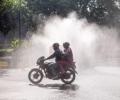
This deterioration in air quality led to prompting enforcement of Stage II of the Graded Response Action Plan (GRAP) in the national capital.

Delhi's crime rate against women stood at 144.4 in 2022 -- the highest among all states and Union Territories.
The Delhi government has announced that vehicles older than 15 years will be denied fuel at petrol pumps starting April 1.
Delhi University and Jawaharlal Nehru University have announced a shift to online classes until November 23 and November 22, respectively, due to the alarmingly high air pollution levels in the city. The decision comes as Delhi and the National Capital Region (NCR) face "alarmingly high" air quality levels, prompting concerns about health and safety. The schedule of exams and interviews remains unchanged, the universities said. The Delhi government has termed the air situation a "medical emergency" and urged institutions to take preventive measures. Several schools and colleges in the region have already started shifting to online classes due to the poor air.

According to the Graded Response Action Plan (GRAP), the air quality is considered to be in the emergency category if the PM2.5 and PM10 levels continue to be above 300 micrograms per cubic metre and 500 micrograms per cubic metre respectively for 48 hours or more.

Katrina prefers denims during Diwali... Kajol has a question... Kartik takes Vidya to Kolkata...

Preventive measures are in place and the forecast suggests further improvement, said the statutory body responsible for forming air pollution reduction strategies for the region and their implementation.

Khushi fares better in emotional scenes but her chemistry with Junaid has the passion of a toothpaste campaign, observes Sukanya Verma.

After a long and harsh spell of heatwave, Delhi witnessed a pleasant morning on Thursday, with the weather department saying parts of the national capital received light rains.

The monthly Rs 2500 payment for poor women is expected to cost Rs 11,000 crore while the pension scheme of Rs 2000 for every senior citizen will cost around Rs 4100 crore. The Yamuna clean up will cost over Rs 10,000 crore while a similar amount is required to upgrade Delhi's hospitals. Ultimately, the new BJP government will have no choice but to ask the centre for financial support, notes Rashme Sehgal.

Gaps in enforcement, limited monitoring, and easy access to firecrackers from the NCR region where restrictions were slack were largely responsible for the widespread flouting of the cracker ban in Delhi on Diwali, experts have opined.

Firecracker bursting till late Sunday night led to a spike in pollution levels amid low temperatures.
Amid Delhi's worsening air quality, which has plunged into the severe plus category with an AQI consistently above 450, Environment Minister Gopal Rai on Tuesday called for immediate intervention from the central government.

Breathing polluted air for long periods of time can cause more serious problems. Avoid exercising outdoors on bad air days, suggests Dr Varun Gupta.
