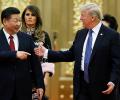
'What matters is that India's perspective on global issues -- climate change, intellectual property, free trade, trade routes being kept free, digital technology -- are listened to with respect,' says Ambassador B S Prakash.
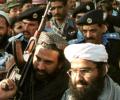
Swaraj took up the issue with Wang at a bilateral meeting in Moscow on the sidelines of the Russia-India-China trilateral meeting of their foreign ministers.

India has been eyeing deeper energy ties with Iran and has already lined up $20 billion as investment in oil and gas as well as in petrochemical and fertiliser sectors there.

Jaishankar's talks with Yang and later in the Strategic Dialogue were expected to cover the key India-China differences like China blocking India's bid to join the NSG and UN ban on Azhar.

Hailing India for keeping "neutral stand" over the South China Sea issue despite pressure from the US and Japan, state-run Chinese media on Wednesday said there are some contradictions and frictions between the two nations but the overall bilateral relations have been developing smoothly.

Donald Trump is believed to be the first US President or President-elect to have spoken to a Taiwanese leader since 1979, when the US severed diplomatic ties with Taiwan after its recognition of the People's Republic of China, points out former RA&W officer Jayadeva Ranade.

India and China have not ruled out a Modi-Xi meeting during the summit.

India on Monday voiced its concern to China over its plan to build a multi-billion dollar Economic Corridor to Pakistan through POK, even as it assured Beijing of its commitment to consolidate strategic bilateral ties.

'While visits and personal meetings are useful, changes of strategic significance have occurred recently, with Beijing trying to take the lead which Modi must take note of.'

The new government needs to clearly insist on diplomatic reciprocal arrangements with China. While reciprocity is a function of power in bilateral relations, the Modi-led government's responses should be based on India'S inherent strengths, says China expert Srikanth Kondapalli.

Modi also said the people of India felt proud that President Xi has twice received him out of the capital.
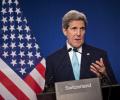
At scaling back Tehran's nuclear programme and relieving the Islamic Republic from the sanctions

Chinese President Xi Jinping arrived in Ahmedabad on Wednesday on a three-day visit, which is expected to define the relationship between the two neighbours who have had a troubled past.

'Both Modi and Xi know that if all that there is to show for Modi's visit -- barely eight months after Xi's India trip -- is a repeat of the same old declarations, there will be a terrible sense of letdown in the public mood resulting in future summits losing credibility. Only the possibility of new ground being broken can justify Modi's trip at this time,' says B S Raghavan.

All the three issues raised by China at the Modi-Xi meeting are either intractable or peripheral to the bilateral relations and suggest conventional methods to placate the other side without yielding much, says Srikanth Kondapalli.

'After a strategic pause though, Beijing will revive its policy of slowly creeping towards acquiring sovereignty over the South China Sea.'
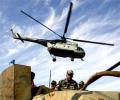
Prime Minister Narendra Modi's initial weeks in office and the composition of his national security team give a sense of his government's foreign policy and national security priorities, says Harsh V Pant

Two US lawmakers write to the House Speaker asking to extend an invitation
'We could quibble with each other whether there were 25 terrorists killed or 250 killed.' 'The message is more that India undertook such an aerial attack and this attack has actually changed the paradigm.' 'The change in paradigm is that India has shown by the surgical strike in 2016 and the aerial strike of 2019 that we will not just sit back and tolerate terrorism which killed so many of our people.' 'We will hit back and by hitting back we will raise the costs of such activities.'

The prejudices the Chinese carry with them mean they are not natural global managers.

Prime Minister Narendra Modi enjoys a close relationship with Shinzo Abe. For Abe, "a strong India is in the best interest of Japan, and a strong Japan is in the best interest of India."

'In the run-up to the summit, Trump had indicated that he might strike a nuclear deal in the course of a single meeting or over several days, but as it transpired, Trump departed Singapore soon after the meeting.' 'This raises questions if his aspirations for an ambitious outcome had been scaled back,' says Rajaram Panda.

Even as the United States snuggles closer to India with the thinly veiled objective of containing China, the Indian strategy is to avoid alienating either nation.

As the context of Panchsheel has changed, it is all the more essential that India and China need to reinvent and redefine Panchsheel for a new world order taking into account globalisation, and mutual economic interdependence. The new Panchsheel, in order to be relevant, needs to shed its binary approach of west verses the east recognising the seamlessness of global frontiers, which globalisation has brought in, says Rup Narayan Das.

An international tribunal in the Hague has ruled in favour of the Philippines.
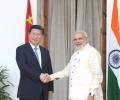
With the continuing stand-off in Ladakh casting a shadow over the Sino-India talks, Prime Minister Narendra Modi on Thursday raised 'serious concerns' over the repeated incidents along the border and sought an early settlement of the boundary question.

India and China decided to seek a fair and rational solution to their border dispute on Saturday as they focused on the proposed border defence cooperation agreement to avert incursions like the one witnessed in Leh region last month.
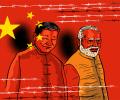
'As China rises and India grows to reclaim their earlier positions on the world stage as two of the largest economies and most important countries, there will indeed be some contention between these two powers.' 'There will also be plenty of space and room for cooperation amongst the two of us.' 'As our economic size increases to match the fact that we are the two most populous nations on earth, it will be all the more important for us to keep the interests of our peoples as well as those of the rest of the world in mind.' 'We shall have to grow together rather than as separate and disparate entities,' points out Ambassador Gautam Bambawale -- who served as India's ambassador to China -- in the 7th annual lecture of the Indian Association of Foreign Affairs Correspondents on March 1, 2019.

'If the US-Pakistan relationship continues to suffer, Pakistan may feel it has less to lose and decide that it need not keep a leash on LeT in order to appease America.' 'A tougher US policy toward Pakistan could lead to an emboldened and strengthened LeT and JeM, resulting in more terrorist attacks in India.'

'Xi Jinping got a dose of Modi's medicine inside the tent where he was being hosted on the banks of the Sabarmati river.' 'Modi reportedly told him, looking deep into his eyes: "This was not expected of your country. Can you tell me when the troops are withdrawing?".'

From early indications, the Modi government's foreign policy seems to be pragmatic and reciprocal, says K G Suresh.

'If, as appears to be the case, India is on way to 'mending fences' with China, and China is equally desirous to 'reset' the relationship, this could be a self-reflexive moment in India's positioning vis-a-vis not just the Dalai Lama, but also the Tibetan issue and China as a whole,' points out China expert Alka Acharya.

New Delhi and Beijing are the only two regional capitals that have commented on US President Donald Trump's speech on August 21 outlining the way forward in Afghanistan. The Indian foreign ministry statement was effusive in praise, while the Chinese statement has been one of cautious and guarded hope. Delhi has identified itself with Trump's Afghan strategy, whereas the Chinese stance is calibrated -- observant and objective, keeping a distance, says Ambassador M K Bhadrakumar.
 © 2026 Rediff.com - Advertise with us - Disclaimer - Privacy Policy - Sitemap - Feedback - About us - Terms of use - Grievances