
In remarks titled 'Implement Consensus and Handle Differences Properly to Bring China-India Relations Back on the Right Track' posted on the Chinese embassy website, Sun spoke of disruptions in the bilateral relationship and outlined five steps to clarify 'some fundamental points'.
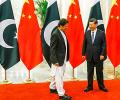
'If a 'two-front war' develops, Iron Brother may only turn out to be a drag on the PLA, since Pakistan is in no position to wage a war with India,' argues Ambassador M K Bhadrakumar.

52 world leaders, including Narendra Modi, will attend this week's Nuclear Security Summit in Washington, DC. Obama will meet separately only with the Chinese president.

Flexing its muscles over Taiwan, China on Monday sailed its aircraft carrier close to the estranged island amid tensions with the US following President-elect Donald Trump's telephone call with the Taiwanese president.

'The US appears to think that Pakistan is highly vulnerable today due to its economic crisis and one more turn of the screw may bring about desired results,' says Ambassador M K Bhadrakumar.

India and China on Monday ended their standoff in Dokalam by withdrawing their troops from the area, just days before Prime Minister Narendra Modi's visit to China to attend the BRICS summit next week.
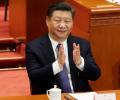
Xi has already been elected as general secretary of the ruling Communist Party of China at its once-in-five-year congress in October last year.
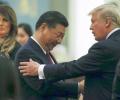
'While many Chinese policy makers dismiss the political, economic and technological component of US-India relations, they express caution on the defence-related ties which also happens to be a major driver in US-India relations,' explains China expert Srikanth Kondapalli.

Dr Manmohan Singh would be faced with very few choices in Beijing given the Chinese conceived notions of the world today and India's low place in their calculus, says Srikanth Kondapalli.
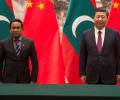
Chinese Foreign Ministry said international community should respect sovereignty and independence of the Maldives.

In a stern message to its neighbours, China today said it is determined to defend "every inch" of its territory and there was "no room for compromise" with Japan over territorial or historical disputes.

'This novel format of diplomacy -- the informal summit -- will not only facilitate bilateral communication and reduce miscalculations at the very top level of the two governments, but possibly open the space for China and India to speak in one voice on various issues of mutual concern,' note Feng Renjie and Ding Kun Lei

Sushma in her address at the Shanghai Cooperation Organisation Council of Foreign Ministers meeting said that terrorism is an enemy of basic human rights.

This is the second time that China has defended the decision to put a technical hold on India's bid to ban Azhar, the mastermind of the January 2 Pathankot terrorist attack.
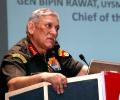
'We should not treat each other as rivals. We should make cooperation the mainstream, China said.

'The Indian version is that the two top diplomats merely exchanged pleasantries, while the Pakistani side characterised the encounter as an 'informal dialogue'.' 'The truth, as always in such piquant situations, is somewhere in between.' 'It stands to reason that ice has been broken,' says Ambassador M K Bhadrakumar.

Khan's visit evoked considerable interest in Beijing as it comes in the wake of his past criticism of the USD 50 billion China-Pakistan Economic Corridor projects and remarks by his ministers to cut down some of the projects over debt concern.
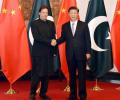
'The scheduling of Imran Khan's visit to Beijing and its focus on the J&K situation underscores that Beijing shares the Pakistani concern that tensions with India are only going to escalate further in the period ahead,' says Ambassador M K Bhadrakumar.

India's decision to skip the meeting came after a year of bilateral discord over China's stubborn opposition to India's entry into the Nuclear Suppliers' Group and a UN ban against Pakistan-based terrorist group Jaish-e-Mohammed leader Masood Azhar.

The meeting, which comes after the Doklam standoff, is aimed at a working a new paradigm for the bilateral relations for the next 15 years.
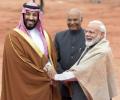
'No matter what Modi may boast about 'new India', the geopolitical reality is that India's stature diminishes when it needs a small country like Saudi Arabia under an autocratic ruler to help out with what is arguably one of the most critical templates of its diplomacy,' says Ambassador M K Bhadrakumar.
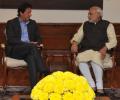
'A good opportunity has thus been provided for both countries to back away from the brink without loss of dignity.' 'There is every reason why they should strain every nerve, and grab every chance, shedding all thought of belligerence and showing who's the boss, to establish, maintain and preserve all it takes to lift themselves by their bootstraps,' says B S Raghavan, the distinguished civil servant.
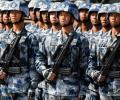
He called for delineation of the 3,488-km Line of Actual Control (LAC) which China has refused earlier.

'Significantly, Foreign Secretary Gokhale was received at very high level in Beijing.' 'It only shows China's keenness to move forward and put the relationship on a 'win-win' footing,' says Ambassador M K Bhadrakumar.

An MoU on sharing hydrological information of the Brahmaputra River by China to India and another pact on amendment of the protocol on phytosanitary requirements for exporting rice from India to China to include non-Basmati rice were signed after the Modi-Xi talks in the eastern Chinese port city.

Prime Minister Modi told President Xi that he has made efforts to improve ties with Islamabad but these efforts have been "derailed".

'If an 'informal meeting' with Xi Jinping materialises before the SCO summit in June, that itself could be regarded as a significant breakthrough in India-China relations,' says Ambassador M K Bhadrakumar.

In a few years there may be 100 Japanese companies in Gujarat, while Chinese firms may commit investments of over Rs 6,000 crore.

Special Representatives of India and China will hold the 16th round of boundary talks in Beijing on Friday, the first such meeting under the new Chinese leadership, to make another bid to move forward on the resolution of the vexed dispute.

'There are reports of political dissent mounting on Xi Jinping's handling of the Wuhan fallout.'

The Wuhan meetings signify an incremental shift in China's position on India as well as each country buying time for the next phase of bilateral relations, says Srikanth Kondapalli.

'Afghanistan cannot be at peace until the Pashtuns regain their pre-eminent role in the country's governance,' says Ambassador M K Bhadrakumar.

Why did the Chinese military take over the lab in Wuhan in end January? Did something go wrong? Claude Arpi glances at the mystery surrounding the origin of the coronavirus.
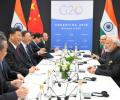
'The reason why we don't have an escalation of war like in 1962 is because in 1962, we didn't have this connectivity.' 'Whereas today, we have lots of incentives to stay stable and connected to China even though we still have that political rivalry.'

'Xi's emphasis on enhancing conventional military deterrence capabilities, joint operations and power projection are likely to increase friction points with India as with other nations,' points out China expert Srikanth Kondapalli.

'We should expect a cold-blooded, transactional relation that requires a lot of engagement and mutual trust to sustain,' says Constantino Xavier, Fellow, foreign policy, Brookings India.
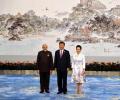
'By crudely dragging the topic into the bazaar to flog it for momentary pleasure, we turned it into a dead carcass by the time Modi even got back from Xiamen,' says Ambassador M K Bhadrakumar.
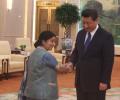
Chinese President Xi Jinping on Monday received External Affairs Minister Sushma Swaraj

Prime Manmohan Singh on Thursday sought Chinese investments in manufacturing and infrastructure sectors in India and called for market access in China for Indian IT and Pharmaceutical firms.

Chinese President Xi Jinping arrived in Ahmedabad on Wednesday to a grand welcome. He is India on a three-day visit which will focus on significantly ramping up trade and investment, besides addressing the contentious border issue that has seen occasional flare ups between the two Asian giants.
 © 2026 Rediff.com - Advertise with us - Disclaimer - Privacy Policy - Sitemap - Feedback - About us - Terms of use - Grievances