
Lavrov's comments came two days after Russia accused the US of attempting to prevent India and other countries from buying Russian oil, saying Washington was using a wide range of 'coercive' measures, including tariffs, sanctions and direct prohibitions.

He added that opposition parties were assured that their concerns regarding the impact of the West Asia situation on India and the safety of Indian citizens were addressed in detail.

2025 was a period of profound transformation across the globe. From historical leadership changes in the United States and the Vatican to groundbreaking scientific achievements and rising geopolitical tensions, these events reshaped international relations.

India has stated it will wait for the outcome of the elections in Bangladesh and the resulting mandate before addressing any existing issues. The country also affirmed its support for free, fair, inclusive, and credible elections in Bangladesh.

Speaking during an event on Saturday, Pakistani President Asif Ali Zardari revealed that during New Delhi's retaliatory strikes in May, his Military Secretary urgently advised him to move to a bunker for safety, highlighting the intense fear gripping Pakistan's top leadership amid the Indian operation.
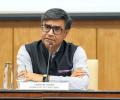
Foreign Secretary Vikram Misri, who faced trolling on social media in the wake of India and Pakistan reaching an understanding on May 10 to halt all military actions, has received support from veteran diplomat Nirupama Menon Rao, a body of Indian diplomats and a host of politicians from several parties.

The big question is whether Trump is any longer in command of the situation. For all practical purposes, the war seems set to cascade as the US is preparing for a potential ground operation in Iran and threatens to destroy 'bridges next, then electric power plants', points out Ambassador M K Bhadrakumar.

India and the European Union have finalized a comprehensive mobility pact that will create new opportunities for Indian students and professionals in Europe. The agreement was reached during summit talks between Prime Minister Narendra Modi and top EU officials.

Congress leader Shashi Tharoor is urging the Indian government to take a more proactive role in mediating the escalating conflict between the US-Israel alliance and Iran, emphasising the impact on India's energy security and regional stability.

The Indian government addressed opposition concerns regarding the West Asia crisis in an all-party meeting, outlining its strategy for ensuring the security of the Indian diaspora, fulfilling energy needs, and maintaining diplomatic relations with key partners. The government also dismissed Pakistan's reported mediation efforts.

India and Pakistan have agreed to a ceasefire on all fronts with effect from 5 pm on Saturday, following talks mediated by the US. The agreement was announced by Foreign Secretary Vikram Misri, who said that the DGMOs of both countries will speak again on May 12 at 1200 hours.
Lavrov said that the US has set itself the objective of 'achieving economic domination', adding further to it that Americans want to control the routes to leading countries to provide its energy sources to them.
India carried out missile strikes on terror targets in Pakistan and Pakistan-Occupied Kashmir, including the Jaish-e-Mohammad stronghold of Bahawalpur and Lashkar-e-Taiba's base in Muridke, after the Pahalgam attack that killed 26 civilians. The Foreign Secretary said the actions were measured, non-escalatory, proportionate and responsible.

Prime Minister Narendra Modi on Saturday met United States Ambassador-designate to India Sergio Gor and said he was confident that India-US ties will further strengthen during his tenure.

India will maintain multiple sources for crude oil purchases and diversify them to ensure stability in the supply chain with national interests remaining the "guiding factor" for the procurement, Foreign Secretary Vikram Misri said.

India and Israel have elevated their relationship to a special strategic partnership, focusing on enhanced cooperation in trade, technology, and defense, while also addressing regional peace initiatives.
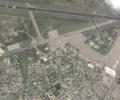
The Pakistani government has once again found itself embarrassed on the world stage, now acknowledging the impact of India's strategic and precision strikes on its military installation during the escalation in May, following Operation Sindoor, which came in retaliation for the April 22 Pahalgam terror attack that killed 26 civilians.

'To suddenly give the impression of taking a position that is hostile to Iran, or, at least, not friendly to Iran, is not a good thing.'

Afghan Foreign Minister Amir Khan Muttaqi arrived in New Delhi for a six-day visit, marking the first high-level trip from Kabul since the Taliban's takeover. He is scheduled to meet with Indian officials to discuss bilateral relations and regional issues.

Afghan Foreign Minister Amir Khan Muttaqi is expected to visit India next week, marking the first high-level trip from Kabul since the Taliban's rise to power. The visit follows a temporary exemption to a UN travel ban and is expected to enhance India's relations with the Taliban government.

Prime Minister Narendra Modi conveyed India's concerns to his British counterpart Keir Starmer over the activities of pro-Khalistani extremists in the UK, emphasizing the need for action against radicalism and violent extremism.

Under the defence partnership, India and the UAE are eyeing defence industrial collaboration and cooperation in advanced technologies, cyberspace training, special operations, interoperability of their militaries and counter terrorism.

'The US values its relationship with India and under the strong leadership of President Donald J Trump and Prime Minister Modi, I am optimistic about the days ahead for both of our nations.'
India joined Russia, China, and other nations in opposing the deployment of foreign military infrastructure in Afghanistan during 'Moscow Format' talks. The discussions focused on bringing prosperity and development to Afghanistan, with participants emphasizing the need to eliminate terrorism and integrate Afghanistan into regional connectivity.
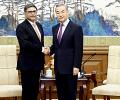
The Chinese Defence Ministry has stated that the Indian and Chinese militaries are implementing the resolutions to end the standoff in eastern Ladakh in a "compressive and effective manner." This follows the disengagement process completed late last year after a pact for troop withdrawal from Depsang and Demchok, the last two friction points in eastern Ladakh. The disengagement has paved the way for the resumption of various dialogue mechanisms between the two countries, with the aim of normalizing bilateral relations.
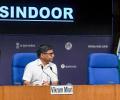
This came after a media report claimed that Col Qureshi and Wing Commander Singh, who led India's press briefings on Operation Sindoor, will be the faces of an ambitious women-centric campaign to be rolled out by the BJP on the completion of 11 years of the Modi government on June 9.

President Putin and Prime Minister Modi greeted each other with a warm hug, after which they walked towards the stage for a family photo of the SCO members.

India has expressed its expectations for Saudi Arabia to consider 'mutual interests and sensitivities' in their bilateral strategic partnership, following Riyadh's strategic defence pact with Pakistan.
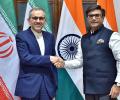
India's Foreign Secretary Vikram Misri will travel to Beijing for a two-day trip beginning Sunday, marking the second high-profile visit from India to China in less than one-and-a-half months. The visit comes amidst ongoing border tensions and follows a recent disengagement pact between the two countries in eastern Ladakh. The Foreign Secretary-Vice Minister mechanism meeting will focus on the next steps for India-China relations, including in the political, economic, and people-to-people domains. The decision to revive this bilateral mechanism was taken at a meeting between Prime Minister Narendra Modi and Chinese President Xi Jinping in Kazan in October.
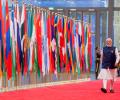
During a special briefing in Tianjin, Misri confirmed that the prime minister will first address the SCO plenary session before meeting President Putin.

Modi has been chairing regular meetings with the top government functionaries involved in the country's military and diplomatic response to the Pahalgam terror attack of April 22.

Prime Minister Narendra Modi raised concerns about cross-border terrorism with Chinese President Xi Jinping, advocating for India-China cooperation to combat the threat. The discussion occurred during the SCO Summit amidst efforts to rebuild bilateral relations after a border standoff.

India's Foreign Secretary Vikram Misri said on Thursday that the choice of de-escalation is with Pakistan, as India only responded to the April 22 Pahalgam terror attack, which killed 26 people. He added that Pakistan has been escalating the situation with cross-border terrorism against India for decades.
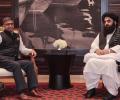
India has said it will consider engaging in development projects in Afghanistan and provide material support to the country in the health sector. The announcement came after Foreign Secretary Vikram Misri held talks with the Taliban regime's acting foreign minister Amir Khan Muttaqi in Dubai.
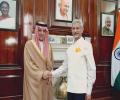
Saudi Arabia's Minister of State for Foreign Affairs Adel Aljubeir visited India on Thursday and held talks with External Affairs Minister S Jaishankar, focusing on de-escalating tensions between India and Pakistan. The visit comes as ties between India and Pakistan have further deteriorated following Indian military strikes on terror infrastructure in Pakistan. Iranian Foreign Minister Abbas Araghchi also arrived in New Delhi on a scheduled visit amidst the escalating tensions.

The landmine exploded when the troops were patrolling in a forward area in Digwar sector this afternoon, the officials said.
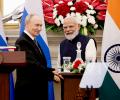
India and Russia have solidified a five-year plan to enhance their economic and trade partnership, while also addressing the ongoing conflict in Ukraine and the threat of terrorism.

Indian Foreign Secretary Vikram Misri is scheduled to visit Bangladesh next week for a foreign secretary-level meeting, amidst ongoing tensions between the two countries. The visit comes after the interim government led by Muhammad Yunus took power in Bangladesh, following the ouster of Sheikh Hasina as prime minister. The meeting will focus on a range of bilateral issues, including the potential extradition of Hasina and visa-related matters. Tensions between the two nations escalated further with the arrest of Hindu monk Chinmoy Krishna Das in Bangladesh, leading to concerns from India regarding attacks on minorities in the country.
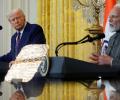
India responds to US President Trump's claim that PM Modi assured him of halting Russian oil imports, stating it is diversifying energy sources to meet market conditions and safeguard consumer interests.

Officials said the government-to-government engagement between the two countries on all other issues remains normal, but conceded rough spots over trade that need ironing out.
