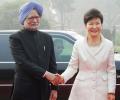
South Korean President Park Geun-hye's visit to India will enhance economic and military ties between the two countries and give the relationship a strategic dimension, says Jiye Kim.

The visit of Park Geun-Hye to India, though a symbolic one, will certainly give a further impetus to the strategic partnership between the two countries says Rup Narayan Das.

Top 20 images of all the events of the week that was.

When a Chinese warship entered Japanese waters, the Indian commander called on China to maintain discipline at sea. Dr Rajaram Panda explains the significance of the Malabar exercises between India, Japan and the US.

'... For the India-US relationship to continue its positive trajectory, it will require India to adapt to a different approach.' Nisha Desai Biswal -- who as the Obama administration's point person for South Asia was in the inner circle of all the Obama-Modi Summits -- tells Rediff.com's Monali Sarkar why she is hopeful that India and the US are on an irreversible forward course.
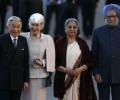
In recent years India-Japan relations have acquired rich economic content and strategic intents. Although the bilateral trade at $18 billion between the two countries is not very impressive and leaves much to be desired, the economic engagement between the two countries is both qualitatively and quantitatively noteworthy. India-Japan defence cooperation, however, has generated a lot interest among the strategic community in the context of rise of China. There has been a lot of speculation about India-Japan strategic partnership to hedge China, says Rup Narayan Das.
At no other time has a single meeting of the leaders of two democracies been so critical and hazardous.

The BRICS summit offers Modi an excellent platform to reach out to world leaders and conduct diplomacy on the very ticklish issue of reform of the world governance structure, and to exchange notes with his peers on international, regional and bilateral issues on the margins of the meeting, says Rup Narayan Das.

'The coming two months could unfold unpredictable results or unpredictable consequences or both at the same time,' says Rajaram Panda.
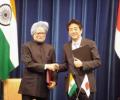
India's commitment to an open and plural security architecture attests to the fact that Asia's transition is a dynamic of both power & identity, says Zorawar Daulet Singh

'Modi and Obama both had agendas that went beyond the nuclear deal. The threat from the chilly Himalayas had to be tackled in the warm waters of the Indian Ocean.'

Obama's decision to visit India must be a result of his judgement that Modi is a man of action, feels Ambassador T P Sreenivasan.

Pushback to Modi govt's policy pronouncements has already started, it now has a very small window of opportunity to bring in reforms.

'India is a huge market for Chinese goods. I don't think a war stands to logic when you have economic compulsions, but then Chinese are known to do illogical things.'
Narendra Modi and his government should look at the emerging geo-politics realistically and not get sucked into having to make a choice between China and Japan. India has enough economic space for both, says Mohan Guruswamy.
'Secretiveness and the element of surprise in announcing decisions marks the Modi style of diplomacy. From being a voluble politician, he became a reticent statesman... But the diplomatic dance is performed on thin ice and his adroitness is still to be proved,' says Ambassador T P Sreenivasan.

Silicon Valley can be replicated, but this will only be achieved so long as fresh talent is welcomed by both our countries - a move that will surely spark a billion ideas and discoveries.

'This is the first time that the Americans have agreed to refer to "cross-border terrorist attacks" in a joint statement.' 'No wonder Pakistan has called the joint statement "singularly unhelpful" and has blasted it, and its all-weather friend China has applauded Pakistan's frontline role in combating terrorism,' points out former foreign secretary Ambassador Kanwal Sibal.

Modi today needs BJP CMs and non-party regional leaders to win votes and build alliances, but he will over-rule them and treat them like dirt once they have served their electoral purpose. Make no mistake: Modi is incurably authoritarian and will brook no dissent -- so long as the RSS is on board, says Praful Bidwai.

While trying to persuade North Korea to give up its provocative actions, engaging China is the first hurdle that world leaders will have to deal with, says Rajaram Panda.

The world is still figuring out the man as he continues his enigmatic journey towards the first 100 days of his presidency.

'It is my duty to give the govt the right price of crude oil.'

From early indications, the Modi government's foreign policy seems to be pragmatic and reciprocal, says K G Suresh.

'The lack of zeal to serve the country in the mammoth government machinery will be the biggest challenge for Narendra Modi and his government as he tries to change things; there will be not just resistance, but a lack of response to begin with.' If Narendra Modi becomes prime minister, Sheela Bhatt/Rediff.com says the issue of human resources, lack of talent and value system in governance will be his biggest challenge.

'As in the Panchatantra tale of the cat and the monkeys, it is possible for the clever swing State to play off the two competing powers.'

Japan has the capital and needs to pull out of China, which has been its major destination. India, on the other hand, desperately needs capital especially for infrastructure, argues Rajeev Srinivasan.
Narendra Modi would have done well to take a few more months before he agreed to receive or call on heads of countries like Japan, China, and the US. The prime minister is to settle down in his job and it was too soon for him to have full awareness of the nuances of intricate international issues, says B S Raghavan.

While China is bigger and feels mightier at the moment, Beijing's rulers would be well advised not to be tempted to provoke India, for that would only trigger a chain reaction around the world that would not serve anyone's interests, says Sanjaya Baru.

'After many rudderless years, India and Japan have prime ministers with a sense of purpose and direction,' says Brahma Chellaney.
Sushma Swaraj, like Clinton, has a strong political base in her own party and is likely to have her imprint on foreign policy, says Ambassador T P Sreenivasan.

'A plausible American tactic,' Rajeev Srinivasan suspects, 'would be to try and prevent the BJP and Modi from coming to power by splitting the anti-Congress vote using the AAP, and in case that fails, to follow up with a Plan B to make India ungovernable, to create mass conflict through their agents.'

'India should think big: About how in a multi-polar world, India can indeed be one of the poles, rather than being a secondary power that has to worry about 'alignment' with one of the poles. A G3 in other words, India should look to getting others to align with itself rather than the US or China,' says Rajeev Srinivasan.
The kind of people Narendra Modi has chosen, the decisions he has taken and the rail and central budgets suggests that he is treading carefully in New Delhi. There is less of innovation and more of continuity, so far. He is not ready to rock the boat and start from scratch, says Sheela Bhatt.

'The Modi-Xi and Modi-Obama meetings, with an interval of just 12 days, are juxtaposed superbly at a crucial point in the prime minister's life. Can Modi carve out a win-win situation with the superpower and the emerging superpower at the same time?'
With Beijing having had a profound rethink on India's admission as a full member of the Shanghai Cooperation Organisation, the tectonic plates of the geopolitics of a massive swathe of the planet stretching from the Asia-Pacific to West Asia are dramatically shifting. That grating noise in the Central Asian steppes will be heard far and wide -- as far as North America, says Ambassador M K Bhadrakumar.

'The real test will be in defence-related deals, for instance the Javelin anti-tank missile: Is the US willing to co-develop something with India, on terms that will support the 'Make in India' initiative? Is there defence technology transfer? Or will it dump old junk on India?' asks Rajeev Srinivasan.
 © 2026 Rediff.com - Advertise with us - Disclaimer - Privacy Policy - Sitemap - Feedback - About us - Terms of use - Grievances