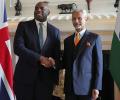
India's External Affairs Minister S Jaishankar has stated that the US administration under President Donald Trump is moving towards multipolarity, which aligns with India's interests. He also revealed that India and the US have reached an agreement on the need for a bilateral trade pact. Jaishankar touched upon various foreign policy issues including India's role in the Russia-Ukraine conflict, the trajectory of the BRICS grouping, and relations with China during a session at the Chatham House think-tank in London.
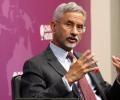
"From President Trump's perspective, the one big shared enterprise that we have is the Quad, which is an understanding where everybody pays their fair share. There are no free riders involved. So that's a good model which works," he said. The Quad alliance consists of the US, India, Australia and Japan.
India has called Pakistan's nuclear bluff with Operation Sindoor and sent a psychological message to state-sponsored terrorists: nobody is untouchable and no place in Pakistan is safe for you, government sources said on Sunday.
India's External Affairs Minister S Jaishankar has expressed concern over information regarding USAID funding in India, calling it "concerning" and hinting at potential "bad faith" activities. Jaishankar asserted that India is looking into the matter and that the country should know who is involved in such activities. He also emphasized the need to expand India's security definition in the digital age, highlighting the influence of technology and narratives on public perception. The statements come amid controversy surrounding USAID funding for certain activities in India, with the US President Donald Trump questioning the agency's funding of voter turnout efforts.
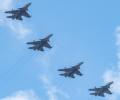
Pakistani military targets at Rafiqui, Murid, Chaklala, Rahim Yar Khan, Sukkur and Chunian were engaged using air-launched precision weapons from Indian fighter jets and the retaliation largely focused on command and control centres, radar sites and weapon storage areas, Qureshi said.
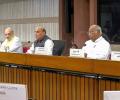
When the country has been at war, the Opposition has buried its differences with the government, points out Aditi Phadnis.

Amid escalating tensions between India and Pakistan, the US has said it will not get involved in the conflict, stressing that it is "fundamentally none of our business." While acknowledging concerns about a potential nuclear war, Vice President J D Vance emphasized that the US cannot control India and Pakistan, but can encourage them to de-escalate. The US has also reiterated its support for direct dialogue between the two countries and encouraged efforts to improve communications.
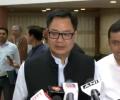
Defence Minister Rajnath Singh told an all-party meeting that at least 100 terrorists were killed in the Indian strikes on terror sites in Pakistan and Pakistan-occupied Kashmir under 'Operation Sindoor'. Leaders from various parties showed maturity and extended all support to the government and armed forces.
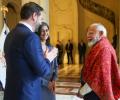
Vance is expected to be accompanied by at least five senior officials, including from the Pentagon and the State Department, the people cited above said.

'It brings precarious peace because the red lines have shifted. 'The next Pahalgam attack would mean a full scale war.'
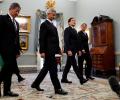
In a move sending a strong signal to China, foreign ministers from Quad countries -- India, Australia, Japan and the United States -- in a joint statement on Tuesday strongly opposed any unilateral actions that seek to change the status quo by force or coercion.
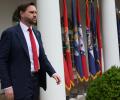
US Vice President J D Vance and National Security Adviser Michael Waltz are scheduled to visit India on April 21, reflecting Washington's focus on strengthening its relationship with India amidst global concerns over President Donald Trump's tariff policy. Vance's visit is likely to be more of a private trip, while Waltz's visit will be a business trip with discussions on security in the Indo-Pacific region, high technology, critical minerals, and export controls. Both are expected to meet Prime Minister Narendra Modi before his trip to Saudi Arabia. The visits come in the wake of Trump's recent pause on tariffs on all countries except China, following widespread economic concerns.
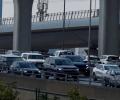
Nine Indian nationals were killed in a road accident near Jizan in western Saudi Arabia. The Indian mission in Jeddah said it is providing full support and is in touch with the authorities and families.

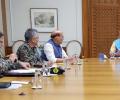
Prime Minister Narendra Modi held a meeting with National Security Advisor Ajit Doval and External Affairs Minister S Jaishankar upon his arrival from Saudi Arabia to take stock of the situation following the terror attack in Pahalgam, Kashmir. The meeting also included Foreign Secretary Vikram Misri. The attack, which killed at least 26 people, including tourists from the UAE and Nepal, has sparked nationwide shock and outrage.

Voting for the Delhi Assembly elections began on Wednesday, with prominent leaders like President Droupadi Murmu, Union ministers S Jaishankar and Hardeep Singh Puri, Congress leader Rahul Gandhi, and Delhi Chief Minister Atishi casting their ballots early in the day. Other notable figures who participated in the electoral process included Lieutenant Governor V K Saxena, Chief Election Commissioner Rajiv Kumar, AAP leader and former Delhi deputy chief minister Manish Sisodia, Delhi BJP president Virendra Sachdeva, Delhi Police Commissioner Sanjay Arora, and Delhi Chief Electoral Officer R Alice Vaz. The election is a triangular contest between the ruling AAP, BJP, and Congress, with the AAP aiming for a third consecutive term. Polling is underway at 13,766 stations across Delhi's 70 assembly constituencies to decide the fate of 699 candidates. The results will be announced on February 8.

India on Thursday night swiftly foiled Pakistan's attempts to hit various key Indian installations including military stations at Jammu, Pathankot and Udhampur with drones and missiles, the defence ministry said.
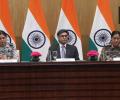
Colonel Sofiya Qureshi revealed that 300 to 400 drones were deployed across 36 locations, with several being shot down by Indian forces using both kinetic and non-kinetic methods.

"We were surprised. It looks strange to us. But nonetheless, what I say is that these are actions which yet again highlight the hypocrisy of Canada towards freedom of speech," the external affairs ministry spokesman said.
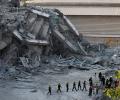
The death toll from a devastating 7.7 magnitude earthquake that struck Myanmar has risen to more than 1,000, as rescue workers continue to recover bodies from the ruins of collapsed buildings.
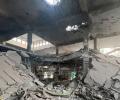
In a strong retaliation to the Pahalgam massacre, India's armed forces early Wednesday destroyed nine terror sites including that of Jaish-e-Mohammad and Lashkar-e-Taiba in Pakistan and Pakistan-occupied Kashmir (PoK) using deep strike missiles in a 25-minute-long 'measured and non-escalatory' mission.
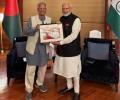
In his first meeting with Bangladesh Chief Adviser Muhammad Yunus, Prime Minister Narendra Modi on Friday flagged concerns over the attacks on minorities, including Hindus and conveyed that any rhetoric that vitiated the environment was best avoided.
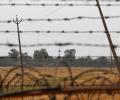
The UN Security Council could meet soon to discuss the situation between India and Pakistan, with the UNSC President expressing concern over rising tensions between the nuclear-armed neighbors. The President, Ambassador Evangelos Sekeris of Greece, said a meeting would provide an opportunity to express views and help diffuse tensions. Sekeris also condemned terrorism in all its forms, including the recent attack in Pahalgam, and called for de-escalation and dialogue between India and Pakistan.
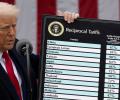
The impact of United States President Donald Trump's reciprocal tariffs is not yet known and New Delhi's strategy to deal with the situation is to firm up a bilateral trade pact with Washington, DC by fall of this year, External Affairs Minister S Jaishankar said on Wednesday.

He may have spent his entire adult life in diplomacy, but doctorate in nuclear physics Subrahmanyam Jaishankar's face betrays both fusion and fission of his moods.
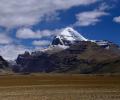
The Ministry of External Affairs (MEA) has announced that India and China have reached an understanding to resume the Kailash Mansarovar Yatra in 2025. While an understanding has been reached, the modalities of the pilgrimage are yet to be firmed up. The Yatra has been suspended since 2020 due to the COVID-19 outbreak and non-renewal of Yatra arrangements by the Chinese side.

Prime Minister Narendra Modi visited Assam and participated in a grand Jhumoir dance performance, celebrating 200 years of the state's tea industry and the rich cultural heritage of the tea tribe community. He played a traditional drum of the tea tribe community, highlighting the government's efforts to support the tea industry and uplift the tea tribe community. The event, attended by dignitaries and ambassadors from around 60 countries, showcased Assam's vibrant traditions to a global audience.
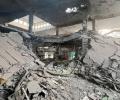
'I am worried that Pakistan will still feel compelled to take substantive military action beyond this apparent drone activity.' 'If so, the crisis could persist for a while more and dangerous days are still ahead.'
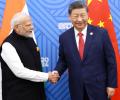
Chinese President Xi Jinping on Wednesday pledged to strengthen the strategic relationships with neighbouring countries by 'appropriately' managing differences and enhancing supply chain ties as China's tariff war with the United States escalated.
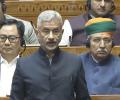
Jaishankar said India-China ties have been abnormal since 2020 when peace and tranquillity in border areas were disturbed due to Chinese actions.
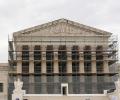
The US Supreme Court has denied the application of Tahawwur Rana, a Canadian national of Pakistani origin accused in the 2008 Mumbai terror attacks, seeking a stay on his extradition to India. Rana, currently detained in Los Angeles, had submitted the application after Associate Justice Elena Kagan initially denied it. Despite a renewed appeal, the Supreme Court ultimately rejected the request.
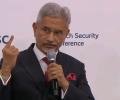
Jaishankar said that India is a democratic society and gives nutrition support to 800 million people. He noted that there are parts where democracy is working well and there could be parts where it is not. However, he underscored that it is should not considered a universal phenomenon.
He said that the two nations will have issues in the foreseeable future. However, there are ways of addressing those issues and what happened in 2020 was not the way to address those issues.

'Fears in Washington began to intensify when it was realised that subsequent Pakistani and Indian attacks on major military facilities -- which were significant in terms of geographic scope and intensity -- could rapidly take both sides to where neither actually wanted to go.' 'The US objective was to stop the fighting as soon as possible. Everything else was secondary.'
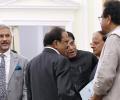
India's National Security Advisor Ajit Doval held bilateral talks with US Director of National Intelligence Tulsi Gabbard, and chaired a conclave of top global intelligence chiefs focusing on strengthening cooperation in confronting various security challenges including terrorism and threats posed by emerging technologies. The meeting also focused on security in the Indo-Pacific region, cooperation to counter terror funding and money laundering, and issues relating to extradition and immigration.
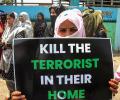
Amid rising tensions between India and Pakistan, the US has called on both countries "not to escalate" the conflict. Secretary of State Marco Rubio is expected to speak with the foreign ministers of Pakistan and India as early as today or tomorrow. The US State Department said Washington is reaching out to both India and Pakistan "regarding the Kashmir situation" and telling them "not to escalate the situation."
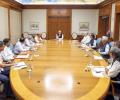
Terrorism and insurgency in J&K had subsided when India demolished East Pakistan -- for the simple reason that Pakistan understands power. We need to follow Chanakya's dictum of Saam, Daam, Dand, Bhed for strategising against Pakistan, asserts Lieutenant General Prakash Katoch (Retd). The ground truth is that unless we are prepared to acknowledge our shortcomings, including massive intelligence failures, punish those responsible and take corrective actions, we will continue in the same vein, asserts Lieutenant General Prakash Katoch (Retd).
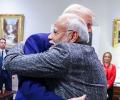
United States President Donald Trump welcomed Prime Minister Narendra Modi at the West Wing lobby in the White House in Washington, DC on Thursday.
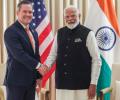
Prime Minister Narendra Modi said he had a 'fruitful meeting' with United States National Security Advisor Michael Waltz and they discussed defence, technology and security areas, which are important aspects of the India-US ties.
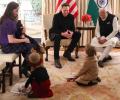
Prime Minister Narendra Modi met SpaceX CEO Elon Musk in Washington on Thursday. US President Donald Trump has chosen Musk to head a new Department of Government Efficiency (DOGE) last month. Musk arrived at Blair House with his three young children, who were sitting with Musk when he met Modi. Earlier, Modi met US National Security Advisor Michael Waltz. The meeting with Waltz was the first engagement of the day. External Affairs Minister Dr S Jaishankar and NSA Ajit Doval were also present at the meeting. Modi arrived in the US capital Wednesday evening for a bilateral meeting with President Trump. After arriving at Blair House, the President's Guest House, Modi met the US Director of National Intelligence Tulsi Gabbard. Just hours before her meeting with Modi, Gabbard took the oath of office as the 8th Director of National Intelligence in the presence of Trump.
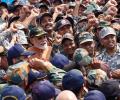
'Had Haji Pir and/or Skardu been taken, the message would have gone out not just to General Asim Munir and his cohort in the Pakistan army but to the Pakistani people that every terrorist incident in India would lead to substantial loss of territory in PoK.'
 © 2026 Rediff.com - Investor Information - Advertise with us - Disclaimer - Privacy Policy - Sitemap - Feedback - About us - Terms of use - Grievances