We have no standard processes in place to address the more serious public health hazard of our lifetime, observes Aakar Patel.

It is the first annual pilgrimage season at the hill temple after the coronavirus outbreak and authorities have decided to restrict the number of devotees to 1,000 per day and to 2,000 on weekends.
Vardhan, who interacted with chief ministers, state health ministers, principal secretaries and additional chief secretaries of Maharashtra, Uttarakhand, Manipur, Mizoram, Tripura, Meghalaya and Goa through video conferencing and urged them to focus on effective clinical management of COVID-19 cases to reduce deaths in the first 24, 48 or 72 hours.
Covid deaths at home, on the way to hospital or in private centres are not being counted in Bihar's official list of dead.

On the basis of feedback from the teams, the ministry has written to the states highlighting the areas of concern, including sub-optimal containment operations and contact tracing, skewed testing and shortage of health workers. Authorities need to work in these areas, it said.

The four states and the UT registered a total of 20,701 cases on Thursday.

The health ministry stressed that more than 70 per cent of the deaths occurred due to comorbidities.
The Centre on Saturday strongly advised 12 states and Union Territories reporting a surge in coronavirus cases to significantly increase testing and ensure people follow COVID-appropriate behaviour, noting that one infected person could spread infection to an average of 406 individuals in a 30-day window without restrictions.
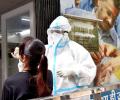
Over the past six months, the neighbourhood primary health centres have remained largely ill-equipped and thus relegated in the fight against the virus. Nitin Kumar reports.

Two United States Senators, a former adviser to US President Donald Trump, his campaign manager and three White House journalists have tested positive for COVID-19, joining several officials working at the presidential palace to have contracted the infection.

The NTAGI has also stated that those having laboratory test proven SARS-CoV-2 illness should defer COVID-19 vaccination for six months after recovery, the sources said.
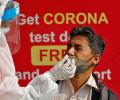
The Centre, however, noted that the last national serosurvey findings have shown that over 70 per cent of the population is still susceptible to the disease.

There is little doubt that the Dongria Kondhs are facing their biggest challenge. Being small in number, they need special attention and care in order to fight this deadly virus.

Chairing the 19th meeting of the Group of Ministers (GoM) on COVID-19 through video-conference on Friday, Vardhan said India has achieved the milestone of more than 10 lakh recoveries, a recovery rate to 64.54 per cent.

India is ready, after battling the pandemic for two years, to travel once again.

According to the Indian Council of Medical Research, a total of 92,97,749 samples were tested for COVID-19 up to July 2, with 2,41,576 of those tested on Thursday.

Pulling up the Delhi government, a bench of Justices Hima Kohli and Subramonium Prasad asked why it waited till the court intervened to take steps such as reducing the number of people attending weddings to 50 to prevent the spread of COVID-19.

While the new COVID cases and total active cases are going up, the administration is focusing on testing, contact tracing and treatment.
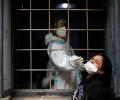
We knew from the moment the pandemic took hold that this would be a long haul -- at least 12 to 18 months. Nothing should have changed that assessment, says Mihir S Sharma.
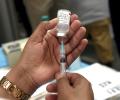
The second phase of Covid-19 vaccination in India will begin from March ,1 in which people above 60 years of age and those above 45 years of age with comorbidities will be vaccinated, Union Minister Prakash Javadekar said on Wednesday.

The number of recoveries stands at 6,12,814, while there are 3,31,146 active cases of coronavirus infection presently in the country. "Thus, around 63.25 per cent of patients have recovered so far," an official said.
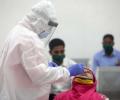
'We were lucky, in many ways, that we got the disease late.'

The capital recorded 2,373 fresh coronavirus cases taking the tally to 92,175. With 61 deaths, the fatalities now stand at 2,864.

In a review meeting through video conference with chief ministers and representatives of seven states with a high burden of COVID-19 cases, Modi said having micro containment zones will help states in dealing with the spread of the infection and also allow normal activities to continue.

It took 64 days for COVID-19 cases in India to touch the (May 19) one lakh-mark from 100 cases, and another fortnight to cross two lakh cases on June 3. It took 10 days for the tally to touch the three lakh-mark and another eight days for the cases to climb to four lakh.

A senior Delhi government official when asked about the spiralling number of COVID-29 cases, and whether there could be another lockdown, however, said, cases have increased as testing has been ramped up, "so, it is not that cases are rising alarmingly, and hence there is no chance of going back to lockdown".

'The state government is putting Maharashtrians in danger by letting people escape institutional quarantine mandate for the sake of their personal vasuli'

This was the fourth consecutive day that COVID-19 cases in the country have increased by more than 26,000.

'There is a deep stigma or taboo attached to COVID-19 in rural areas.' 'People don't want to test because they fear social exclusion.' 'Even those who test positive may not reveal and not follow the quarantine protocol.'

'If your oxygen saturation is okay and is maintained after the six-minute walk test -- which has been described all over the world -- and you do not have an unrelenting fever, then you can even be managed at home.'

The country has recorded over 20,000 cases of the infection for the fourth consecutive day. India went past Russia on Sunday to become the third worst-hit nation by the COVID-19 pandemic.

The spending on a typical RT-PCR test would take up 23 per cent of the monthly income of an average Indian, compared to 2 per cent in China. This is one of the deepest cuts in the pocket of an individual, in comparison to 14 other countries, reports Abhishek Waghmare.
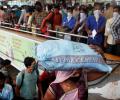
Six months after the lockdown was imposed, two dozen migrant workers were interviewed across five villages of Prayagraj. As the economy opens up, most of them are either hunting for a job or desperately waiting for a phone call from their previous employers. But the bruises of the lockdown are still fresh in their minds. Somesh Jha reports.

The expert noted that in India the pandemic is unlikely to be over in the months to come, and the number of people getting infected will continue to rise.

'By the time actual action began, it was already too late.' 'The virus was raging.'
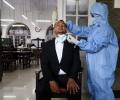
'If we wear a mask, social distance and vaccinate as many people, we may come out of this pandemic in 6 months' time.' 'If we decide to be disciplined, we can get out of this pandemic in the next 6 months.' 'If not, it is any body's guess.'
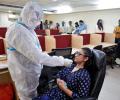
In another 2-3 weeks, coronavirus will chariot India to overtake the United States. In March, Modi had exhorted the nation to celebrate India's impending success over the virus by clanging metal plates. Make no mistake, India is losing this momentous war under his captaincy, notes Ambassador M K Bhadrakumar.

'People are just putting the mask below their nose.' 'They are only protecting the mouth, but not the nose.' 'People need to understand that it is the nose which has to be protected.'

'The main reason being Kejriwal's working style is very centralised.' 'And if you don't form a team and work, take bureaucrats into confidence, take doctors and hospitals into confidence, this problem was surely going to evolve.'

'People who have already got diabetes or heart disease or high blood pressure seem to be more badly affected by the disease.'
 © 2026 Rediff.com - Advertise with us - Disclaimer - Privacy Policy - Sitemap - Feedback - About us - Terms of use - Grievances