
Gyaincain Norbu was approved as the 11th Panchen Lama by the Chinese government in 1995, disregarding the wishes of the exiled Dalai Lama, who had nominated Gendun Choekyi Nyima.
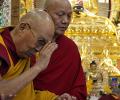
His successor issue is also expected to flare up fresh tensions between Beijing and Washington as China's policy comes in conflict with the US Tibetan Policy and Support Act of 2020, which reaffirmed America's steadfast support for the Dalai Lama and Tibetan Buddhism.
Panchen Lama, being groomed by China to rival exiled Tibetan spiritual leader the Dalai Lama, on Wednesday stepped out of the Chinese mainland for the first time to attend an international Buddhist conference in Hong Kong.

Panchen Lama, being groomed by China to rival exiled Tibetan spiritual leader the Dalai Lama, on Thursday made his first speech outside the Chinese mainland, highlighting the emergence of dharma from ancient India and need for its global promotion.
Self-immolation by six Tibetans, including three teenage monks, protesting Chinese rule in Tibet continued to haunt China as Communist Party leaders on Thursday began a key meeting where Panchen Lama, projected by Beijing as the rival to the Dalai Lama, was given prominence.
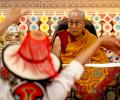
On July 2 or July 6, the Dalai Lama will reveal his mind on his successor. This makes Beijing extremely nervous as the Communist regime fully realises the importance of controlling the next Dalai Lama, points out Claude Arpi.

China has objected to Indian Minister Kiren Rijiju's remarks on the Dalai Lama's reincarnation, urging India to be cautious on Tibet-related issues to avoid impacting bilateral relations. China insists any future Dalai Lama must receive its approval.
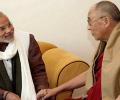
China has protested to India over Prime Minister Narendra Modi's greetings to the Dalai Lama on his 90th birthday and the attendance of Indian officials at the celebrations, stressing New Delhi should appreciate Beijing's sensitivities on Tibet-related issues.
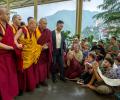
India has stated its neutral stance on religious matters following the Dalai Lama's announcement of his succession plan, which China has rejected. The statement comes as the Dalai Lama approaches his 90th birthday, with China urging India to exercise caution on Tibet-related issues.

The epicentre was located in Tsogo Township of Dingri County, which has a population of approximately 6,900 people within a 20-km radius. There are 27 villages within this area.

Why can't the Indian government propose to the Chinese a corridor circumambulating the Holy Mountain where people from both sides could perform the yatra again? asks Claude Arpi.
A young boy, who disappeared after being appointed as second highest Tibetan Buddhist religious leader by the Dalai Lama, is living with his family somewhere in Tibet, a top Chinese official said on Sunday.

'Why did your generals try to grab a few square kilometres of Indian territory in Ladakh?' 'And what happened to the hard work that you and Prime Minister Modi put into the Wuhan and Mamallapuram meets?' Claude Arpi writes a letter to Xi Jinping, China's self-styled supreme leader, who turns 68 today, June 15.
Campaigns Coordinator of Friends of Tibet Shibayan Raha and another activist Migmar Tsering were demanding the release of Gendhun Choekyi Nyima, the 11th Panchen Lama, the second most important religious figure.
Though Beijing asserts the Dalai Lama's successor needs its approval, observers say it remains concerned as the present Panchen Lama, the number two spiritual leader who was appointed by it after unseating the boy nominated by the Dalai Lama, has not gained much traction in Tibet.

The Chinese Communist party has not closed its door of contacts and negotiation with the Dalai Lama, a senior Communist leader wrote recently. Former RA&W officer and China expert Jayadeva Ranade explains what the thinking on Tibet is likely in Beijing.
Was Wang Yi'S visit intended to remind India of 1962, asks Claude Arpi?

'While wishing the Tibetan leader a long and healthy life, one can hope for a 'selection' of the Tibetan leader in the Indian Himalayas.' 'It is vital for Tibetan Buddhism, but it is also in India's political interests,' says Claude Arpi.
In the long-running rivalry between the 'Delhi Karmapa' and the 'Chinese Karmapa', the latter seems to have won.
Xi Jinping's recent actions in South Asia have amply demonstrated the disastrous impact of China's embrace, observes Jayadeva Ranade, the retired senior RA&W officer and China expert.
An article in The New York Times recently speculated that Beijing would try to legitimise its hand-selected (and therefore illegitimate) Panchen Lama, Gyaltsen Norbu, by sending him to study in the Labrang Monastery in Xiahe at the somewhat advanced age of 21.
The rumblings from the Tibetan areas of China continue. The more the Chinese suppress, the more the Tibetans protest. The more the Chinese demonise the Dalai Lama, the more the Tibetans respect him.

The world must hang its head in shame for being a mute spectator to the 'cultural holocaust' in Tibet, says Major General Mrinal Suman (retd).
China's ruling Communist Party has cracked down on Tibetans who planned to attend the Kalachakra Puja in Bodh Gaya. But the Tibetan people have dared the Communists by listening to the Dalai Lama's sermons on the Internet and sharing videos on social media.
Ogyen Trinley Dorje hopes to get a university education, but will the government allow it? Anand Sankar wonders.
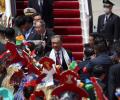
Wang Yang and Xi Jinping's visits signal the beginning of a major Chinese push to bring about a transformation of Tibet, observes Jayadeva Ranade, the distinguished China expert and retired RA&W officer.

Communist China has recently developed a great expertise in 'soul reincarnation', feels Claude Arpi

Penpa Tsering was on Thursday sworn-in as president of the Central Tibetan Administration, the Dharamshala-based Tibetan government-in-exile, and said he will reach out to the Chinese government to find a "mutually beneficial" and non-violent solution to the Sino-Tibet conflict.

'Information about the Dalai Lama's heath is normally not shared with the public. Its release on this occasion implicitly underscores the message that the window of opportunity for Beijing to recommence the dialogue with the Dalai Lama -- an advocate of non-violence -- to resolve the contentious Tibetan issue is limited.' says Jayadeva Ranade.

The spiritual leader on Saturday addressed devotees speaking to them about the pratices of Boddhisattavas at the Yid GaChosin monastery in Tawang, Arunachal Pradesh.

The seventh Tibet Work Forum was held in Beijing on August 28 and 29. Delhi should be deeply concerned, at a time India faces a precarious situation in Ladakh, because the TWF also defines China's western border policies, observes Claude Arpi.

China on Friday inaugurated its second railway line in Tibet, built at a cost of $2.16 billion, close to Indian border in Sikkim, enhancing mobility of its military in the remote and strategic Himalayan region.

Important for India was Xi's meeting with representatives of PLA officers and soldiers stationed in Tibet. The video of the encounter was interesting to watch, especially the large number of lieutenant generals and major generals, observes Claude Arpi.

Thirty years after the massacre at Tiananmen Square, coerced collective amnesia envelops the Chinese nation about that horrific event. Claude Arpi glances back at how the student uprising could have changed the Middle Kingdom forever had the Chinese Communist party not traveled on the route of martial law.

Why omit the Tiananmen massacre from the history of China's Communist party, asks Claude Arpi.
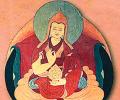
Tawang is very much a part of India, and if the present Dalai Lama decides one day to take rebirth in Tawang, the Indian government will openly welcome him and support him, notes Claude Arpi.

'China wants to change the status quo of India's Northern Border and proves that it can do whatever it wants in what it perceives as its own territory,' states Claude Arpi.

India was fooled into believing that Communist China wanted a 'negotiated' settlement with the Tibetans; it was never the case, says Claude Arpi.

Important for Chinese President Xi Jinping will be Zhao's discussions on the issues of Tibet and the Dalai Lama and his assessment of the likely results of India's coming national elections, notes former senior RA&W officer and China expert Jayadeva Ranade.

Arpi deserves to be complimented for the commitment and hard work that have gone into this production. The frustrations of seeking reliable documentation from the catacombs of the Indian bureaucracy did not deter him from going after the best information available, and the result is one that he can take much satisfaction in. Ambassador Prabhat P Shukla, Member Advisory Council, Vivekananda International Foundation, reviews Claude Arpi's The End of an Era: India Exits Tibet.
 © 2026 Rediff.com - Advertise with us - Disclaimer - Privacy Policy - Sitemap - Feedback - About us - Terms of use - Grievances