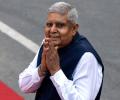
The Congress party has criticized former Vice President Jagdeep Dhankhar for his silence following his resignation, questioning the circumstances and demanding a farewell.

Amid the political push and pull, the Centre's decision to allow sugar exports and remove the 50 per cent duty on molasses exports has rekindled hope in the industry that more relief may follow.

The Bharatiya Janata Party-led National Democratic Alliance appeared to register a landslide victory in Bihar, opening up impressive leads in more than 180 of the state's 243 assembly seats, with early trends also indicating that the saffron party was on track to post its biggest tally.

Merely refusal to get married by a man after a consensual physical relationship for four years would not constitute a cognisable offence, the Allahabad high court has said while rejecting the plea of his live-in partner who had accused him of rape.

The Congress party has strongly criticized Prime Minister Narendra Modi's remarks regarding the dropping of stanzas from 'Vande Mataram' in 1937, calling his statements shameful and demanding an apology. The party argues that Rabindranath Tagore himself suggested adopting the first two stanzas of the song.
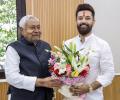
Following their landslide victory in the Bihar assembly polls, NDA leaders have begun discussions on forming a new government. Key coalition partners visited Chief Minister Nitish Kumar's residence, expressing support for his continued leadership. The article also touches on political developments within the RJD and reactions to the election results.

Aditaynath alleged that the Congress, RJD and SP were "embracing" criminals in Bihar and allowing infiltrators to compromise with the state's security.

A court in Bihar's Sheikhpura district has issued summonses to INDIA bloc leaders Rahul Gandhi, Tejashwi Yadav, and Mukesh Sahani in connection with alleged abuses hurled at Prime Minister Narendra Modi during a Congress event in August.
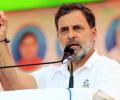
Democracy in India is too important to be left to a leader with a limited appeal. If Rahul Gandhi cares for India, he should step aside for a new crop of leaders, suggests Harishchandra.
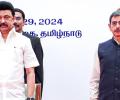
'It makes law-making on the part of the state governments much more difficult and throws up bottlenecks as governors are not acting on bills.'

The video is said to be of Mokama, which falls under Lalan's Munger Lok Sabha seat, where the former Janata Dal-United president's defence of party candidate Anant Singh in a murder case has already drawn flak from the Opposition.

Opposition parties in India are demanding a thorough and speedy investigation into a car blast near the Red Fort in Delhi that resulted in multiple fatalities and injuries. They are also raising concerns about the security situation in the national capital and questioning the government's handling of the matter.

The Congress's performance in the Lok Sabha elections showed that it may be down but not out, and Modi is determined to ensure that in the next round in 2029, it is consigned to irrelevance, points out Saisuresh Sivaswamy.

The Muslim League had orchestrated two deadly attacks on Sardar Vallabhbhai Patel in 1939 but the Congress establishment 'quietly' kept the story buried for 86 years because it was an 'uncomfortable truth', the Bharatiya Janata Party said on Friday, launching a blistering attack on the opposition party.

Prime Minister Narendra Modi on Saturday claimed that people were not voting for the Rashtriya Janata Dal-helmed opposition in Bihar as they fear that if voted to power, its regime will 'put katta to their heads and order them to hold their hands up'.
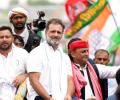
The sweeping victory of the Bharatiya Janata Party-led National Democratic Alliance in the Bihar Assembly elections has caused ripples across the country, but perhaps more pronounced in politically crucial Uttar Pradesh, where Assembly elections are due in 2027.
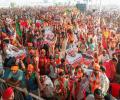
Electoral fortunes of 1,302 candidates, including over half a dozen ministers in the Nitish Kumar government, will be sealed on Tuesday with 3.70 crore voters eligible to exercise their franchise across 122 assembly segments in the second and final phase of the Bihar polls.
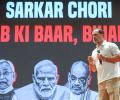
'Rahul Gandhi's problem is that he doesn't think big.' 'He looks more like an activist, while politics is like a game of chess. You attack and then defend and have a game-plan.'
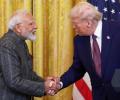
Opposition leaders in India have expressed hope that Prime Minister Narendra Modi raised the issue of the deportation of Indian illegal immigrants from the United States during his recent visit. They criticized the manner in which the Indians were sent back, shackled and handcuffed on a military aircraft. The leaders also discussed the need for India to address the root causes of migration and the importance of national interest in diplomatic relations with the United States.

The police sounded a high alert in Delhi. Seven fire tenders were rushed to the spot with police cordoning off the area, the Delhi Fire Services said.

The debate over working hours flared up after Infosys Co-founder N R Narayana Murthy called for 14-hour workdays.

Former Supreme Court judge B Sudhershan Reddy is the joint candidate of the Opposition parties for the Vice-Presidential polls, Congress President Mallikarjun Kharge announced.

'Are elections still fair in India, or are we all witness to a macabre style of 'selection' of lawmakers? The jury will be out on this for a long time because there is no definitive evidence on either contention, at least as yet,' notes Nilanjan Mukhopadhyay, author, Narendra Modi: The Man, The Times.

Purshottam Kushwaha, who belongs to an OBC community, allegedly posted on Instagram an Artificial Intelligence-generated image showing another villager, Annu Pandey, wearing a garland of shoes, the officials said.
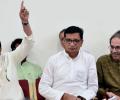
Top leaders of Maha Vikas Aghadi, including Shiv Sena-Uddhav Balasaheb Thackeray chief Uddhav Thackeray, Nationalist Congress Party-Sharadchandra Pawar head Sharad Pawar along with Maharashtra Navnirman Sena president Raj Thackeray, will lead the Opposition's November 1 protest march in Mumbai against alleged irregularities in voters' lists.
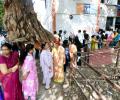
The first phase of Bihar assembly elections saw a moderate pace of polling across 121 constituencies, with 53.77% voter turnout reported till 3 pm. Sporadic incidents of violence were also reported. Key leaders are in the fray for both the ruling NDA and the opposition INDIA bloc.
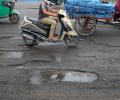
There has been growing criticism against the state government over the potholes on roads in Bangalore.

'The seats which we would be contesting have been identified. Respective candidates have also been finalised. Four non-performing sitting MLAs will be replaced with fresh faces.'
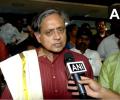
"It is high time India traded dynasty for meritocracy. This would require fundamental reforms, from imposing legally mandated term limits to requiring meaningful internal party elections, together with a concerted effort to educate and empower the electorate to choose leaders based on merit," Tharoor said.
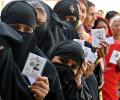
The Election Commission defends its directive to verify the identity of burqa-clad women at Bihar polling stations, citing a 1994 order issued during T N Seshan's tenure.

Assam Chief Minister Himanta Biswa Sarma has instructed police to register a treason case against Congress leaders for allegedly singing the Bangladesh national anthem at a party meeting. The move has sparked controversy and accusations of disrespect towards India's national anthem.

Following Raut's statement, the MNS, however, said the party's stand is decided by its chief.

Three persons were arrested on Sunday for their alleged involvement in the 'gang rape' of a student of a private medical college in West Bengal's Paschim Bardhaman district, police said.
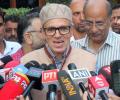
The Jammu and Kashmir government has ordered the closure of Darbar Move offices in Srinagar on October 31, following Chief Minister Omar Abdullah's announcement to restore the tradition. The Darbar Move, which involves shifting government offices between Srinagar and Jammu, was scrapped in 2021 but is now being reinstated.

"We did not know that a CBI inquiry was requested on our behalf regarding the Karur tragedy. It has been nine years since my husband Panneerselvam, who had signed the petition, abandoned us," says Sharmila, mother of the 9-year-old boy who had lost his life in the stampede during a political rally addressed by actor-politician Vijay.

Afghan Foreign Minister Amir Khan Muttaqi addressed the controversy surrounding the absence of women journalists at a recent press interaction in New Delhi, stating there was no intention to exclude them. He also discussed trade and investment opportunities between Afghanistan and India.

A team of Election Commissioners will visit Patna to review poll preparedness in Bihar ahead of the upcoming assembly elections. The team will meet with political parties, police, administrative officials, and observers to ensure a free and fair election.

Opposition parties are expected to announce their joint vice-presidential candidate, potentially leading to a 'south versus south' contest. Meetings and discussions have been held to finalize the candidate, with names from Tamil Nadu being considered. The opposition aims to field a non-political figure with national standing.

A SWOT analysis of the NDA coalition led by Nitish Kumar as Bihar heads into assembly elections, examining its strengths, weaknesses, opportunities, and threats against the INDIA bloc.

The opposition INDIA bloc leaders are expected to discuss their joint candidate for the post of vice-president at a meeting of floor leaders on Monday morning.
 © 2026 Rediff.com - Advertise with us - Disclaimer - Privacy Policy - Sitemap - Feedback - About us - Terms of use - Grievances