
The new laws aim at fetching fair price for farmers' produce and give them liberty to sell it wherever they wish, the Union minister further said.

The Maharashtra government on Thursday extended the lockdown-like restrictions in the state till June 1 to break the chain of COVID-19.

'All imaginary figures are pushed by government bureaucrats.' 'They never showed that the production of wheat was less this time.'

At the benchmark Lasalgaon Agricultural Produce Market Committee (APMC) mandi, the model onion price shot up to Rs 21.50 a kg on Thursday, as against Rs 16.50 a kg on Wednesday. This was the highest since February 11.
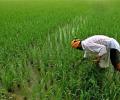
It has decided not to levy the 2 per cent tax deducted at source (TDS) on cash payments above Rs 1 crore made through Agricultural Produce Market Committees.

Releasing the manifesto titled 'Badlav Ka Sankalp' (commitment to change) in the presence of All India Congress Committee (AICC) general secretary Randeep Singh Surjewala and other Mahagathbandhan leaders, Tejashwi Yadav said their government, if elected, would first approve the process for appointments on about 10 lakh jobs in the government.

Union minister Prakash Javadekar accused the Congress of ignoring farmers' interests and keeping them poor to ensure cheap grain prices, and asserted that the Modi government empowered them by implementing the Swaminathan commission report to give them remunerative price through MSP.

Niti Aayog CEO Amitabh Kant said only farm revolution can make it possible. He also stressed on scrapping Agriculture Produce Marketing Committee and some old laws like Essential Commodites Act, which restrict movement of farm produces.

'Slower-than-anticipated recovery can be a bigger risk this time than a liquidity-driven event -- at least for India.'
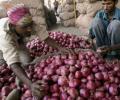
At Lasalgaon mandi, Asia's largest onion selling market, the onion price jumped Rs 1.50 a kg to Rs 32 a kg, the highest since January last year.

The petitions alleged that these laws would dismantle the Agricultural Produce Market Committee system intended to ensure fair prices for farm products

'The consolidation of the world's fifth-largest economy in the hands of 15-20 corporate giants is a once-in-generation event, which we are focusing on.'

Extended rounds of negotiations having failed, farm leaders now reckon that their best chance to pressure the government lay in defeating the BJP in the coming assembly poll, particularly in UP, observes Virendra Kapoor.

'Waiting for a market correction and optimising entry time in the markets will be akin to missing the woods for the trees.'
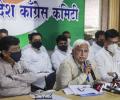
Deputy Chief Minister and NCP leader Ajit Pawar said farmers as well as the NCP and other parties are opposed to the new bills. "Farmers think that the laws are not beneficial for them. There was no hurry (to pass them)," he said.

On October 25, the government issued an ordinance on the denotification. Earlier, in July 2016, it had denotified fruits and vegetables, thereby allowing farmers to sell these to buyers within or outside APMC yards, as they chose

The President's assent to these bills comes amid the Opposition criticising the manner in which they were passed in Parliament.
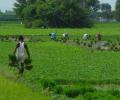
Cargill believes the reforms would act as a catalyst in attracting private sector investment in building supply chains for taking Indian farm produce to national and global markets.

V Singh said that "actual farmers are very happy with what has been done in last six months."

"The conduct of opposition leaders in the Upper House of Parliament on Sunday was shameful, irresponsible and utter disrespect to parliamentary rules and dignity," Union Minister Ravi Shankar Prasad said.

Barring stray incidents of violence like stone pelting, the shutdown called by the MVA allies Shiv Sena, the Congress and the Nationalist Congress Party was largely peaceful.

Political parties, agriculture experts and progressive farmers demanded such agri reforms for long, he said and attacked the opposition for misleading cultivators on the issue of MSP (minimum support price) and APMCs.

Replying to the general discussion on Budget in Lok Sabha, she said the former Congress chief was creating fake narratives but does not have patience to listen to replies on allegations levelled against the government.
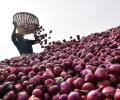
Data from the Nashik-based National Horticultural Research and Development Foundation showed that onion was trading at at Rs 24 a kg on Tuesday in the benchmark Lasalgaon mandi in Nashik district of Maharashtra. That's a fall of four per cent since Monday and 40 per cent from Rs 40 a kg on January 20, a level not seen since November 6, 2019. It continues to sell at Rs 40-44 a kg in retail markets across the country.

He asserted that the government purchase of farm produce will remain, adding that the mechanism of minimum support price will continue in the same way it always has.

As far as possible, investment in the agriculture sector must be from the government, and not the private sector, states Santushti Raj Thapar.

With Pawar backing farmers' protest against the contentious agri reforms, government sources on Sunday pointed out that as the agriculture minister in the UPA dispensation he had asked chief ministers to amend the APMC Act in their states to allow the private sector to play an important role in the field.

The S&P BSE Sensex shed 119 points to close at 27,977 and the Nifty50 dropped 45 points to finish at 8,591.
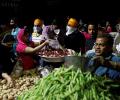
The government of Maharashtra decided to shut operations at APMC Vashi mandi between May 11 and 17 after confirmed cases of Covid-19 surpassed 80 in the APMC and over 450 across Navi Mumbai, where the mandi is located.
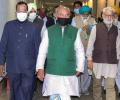
Tomar said the next meeting will take place on Saturday at 2 pm which he hoped would take the matter to a decisive stage and towards a final resolution.

The government's annual Economic Survey on Friday strongly defended new farm laws, saying they herald a new era of market freedom which can go a long way in improving lives of small and marginal farmers in India. These legislations were designed "primarily" for the benefit of "small and marginal farmers", which constitute around 85 per cent of the total number of farmers and are the biggest sufferer of the "regressive" APMC-regulated market regime, the survey said. The pre-budget document defended the farm laws in the backdrop of long-running farmers' agitation at various borders of the national capital seeking repeal of these legislations expressing concern that they are pro-corporate and could weaken government regulated mandis, also called Agriculture Produce Marketing Committees (APMCs).

'It is undemocratic and shows fascist tendencies.'

Winning an election may be a breeze for the BJP but the aftermath of victory isn't always painless.

Days after their passage in the Lok Sabha, Tomar introduced the Farmer's Produce Trade and Commerce (Promotion and Facilitation) Bill, 2020, and the Farmers (Empowerment and Protection) Agreement of Price Assurance and Farm Services Bill, 2020 in the Rajya Sabha.

'Interestingly in spite of slightly more than half (52%) the respondent farmers opposing the three new agri laws, almost 44% respondent farmers said the Modi government was 'pro-farmer'

'If a company contracts to buy its produce after three or four months, is there any loss in it?'

The government is looking at tweaking provisions of the Indian Contracts Act of 1872 to bring agreements between farmers and companies under its ambit, aiming to prevent exploitation of farm people.

Robust procurement of paddy and wheat since 2017 and prompt payment to farmers have helped the UP government cultivate a positive and pro-farmer perception, defusing possible farm face-off situations.

State Bank of India's house economists on Monday said the recent farm sector reforms reek of parochial thinking and promote lazy farming as they only cater to cereal-producing states. In the recently concluded monsoon session, the government rushed through three legislation to change the way agricultural produce is marketed, sold and stored by dismantling the decades-old APMC (Agricultural Produce Market Committee) mandis.

Though the Bills of Punjab and Rajasthan have a lot of similarities, the one approved by the Chhattisgarh Assembly is structurally different. None of the three has tried to address a key demand of the agitating farmers in full, which is to make all payments below the MSP, within and outside mandis, illegal.
 © 2026 Rediff.com - Investor Information - Advertise with us - Disclaimer - Privacy Policy - Sitemap - Feedback - About us - Terms of use - Grievances