
'Whenever Dalits have agitated on the streets, the government has blamed Naxalites.'

Right from his arrest in May 2014, the Nagpur jail authorities have denied Professor Saibaba his basic rights, even flouting court orders in the process.
'I really wish I knew how to arouse love in the hearts of people, how to make them understand that religion comes later, first we are all humans.'

'I'm 79 + now, and I've been doing all this since my late 20s.' 'Sometimes the ideological war extends to the home as well.' 'Many nights I couldn't sleep when someone close to me uttered the smallest insult.' 'It would cause me a lot of pain. But one has to be honest to oneself.'
Would a Muslim or Christian or Dalit mob who lynched someone because their religious feelings were hurt be given State protection? asks Jyoti Punwani.
The silence is specially deafening from three parties that symbolised hope for Muslims: The Congress, the Aam Aadmi Party and the Samajwadi Party. 'What fear prevents these leaders from at least talking about the way our community is being targeted?' 'Will they really lose Hindu votes if they do so?'
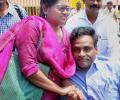
In the Nagpur Central Jail, a COVID-19 patient who has been complaining since the last 10 days of high fever, breathlessness, joint pain, cold and sore throat, is being treated in jail quarantine. The prisoner is Professor G N Saibaba, 90% handicapped, wheelchair-bound, with a damaged heart and pancreas; dependent on others even for his essential bodily functions.

The police do not have it in them to confront the Hindutva groups in a country ruled by a Hindutva party. No wonder Munawar Faruqui feels this is the end for him, asserts Jyoti Punwani.

'The Congress should have accepted our demands.' 'Gone are the days when it could decide how many crumbs to throw at us.' 'Now, we make the demands.'
'Was he afraid that his answers during cross-examination would land him in trouble under the new ruling dispensation?'
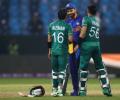
'Section 153A is not meant to protect fragile sentiments of the majority Hindu community who choose to get offended by slogans celebrating the success of the Pakistani cricket team.'

'The wrong person had to spend a banvaas of 14 years on a wrong charge.'
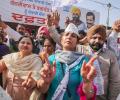
'The 10% increase in women voters was a determined bloc of voters.' 'They were willing to try this third party, specially because it seemed it had done something in Delhi.'

Unlike other top police officers, A A Khan spoke boldly --- be it while defending 'encounters' in many of which he was involved, or in tracing the cause of the ghastly Radhabai Chawl incident, recalls Jyoti Punwani. Encounters were useful, he said, because hardened criminals who were targeted were beyond reform and no good for society.

'These villages have never seen a communal dispute, let alone communal violence.' 'Are attempts to create a communal divide acceptable to the MP administration?'

'One police officer told me that trials take forever, conviction rates are low.' 'So one way to judge states' performance on handling crime is through the 'recovery rate' of their police.' 'The fastest way to get recovery is by torturing the accused.'
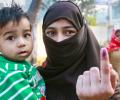
'He won't be able to migrate; he must survive in that environment.' 'He will go back after the election to becoming invisible.'
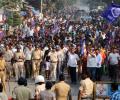
The reasons for the snail's pace at which the commission is proceeding are linked both to the government's indifference to it as well as the indifference of the parties appearing before it.

Ansuya Dutt, who never stopped fighting for women's rights, can be an inspiration to us never to lose sight of our basic beliefs, never mind peer pressure.

Jyoti Punwani reports on the strange case of Prashant Rahi, MTech, journalist, activist, now in solitary confinement in a Maharashtra prison.
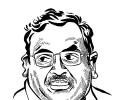
'Saibaba has 19 ailments, including severe heart and kidney problems.' 'Even healthy persons find their systems failing after Covid.' 'What will happen to someone like Saibaba?', Professor G N Saibaba's wife asks Jyoti Punwani.

'It's like the BJP is mocking people: Do what you want, we'll still win.'
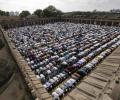
'One can understand this prejudice in the minds of policemen against Muslims, without accepting it. But what tilts the balance disproportionately is the police's blind eye to offences committed in the name of the majority.' says Jyoti Punwani.
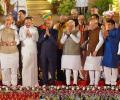
The PM's choice of ministers is interesting, to say the least, says Jyoti Punwani.
Curiously, on one aspect -- the large turnout of Dalits at Bhima-Koregaon -- both the counsel for the government and police, and the counsel for Milind Ekbote, an accused in the Bhima-Koregaon violence, pursued the same line of questioning. They asked Tukaram Gavare about the planning that must have gone behind this turnout.

Not just in the hostel, but in college too, they would block his way in the corridor; snatch his mobile; make him get up from where he was sitting; crowd around him in the mess; drag him into their room and threaten to hit him with a belt.

'The police are busy arresting people from Delhi, but not those we saw burning our home!'

'Father Stan was concerned about other innocents who may be implicated and put inside without the slightest proof, the way he was.'

Tanaji Sable's story confirmed what the first witness had told the commission: That the Dalits who had gone to Bhima-Koregaon were stoned; that there were motorcyclists bearing saffron flags roaming around inspiring fear; that the police did nothing to protect the Dalits.
From playing to the Sikh vote bank because Punjab elections are round the corner, to ensuring that a discordant 'us versus them' note was struck, whatever could be done to exploit every last drop of communal appeal, was done, observes Jyoti Punwani.
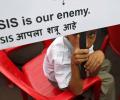
Such was the terror created by the ATS, that all their relatives stayed away.

Where does one find a man who shows no bitterness or animosity towards Hindus, even after a frenzied Hindu mob burnt his house down?, Jyoti Punwani asks in this tribute to a truly extraordinary Indian.
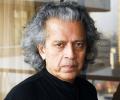
'Everywhere Anil Dharker went, he assembled teams of talented people, gave them opportunities, then got out of the way and allowed them to flourish.' Meenakshi Shedde remembers a very special editor.

Over the last decade, individual Muslims have started breaking from the tradition of sacrificing animals on Bakra Eid, motivated by the thought that the considerable amount spent on buying and sacrificing animals would be put to better use for the community's welfare, specially education.

Modi did not consider these deaths important enough to express regrets. Will these lives continue to count for nothing? asks Jyoti Punwani.
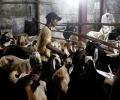
'Why the restrictions for Bakri Eid?'
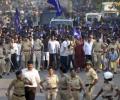
He is neither a victim of the violence that broke out at Bhima Koregaon on January 1, 2018 nor an eye-witness to it. Yet, Bhimrao Bansod testified for a full 14 days before the judicial commission of inquiry set up to inquire into the violence.

The one thing holding back the plucky youngster who has never hesitated to plunge into unknown territory, is funds
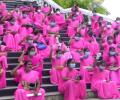
While those who attended 'Livelihoods in Lockdown' learnt a lot, was anyone from the government listening?
 © 2026 Rediff.com - Advertise with us - Disclaimer - Privacy Policy - Sitemap - Feedback - About us - Terms of use - Grievances