
India Inc is automating and squeezing more output from its workers and so needs fewer of them, finds out IndiaSpend Team.

The agreement on pricing last month marks a significant step towards promoting energy security in the region, say Nisha Taneja & Samridhi Bimal.

The Modi government has handled inflation far better than any government in the past two decades. Both the stock market and currency indices have begun to show confidence in the economy, despite the mounting global headwinds of trade.

Be it loan waiver or DBT transfer, it only helps in creating a "feel good" factor and postpones the problem for some time if structural problems are not handled.

E-auction or e-tendering moves the process of bidding for government contracts completely online, removing most manual procedures and, therefore, creating an accountability trail.
Special Economic Zones are likely to be central to realising Prime Minister Narendra Modi's ambitious Make in India agenda.

New body to replace Plan panel might retain 40% of existing staff

'The new government will have to contend with slowing economic growth, weak private investment, anaemic exports and vulnerable external imbalances, a stressed financial system, mounting fiscal pressures (including high government debt-to-GDP ratios) and an exceptionally bad employment situation,' says Shankar Acharya, former chief economic adviser to the Government of India.

Allegations abound that traders milked the scheme to artificially keep prices down, while a significant amount of growers didn't even register owing to multiple difficulties in registration and were deprived of the payout.

Officials in the weather department said the monsoon is expected to be below normal because of the El-Nino effect.
Strongly pitching for resumption of suspended Indo-Pak dialogue process, Pakistan on Thursday said the two countries should not "remain prisoners of the past or the present" and once they move forward all other things, including movement in trade ties, will fall in place.

Rupee volatility could be dampened if it is steadily manoeuvered to levels consistent with inflation differentials, say Jaimini Bhagwati and Abheek Barua

Many things could play spoilsport for the Indian economy.

Most employment surveys suffer from drawbacks such as limited data coverage, infrequent data collection, and time lag

P Chidambaram said to be able to play a meaningful role in the global governance, the G-20 agenda should be sharper and focused only on those issues on which it can make a distinctive contribution, particularly, on economic and financial matters.

Former environment minister Jairam Ramesh on Thursday virtually backed the non-governmental organisation Greenpeace in the backdrop of an Intelligence Bureau report warning that the NGO is a threat to the country's economic growth.

Credit rating agency Crisil observed in its report that some 'high frequency indicators go out of whack' as credit growth and service tax collections are not in tune with the CSO's growth projections.

The rise in US interest rates and associated change in the direction of capital flows, the fall in oil prices and the slowdown in China will dominate the markets, say Abheek Barua and Bidisha Ganguly

Despite the Indian government's recent efforts anecdotal evidence indicates that there has been little change in the extortionist behaviour of a significant proportion of tax and police officials, says Jaimini Bhagwati.

The trio, 'twin shocks' of demonetisation and GST, 'twin balance sheet' problem that has been weakening India's banking system and the 'twin deficit' problem will continue to challenge economic management and performance in the year ahead, says Shankar Acharya.

Given the international practice, it is inexplicable why the government is going with anonymous electoral bonds.
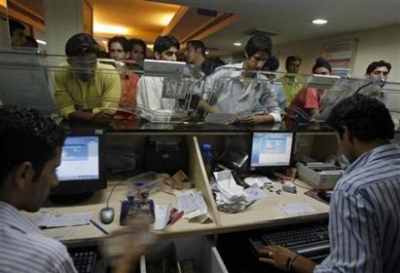
Private banks are assumed to be more efficient at intermediating between depositors and investors.

Unless there is a sharp uptick in oil prices, Fed may push back rate hike

In its essence, GST is a national level system of value added taxation of goods and services, says Shankar Acharya.

Saudi Arabia's deep pockets and a strong financial system could help the country to ride out a low-price environment in order to protect its market share.

A Collection of Services Trade Statistics Act is being thought of.

To do so, the government will have to tackle a number of broad development challenges successfully, says Shankar Acharya

More lucrative routinely prescribed drugs are at higher risk of failing quality standards

Data on the real value of the currency against other currencies tells a different story.

Budget should raise revenues & reduce spending to increase capital expenditure.

Perhaps half-way through India's demographic transition, what is the outlook for the future?

Substantial gains can still be made with good policies and initiatives.

India's fiscal deficit trends are a bit like an alcoholic trying, unsuccessfully, to reform. Virtue does not last for too long, says Shankar Acharya.

Existing units stay operational; those approved may not be notified, land could be used for other purposes

The challenge ahead for central and state governments remains enormous.

It could be a matter of concern that foreign shareholders of the NSE are registered in tax havens such as Mauritius and Cyprus.

The pipeline for well-qualified and experienced policy economists at senior levels of government has broken, leading to a growing dearth of suitable candidates for top economist positions.

The prospects for strong, sustained economic reforms do not appear to be promising in India.
The employment structure of India's organised manufacturing sector has undergone substantial changes over the last decade.

Shankar Acharya gives ten predictions on key politico-economic developments in the world and ten for India.
