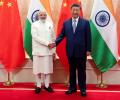
Prime Minister Narendra Modi and Chinese President Xi Jinping vowed to work towards a "fair, reasonable, and mutually acceptable" resolution of the festering boundary issue and pledged to work towards stabilising global trade.
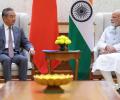
Former Army chief Gen M M Naravane (retd) said India-China ties are "on the mend" with initiatives announced at political, diplomatic and military levels. He expressed hope that China will reciprocate India's goodwill as they move forward in discussing the boundary question.
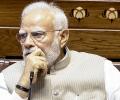
China welcomes Prime Minister Narendra Modi's planned visit to the Tianjin Summit of the Shanghai Cooperation Organisation (SCO), expressing hope that the event will be a 'gathering of solidarity, friendship and fruitful results'.
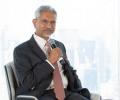
External Affairs Minister S Jaishankar is scheduled to visit China for an SCO conclave, marking a significant step in easing tensions after the 2020 border standoff. Discussions on the boundary dispute are also anticipated.

India and China reviewed the situation along the Line of Actual Control (LAC) in eastern Ladakh and prepared for the next Special Representatives' dialogue on the boundary question.
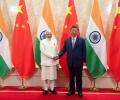
Prime Minister Narendra Modi and Chinese President Xi Jinping held bilateral talks focusing on economic ties and global stability amid trade tensions and the aftermath of the Ladakh border row.

A meeting with Chinese President Xi Jinping on the sidelines of the SCO summit is being planned.
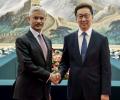
India and China should build on 'good progress' in normalising the bilateral ties to address border-related issues including de-escalation, and it is essential to avoid 'restrictive trade measures and roadblocks', External Affairs Minister S Jaishankar said on Monday during talks with his Chinese counterpart Wang Yi.

"Our country has never bowed down and will never bow down to any world power, and I am able to say this because of braves like you," Prime Minister Narendra Modi said on Friday while interacting with the soldiers, who were injured in the June 15 clash with the Chinese troops in eastern Ladakh's Galwan Valley.
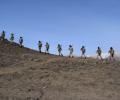
Indian military sources said no firearms were used in the clashes and that most of the injuries were sustained following stone-pelting and use of rods by the Chinese side.

China has honored an army regiment commander who was injured in the Galwan Valley border clash with Indian soldiers in 2020 as an outstanding member of the national advisory body - Chinese People's Political Consultative Conference (CPPCC). Qi Fabao, who was made the torchbearer for the Winter Olympics in 2022, was among the 33 individuals honored with the 2024 Outstanding Performance Award for CPPCC Members. The incident, which resulted in the deaths of 20 Indian soldiers, led to a freeze in relations between the two countries for over four years. Ties were restored after a meeting between Prime Minister Narendra Modi and President Xi Jinping in October 2023.

Defence Minister Rajnath Singh has conveyed to his Chinese counterpart Admiral Dong Jun that India and China should maintain the positive momentum in the bilateral ties and avoid adding new complexities.

National Security Advisor Ajit Doval on Monday emphasised the need to counter terrorism in all its forms for overall regional peace and stability during a meeting with Chinese Foreign Minister Wang Yi in Beijing.

The 30-member committee, chaired by senior Bharatiya Janata Party leader and former Union minister Jual Oram and of which Rahul Gandhi is also a member,wishes to visit the eastern Ladakh region in the last week of May or in June.
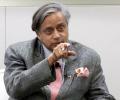
"China is an absolutely impossible factor to ignore in what has been our confrontation with Pakistan," Tharoor said.
The eastern Ladakh military standoff between India and China began in May 2020 and a deadly clash at the Galwan Valley in June that year resulted in a severe strain in ties between the two neighbours.

India is preparing to resume the Kailash Mansarovar Yatra, a pilgrimage to Mount Kailash in Tibet, after a three-year hiatus. The decision comes as part of efforts to improve relations between India and China, which have been strained since a military standoff in 2020. The two countries have also agreed in principle to resume flight services between them.
External Affairs Minister S Jaishankar said the 2008 Mumbai terror attack marked a turning point in relations with Pakistan when Indians collectively felt that such behaviour from a neighbouring country could no longer be tolerated. Speaking at Charotar University of Science and Technology, Jaishankar acknowledged India's transformation under Prime Minister Narendra Modi over the last decade, while Pakistan has remained unchanged, continuing with what he termed as its "bad habits."

China on Tuesday confirmed that it has reached an agreement with India to end the standoff between the two armies in eastern Ladakh.
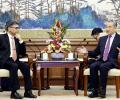
India and China have agreed to rebuild ties and resume people-to-people exchanges, including resuming direct flights and the Kailash Manasarovar Yatra this year. The two countries also discussed the resumption of dialogue mechanisms to address each other's concerns and move relations to a more stable path. The meeting comes after a period of strained relations following the Galwan Valley clashes in 2020.
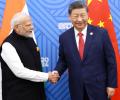
Chinese President Xi Jinping on Wednesday pledged to strengthen the strategic relationships with neighbouring countries by 'appropriately' managing differences and enhancing supply chain ties as China's tariff war with the United States escalated.
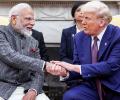
India has firmly rejected any involvement of a third party in its border dispute with China, declining an offer of mediation from US President Donald Trump. Foreign Secretary Vikram Misri emphasized India's commitment to resolving bilateral issues through direct dialogue, stating that New Delhi has always maintained a bilateral approach in dealing with such matters. This stance underscores India's position that the border dispute with China should be addressed through direct negotiations between the two countries.

Their Supreme Sacrifice for the Motherland will Never be Forgotten.
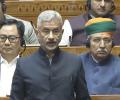
Jaishankar said India-China ties have been abnormal since 2020 when peace and tranquillity in border areas were disturbed due to Chinese actions.
Chinese Foreign Minister Wang Yi said on Friday that India-China relations have made positive strides and achieved a series of encouraging outcomes at all levels after last year's breakthrough ending the over four-year-long military standoff in eastern Ladakh. Wang's remarks came during his annual press conference as he replied to a question on how Beijing views the course of bilateral ties after the two countries ended the prolonged stalemate in the ties.

The two sides had started coordinated patrols in the first week of the month after completing disengagement in both Demchok and Depsang in the last week of October.

China on Wednesday said the Chinese and Indian militaries are implementing the resolutions concerning the disengagement in eastern Ladakh along the Line of Actual Control (LAC) in an 'orderly' manner.
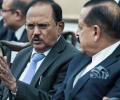
National Security Advisor Ajit Doval is likely to travel to Beijing within the next few weeks to lead the Indian delegation at a new edition of the Special Representatives dialogue on the larger boundary question that will be held after a gap of nearly five years, authoritative sources said.

On Saturday, Ministry of External Affairs spokesperson Randhir Jaiswal told the media in New Delhi that the Indian Army has commenced verification patrolling at Depsang, the second friction point in eastern Ladakh.

Sources had earlier said that the areas and patrolling status were expected to be moved back to pre-April 2020 level.

The Indian Army is looking at deploying over 350 light tanks, mostly in the mountainous border areas.

The Indian Army began patrolling at Demchok on Friday, days after Indian and Chinese troops completed disengagement at the two friction points in eastern Ladakh, Army sources said.

But there is a bigger issue that both of us have brought forces close up and in that sense there is a militarisation of the border, he said.

The Indian Army has commenced a verification patrolling at Depsang, the second friction point in eastern Ladakh, the government said on Saturday.

India and China have held their first diplomatic talks since withdrawing troops from two face-off points in eastern Ladakh, reflecting on the lessons learned from the border row to prevent future incidents. The two sides agreed to maintain peace and tranquillity in border areas, prepare for the next meeting of Special Representatives on the boundary question, and highlighted the importance of regular exchanges and contacts at diplomatic and military levels. The talks come after the completion of the disengagement process from the last two friction points, following an agreement finalized in October 2022.
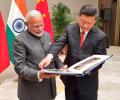
China's foreign ministry on Monday parried questions on a possible meeting between Prime Minister Narendra Modi and President Xi Jinping on the sidelines of the BRICS summit in Russia this week.
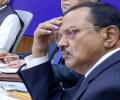
National Security Advisor Ajit Doval arrived in Beijing on Tuesday to take part in the India-China Special Representatives' talks to be held on Wednesday aimed at restoring the bilateral ties stalled for over four years' due to the military standoff in eastern Ladakh.
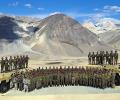
China has said that the disengagement of troops in eastern Ladakh by the Chinese and Indian armies is going on "smoothly" following a recent agreement between the two nations.

The sources have said that patrolling will begin at these points once the disengagement that began last week is completed and both sides will move their respective troops and dismantle temporary structures.

In the meeting, Doval conveyed to Wang that peace and tranquillity in border areas and respect for the Line of Actual Control are essential for return of normalcy in bilateral ties, according to the ministry of external affairs.
 © 2026 Rediff.com - Investor Information - Advertise with us - Disclaimer - Privacy Policy - Sitemap - Feedback - About us - Terms of use - Grievances