
The Archaeological Survey of India (ASI) began working on a scientific survey of the Gyanvapi premises in Varanasi on Friday to determine whether the 17th-century mosque was constructed over a pre-existing structure of a Hindu temple.

Amid escalating tensions at the Uday Pratap College in Varanasi over a mosque located on its premises, police on Thursday restricted outsiders' entry to the campus, allowing only students with valid identity cards.
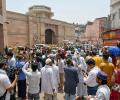
The committee argued that only the Waqf Board has the right to hear any matter pertaining to the mosque.
The photocopies have to be verified by the district judge, the high court said.
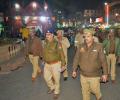
Shops in Varanasi's Muslim-dominated areas remained closed and the police sounded an alert in the entire district ahead of the Friday namaaz, following the district court order to allow Hindu prayers in a cellar of the Gyanvapi mosque.
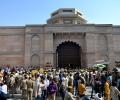
Abhay Nath Yadav died on Sunday night and will be cremated on Monday
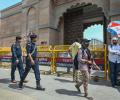
The Allahabad high court on Tuesday heard both the Hindu and Muslim sides on the Gyanvapi mosque committee's appeal challenging the Varanasi district court order allowing Hindu prayers in a cellar of the mosque.
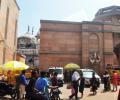
According to the committee, the structure in question was part of a fountain in the "wazookhana", a small reservoir used by devotees to perform ritual ablutions before offering namaz.
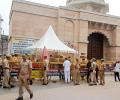
The Allahabad high court reserved its judgment on Friday in a petition challenging the maintainability of a suit seeking 'restoration' of a temple at the site of the Gyanvapi mosque in Varanasi.

Students at Udai Pratap College in Varanasi, India, protested demanding the removal of a mosque located on the campus. The protest came after tensions arose when a section of students recited Hanuman Chalisa near the mosque while prayers were being offered. The college administration has denied claims by the Uttar Pradesh Sunni Central Waqf Board that the mosque and surrounding land are Waqf property, stating that the mosque was built illegally. The college administration has also accused the mosque of stealing electricity.
A Varanasi court on Thursday rejected the Gyanvapi masjid committee's objection to a petition seeking the right to worship a 'Shivling' claimed to have been found in the mosque complex, and fixed December 2 for hearing the case.

In the appeal filed before the high court, it has been pleaded that the Hindu side's suit itself is barred by order 7 rule 11 of the Civil Procedure Code, Naqvi said.
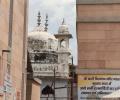
The Supreme Court's 2023 order refusing to stay a scientific survey at the Gyanvapi Mosque complex has sparked claims over several other disputed places of worship across India. This has led to several court cases, including one in Mathura where a survey of the Shahi Idgah Mosque complex was ordered, and another in Ajmer where a claim was made that a Shiva temple existed within the dargah of Sufi saint Moinuddin Chishti. The article also highlights a dispute over the Bhojshala in Madhya Pradesh, which Hindus consider a temple and Muslims consider a mosque. The Supreme Court's order has reignited debates about the Places of Worship (Special Provisions) Act, 1991, which prohibits the change of character of religious places as they existed on August 15, 1947.
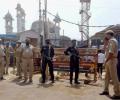
A district court hearing the Gyanvapi mosque-Shringar Gauri complex case in Varanasi reserved its judgment till September 12 as both the Hindu and Muslim sides concluded their arguments on the maintainability of the suit on Wednesday.

Muslim body Anjuman Intezamia Masjid committee on Thursday moved the Supreme Court against the Allahabad high court order permitting an Archaeological Survey of India (ASI) survey at the Gyanvapi mosque.
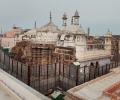
The Supreme Court on Monday agreed to hear on April 14 a plea by the Anjuman Intezamia Masjid committee seeking permission for wazu (ritual ablution) at the Gyanvapi mosque complex in Varanasi during the month of Ramzan.
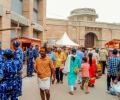
The Archaeological Survey of India (ASI) team surveyed the northern wall, the dome and basements of the Gyanvapi complex here on Tuesday, the fourth day of the court-mandated exercise to determine if the mosque was built over a temple.

The Allahabad high court on Friday did not give any immediate relief to the Gyanvapi Masjid committee which had challenged the order of the Varanasi court allowing Hindu prayers in a cellar of the mosque.

The court was hearing a plea by the Anjuman Intezamia Masjid committee seeking permission for wazu at the mosque complex in Varanasi during the month of Ramzan.
The Supreme Court asked the Varanasi district collector on Friday to ensure that a sufficient number of plastic tubs with water is made available for wazu (ritual ablution) for Muslim devotees at the Gyanvapi mosque complex.
The Muslim side had sought 15 days' time to present its response to the Hindu petitioners' arguments as their main advocate had died of heart failure a few days ago.

The Allahabad high court on Thursday allowed the Archaeological Survey of India (ASI) to conduct a scientific survey at the Gyanvapi premises in Varanasi to determine whether the 17th-century mosque has been constructed over a pre-existing structure of a Hindu temple.
To maintain law and order, he said, the entire city has been divided into sectors which have been allocated police force as per their requirement.
The lawyers of the Hindu side sought time for filing their counter-objection, following which the court of district judge A K Vishvesha fixed November 11 as the next date of hearing in the matter.
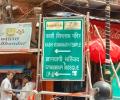
In a relief to the Hindu side, the Supreme Court on Friday refused to stay the Allahabad high court order allowing the Archaeological Survey of India (ASI) to conduct a scientific survey at the Gyanvapi mosque complex to determine if the 17th-century structure was built upon a pre-existing temple.

The petitions filed by the Anjuman Intezamia Masjid Committee (AIMC) and the Uttar Pradesh Sunni Central Waqf Board had also challenged a Varanasi court order of April 8, 2021 to conduct a comprehensive survey of the Gyanvapi mosque.
A bench comprising Chief Justice DY Chandrachud and Justice PS Narasimha and Justice JB Pardiwala took note of the submissions of lawyer Vishnu Shankar Jain that the district judge of Varanasi has deferred five times the decision on a plea seeking clubbing of all civil suits pertaining to the dispute.
Advocate Madan Mohan Yadav, who is representing the Hindu petitioners, said, "The report in sealed cover was placed before the court by the ASI's standing counsel Amit Srivastava."
The court has also directed all concerned parties to file objections to the report submitted by the commission that surveyed the mosque premises.
A fresh plea seeking permission to worship the "Shivling" claimed to have been found on the mosque premises during a videography survey ordered by a lower court was also filed.
Mishra said that the court has fixed July 7 for the next hearing.
The petition seeks the court's permission for worshipping the idols of the Hindu deities located on an outer wall of the mosque on a daily basis.
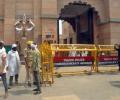
The Hindu side had claimed in the lower court that a Shivling was found during the videographic survey.
'Why were they silent when over 128 temples and shrines including Shivlings were broken down at the time of the construction of the Kashi Vishwanath corridor?' a Varanasi resident asks Rashme Sehgal.

Five members of the Muslim side also participated in the survey. Its advocate Tauheed Khan said advocates of the Intezamia Masjid Committee Akhlaq and Mumtaz accompanied the survey team.

A mosque committee member said it is waiting for the Supreme Court ruling on the matter but till then it will cooperate with the district court.
Singh said the court also gave a week's time to both Hindu and Muslim sides to file objections to the report of a court-mandated videography survey of the Gyanvapi mosque premises.
District Judge A K Vishvesh ordered that it would continue to hear the petition seeking the right to worship in the temple.
 © 2026 Rediff.com - Investor Information - Advertise with us - Disclaimer - Privacy Policy - Sitemap - Feedback - About us - Terms of use - Grievances