
The Indian Institute of Astrophysics (IIA) has debunked viral social media claims of a rare planetary alignment on February 28, calling the claims "highly exaggerated and misleading."

Finance Minister Nirmala Sitharaman on Sunday said individual persons residing outside India (PROI) will be permitted equity investments in listed Indian companies through a portfolio investment scheme.

'In three years, you will have an AI model that will be smarter than the smartest mathematician or the smartest scientist.'

'This policy is a vision to position Karnataka as the epicentre of India's space ambitions'
rediffGURU Rohit Gupta, co-founder and COO of College Vidya, offers expert advice on career programmes in India.

The excitement swept across India on Sunday night as thousands of people gathered in different cities to witness the much-awaited Total Lunar Eclipse, popularly known as the Blood Moon.

The University of Mumbai's Centre for Extra Mural Studies is inviting applications for weekend certificate courses.
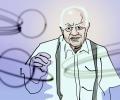
Jayant Narlikar wrote alternative what-if histories, explained difficult scientific theories with funny analogies, and leavened his lectures with jokes and humorous asides.
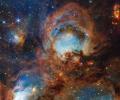
Researchers from the Indian Institute of Astrophysics (IIA) have discovered an unexpectedly high abundance of germanium in the Extreme Helium star A980, challenging existing theories about stellar chemistry and the evolution of rare stars.

Devesh Pankaj Bhaiya from Jalgaon and Sandeep Kuchi from Hyderabad won gold medals while Debadatta Priyadarshi from Bhubaneshwar and Ujjwal Kesari from New Delhi secured silver at the International Chemistry Olympiad 2025 in Dubai.
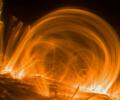
The breakthrough reveals the dazzling world of miniature plasma loops, or tiny loops, which stretch almost as long as the distance between Kashmir and Kanyakumari.The breakthrough reveals the dazzling world of miniature plasma loops, or tiny loops, which stretch almost as long as the distance between Kashmir and Kanyakumari.
Researchers have detected hints of molecules known to be produced by marine organisms on the exoplanet K2-18 b, providing "the strongest evidence yet" of life outside the Solar System. While the discovery is exciting, more data is needed to confirm whether the molecules are indeed produced by life or through other chemical processes. The exoplanet, over 8.5 times as massive as Earth, lies 120 light-years from Earth and orbits the star 'K2-18'.
Applications are invited from students for Research Scholarships at IUCAA, Pune and NCRA - TIFR.
The Indian Institute of Astrophysics invites applications for research and software trainees to work with the Himalayan Chandra Telescope Remote Control Station.

'When Dr Murli Manohar Joshi wanted to start a course on astrology, Jayant was the first one to have the courage to stand up and say astrology is not science.' 'That's a very rare quality -- to stand up to authority.'
The growing decline of MTech applicants in Indian colleges is due to multiple factors, including outdated curricula, poor return on investment and lucrative non-engineering alternatives, say experts.
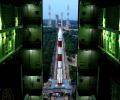
Aditya-L1 is a fully indigenous effort with the participation of national institutions., an ISRO official said.

The images show VELC (Visible Emission Line Coronagraph) and SUIT (Solar Ultraviolet Imager) instruments as seen by the camera on-board Aditya-L1 on September 4, 2023.

A beam of sunlight fell directly on Ram Lalla's idol at the new temple in Ayodhya on noon Wednesday, marking the 'Surya Tilak' of the idol on the first Ram Navami since its consecration.

Aditya-L1 is the first Indian space-based observatory that will study the Sun from a halo orbit around the first Sun-Earth Lagrangian point (L1), which is located roughly 1.5 million km from the Earth.

Aditya L1, the first space based Indian mission to study the Sun underwent the second earth-bound manoeuvre successfully, during the early hours on Tuesday, Indian Space Research Organisation (ISRO) said.
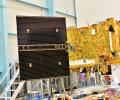
Aditya-L1 spacecraft is designed for providing remote observations of the solar corona and in situ observations of the solar wind at L1 (Sun-Earth Lagrangian point), which is about 1.5 million kilometres from the earth.
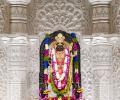
This would be the first Ram Navami since the consecration of the Ram idol at the new temple, inaugurated by Prime Minister Narendra Modi on January 22. The system was tested by the scientists on Tuesday.

The Trans-Lagrangian Point 1 Insertion manoeuvre marks the beginning of the spacecraft's about 110-day trajectory to the destination around the L1 Lagrange point, a balanced gravitational location between the Earth and the Sun.

Aditya-L1 will be launched by PSLV-C57 rocket on September 2 at 11:50 am. It carries seven payloads to study the Sun, four of which will observe the light from the Sun and the remaining three will measure insitu parameters of the plasma and magnetic fields.
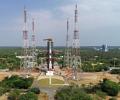
Days after landing on the Moon, India will aim for the Sun on Saturday with its maiden solar expedition, as ISRO's trusted PSLV will carry the Aditya L1 mission on a 125-day voyage to the Sun.

A satellite placed in the halo orbit around the first Lagrangian point (L1) of the Sun-Earth system has the major advantage of continuously viewing the Sun without any occultation/eclipses, the IIA said.
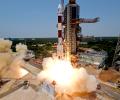
The successful launch of Aditya-L1 - the country's maiden mission to study the Sun - is expected to garner increased investor interest in the Indian space sector and trigger more funding for private players. Several private sector players, including Larsen & Toubro (L&T), MTAR Technologies, and Ananth Technologies, have played a pivotal role in the Indian Space Research Organisation's (Isro's) solar observatory mission. Aditya-L1 on Saturday set off on a 125-day journey on a PSLV-C57 rocket, in its attempt to study various elements relating to the nearest star from the halo orbit around Lagrange point 1 (L1) of the Sun-Earth system, which is about 1.5 million km from Earth.

At this year's TIME ball in New York City on Thursday, April 25, you would have run into a Coimbatore-born American scientist, looking lovely in Sabyasachi Mukherjee designer finery, who would most likely have been hanging out with Dua Lipa.

Scientists expect to get new information about the past, present and future of the Sun after analysing the data that will be collected by India's first solar mission Aditya-L1, scheduled to be launched by Indian Space Research Organisation (ISRO) on September 2.

In this process, millions and millions of tons of solar materials are thrown into the interplanetary space, he said, adding these CMEs can travel at a speed of approximately 3,000 km per second.

Chandrayaan-1 X-ray fluorescence spectrometer detected sodium from its characteristic line in X-rays which opened up the possibility of mapping the amount of sodium on the moon, ISRO said.
Leading scientists and experts said this monumental accomplishment not only marks India's indelible imprint on lunar exploration but also demonstrates the prowess of human collaboration, determination, and cutting-edge technology.

The race to the uncharted south pole of the Moon is quickening with India's Chandrayaan-3 and Russia's Luna-25 gearing up for lunar landings next week, each mission holding significant implications beyond the thrilling competition in the skies.

ISRO will now conduct further testing of VELC and its eventual integration with the Aditya-L1 spacecraft, it said in a release.

Born in 1929, Swarup was one of the pioneers of radio astronomy in India.

For all its tall claims of edge and darkness in the title, Rudra is a rather bland, blah, posturing, personality-less take on a sinister series, observes Sukanya Verma.
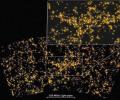
This is one of the largest known structures in the neighbourhood of the universe, 4,000 million light-years away from Earth and roughly more than 10 billion years old, IUCAA said.
IUCAA, Pune, National Centre for Radio Astrophysics of the Tata TIFR invite applications from highly motivated students.

"He was my teacher, and I knew him from a time when he could speak. Personally it's a huge loss. Hawking is special because he is larger than life," Raychaudhury said.
 © 2026 Rediff.com - Advertise with us - Disclaimer - Privacy Policy - Sitemap - Feedback - About us - Terms of use - Grievances