

The Indian Institute of Astrophysics (IIA) is debunking viral social media claims about a rare planetary alignment, clarifying that the celestial event is highly exaggerated and potentially dangerous to observe without proper precautions.
Key Points
- The Indian Institute of Astrophysics (IIA) has debunked claims of a rare planetary alignment on February 28, calling them misleading.
- Only Jupiter will be easily visible in the evening sky, while other planets like Mercury and Venus will be difficult to spot due to their proximity to the Sun.
- The IIA warns against using telescopes or binoculars to view planets near the Sun before sunset to avoid severe eye damage.
- Viewing conditions will improve in March and April, with Venus becoming more visible and Mars and Saturn emerging in the morning sky.
The IIA has stepped in to rain on the celestial parade promised by viral social media posts, debunking claims of a rare planetary alignment on February 28 as "highly exaggerated and misleading".
While internet trends suggest a grand spectacle where all planets in the solar system will line up, scientists at the Bengaluru-based institute have clarified that the actual visibility of these bodies will be far from a coordinated display for most observers.
In an informative video released on its official social media pages, the Indian Institute of Astrophysics (IIA) provided a detailed breakdown to separate astronomical fact from the digital fiction currently trending on social media.
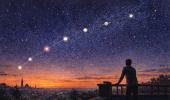
The term "planet parade" is often used loosely on social media to describe several planets appearing in the same region of the sky, but experts emphasise that these planets remain millions of kilometres apart and rarely form the "perfect line" often depicted in viral graphics.
Planet Visibility on February 28
The video explains that the only planet offering an easy viewing experience is Jupiter, which will be positioned high in the evening sky and will not set until approximately 3.30 am. For those using a small telescope or binoculars, the planet's main belts and its Galilean moons will be visible, but other members of the solar system will be significantly harder to find.
Mercury and Venus are currently positioned extremely close to the Sun and are expected to set just 45 minutes after sunset. Being only 10 to 12 degrees above the horizon during twilight, the video notes they will be nearly impossible to spot. Similarly, Saturn will set about 1.5 hours after the Sun and remain very low on the horizon, while Mars will be entirely invisible to morning observers as it sets before the Sun.
Safety Warning for Skywatchers
The IIA used the video to issue a crucial safety warning, urging skywatchers not to use telescopes, binoculars, or the unaided eye to search for Mercury, Venus, or Saturn before sunset. Accidental exposure to direct sunlight through such instruments can cause permanent and severe eye damage. For those seeking the distant planets Uranus and Neptune, the institute clarified that telescopes are a necessity, with Neptune being particularly difficult to locate due to its proximity to Saturn.
Future Viewing Opportunities
Looking ahead to March and April, the IIA video stated that viewing conditions will shift as Jupiter begins setting earlier each evening. Conversely, Venus will become increasingly visible for longer periods in the western sky. By that time, Mars and Saturn are expected to emerge in the eastern morning sky alongside Mercury, providing a more reliable opportunity for astronomical observation than the much-hyped alignment of February 28.








 © 2026